Send in the Clowns

Myanmar’s junta-backed election body is busy preparing for a planned poll in December, training staff to use electronic voting machines in place of paper ballots and exploring ways to boost public support for an election deemed crucial to the junta’s claims of legitimacy.
On Wednesday, junta Union Election Commission chairman Ko Ko met with the Myanmar National Human Rights Commission to discuss election observers and voting accessibility for the disabled, the elderly, and pregnant women. The meeting came two weeks after he instructed pro-junta media outlets to promote the commission’s activities to the public.

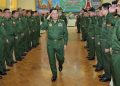

On Monday, Information Ministry officials courted comedians with donations at a ceremony to honor veteran entertainers, urging them to rally public support for the vote.
The regime has also rewarded prominent pro-junta entertainers with honorary titles and medals for their “outstanding performance and social services.”
The junta has showcased the voting machines and mock polls across all 14 regions and states – including conflict zones like Sagaing, Magwe, Karenni (Kayah), and Rakhine, where it controls only limited territory.
The election commission says voting will take place in 267 out of Myanmar’s 330 townships, with nine national parties – including the junta-backed Union Solidarity and Development Party – among 54 registered to contest.
The planned poll is widely seen as a bid to entrench military rule, four years after the junta ousted the elected National League for Democracy (NLD) government and threw its leaders in jail. The NLD is among dozens of political parties dissolved after refusing to contest an election amid brutal military rule and civil war.
Courting Loyalists, Silencing Opponents

Junta boss Min Aung Hlaing travelled to Mandalay Region’s Meiktila on Thursday to rouse support from the usual suspects: the Union Solidarity and Development Party (USDP), military veterans, and the ultranationalist Ma Ba Tha (Association for Protection of Race and Religion).
He urged them rally together for the “success” of December’s poll, widely condemned as a sham to entrench military rule.
The general, who seized power in February 2021 citing ungrounded claims of electoral fraud, has been enthusiastically campaigning for a return to the ballot box.
During a May visit to eastern Shan State – another USDP stronghold – the self-declared protector of the nation told troops and their families to choose candidates who would truly serve the national interest – code for “make sure I stay in charge.”
The USDP managed to win Meiktila in 2015, despite a national poll that ushered in Myanmar’s first civilian government in nearly three decades. However, it lost the city to the NLD five years later, as Daw Aung San Suu Kyi’s party secured a landslide victory in December 2020.
One month later, Meiktila’s USDP and Ma Ba Tha loyalists staged loud, flag-waving rallies to support the military’s claims of voter fraud in the election. On February 1, the military dispensed with public rallies and simply seized power.
Now, five years later, the junta leader is pushing for a return to the polls, aiming to legitimize military rule through a tightly controlled electoral process.
This time, however, he has eradicated the potential of defeat by ensuring that all the “right people” get elected – or at least that the wrong ones stay banned, imprisoned or exiled.
Push-button poll practice
Myanmar’s regime is training staff in the use of electronic voting machines ahead of its proposed election in December or January.
Since June, the junta has organized “Myanmar Electronic Voting Machine” demonstrations, mock voting and training sessions in Yangon, Mandalay, Naypyitaw, Pathein, Sagaing, Magwe, Taunggyi, Loikaw, Mawlamyine, Dawei, Homalin and Paung, largely in government departments, universities and military headquarters.
Civil servants, political parties, civil society organizations and community representatives have attended the events.
Regime cuts Rakhine food supply
Food prices have surged in Rakhine State’s Kyaukphyu town amid intensifying fighting between junta troops and the ethnic Arakan Army.
Rice prices have hit around 500,000 kyats (around US$ 110) per 50-kg sack.
The regime blockaded the town in early 2024, allowing only military-approved cargo ships to bring in rice, food, and fuel from outside, so residents rely entirely on these shipments for their basic needs.
But as the battle comes closer, the cargo ships have stopped arriving.
Russian arms giant offers ‘quake aid’
Rosoboronexport, a Russian arms company that has sold weapons worth hundreds of millions of dollars to Myanmar’s military regime, has donated US$ 431,000 (906.25 million kyats) to the junta’s earthquake relief fund.
Junta media reported that the donation was received by Minister for Relief and Resettlement Dr. Soe Win in Naypyitaw on Tuesday.
The March 28 earthquake claimed over 3,700 lives in central Myanmar, with bodies still being unearthed from the rubble months later, according to the junta.