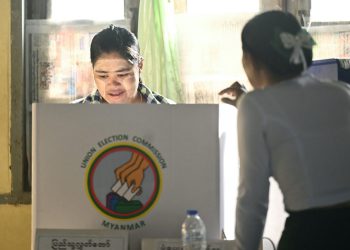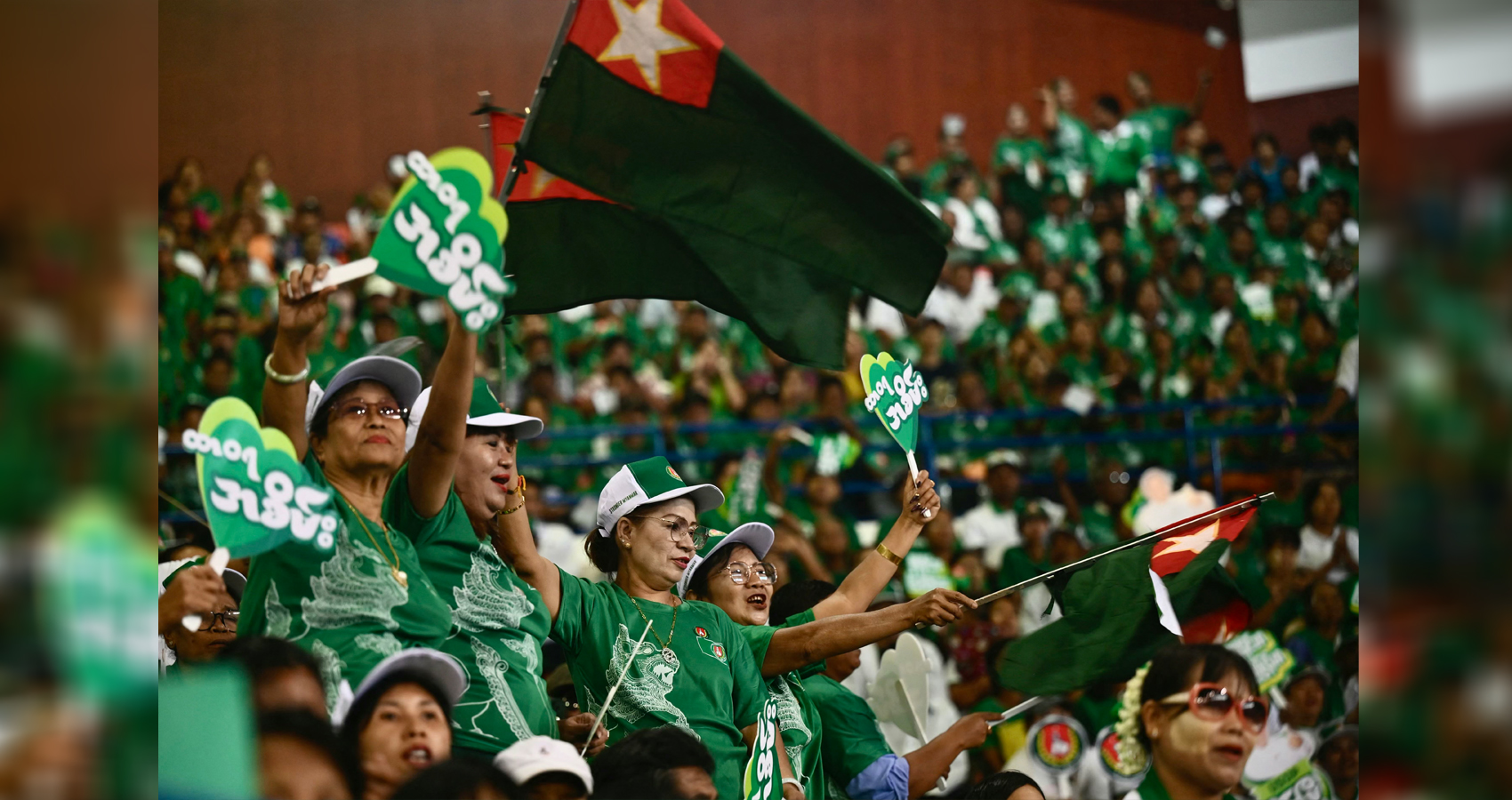
In the first phase of the junta’s election, which has been widely criticized as an illegitimate sham, the military-backed Union Solidarity and Development Party (USDP) won a sweeping majority, according to results tallied as of Jan. 8.
The military regime, whose administrative apparatus has collapsed in much of the country since the 2021 coup, has divided the election into three phases. The first took place in 102 townships under its control.
Lower House results


According to the junta-appointed Union Election Commission, the USDP secured victories in 90 of the 102 constituencies for the Lower House. Ethnic and regional parties claimed the remaining 12 seats as follows:
- Naga National Party (3 seats in Sagaing)
- Pa-O National Organization (3 in Shan)
- National Unity Party (2 in Magwe and Ayeyarwady)
- Shan and Nationalities Democratic Party (SNDP) (1 in Shan)
- Mon Unity Party (1 in Mon)
- Shan-ni Solidarity Party (1 in Shan)
- Rakhine Nationalities Party (1 in Rakhine)

The commission also counted 14 uncontested constituencies included in phases 2 and 3, bringing the total to 116 Lower House seats. Of these, 13 went to the USDP and the SNDP won in Shan State’s Mongnai.
Overall, the USDP has won 103 of the 116 Lower House seats called so far.
Upper House results
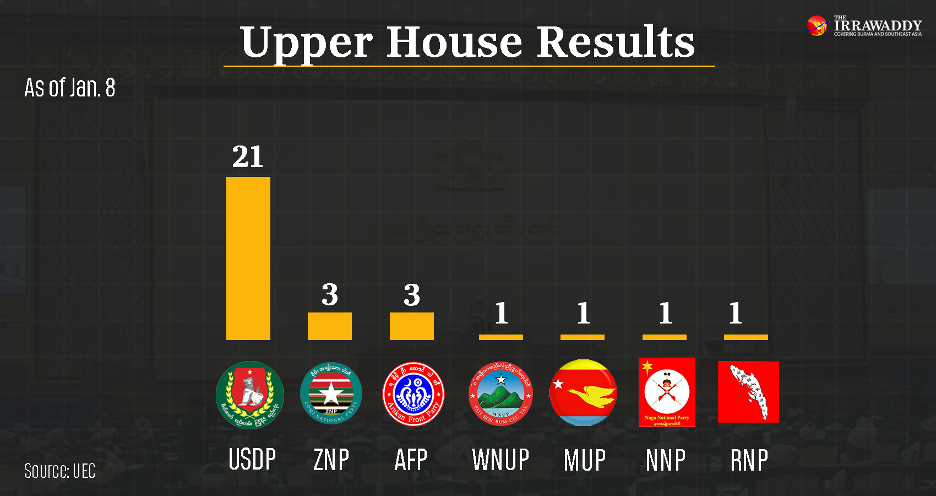
As of Jan. 8, the UEC reported 31 confirmed seats in the Upper House. The USDP won 21, while ethnic parties took the rest:
- Zomi National Party (3 seats)
- Arakan Front Party (3 seats)
- Rakhine Nationalities Party, Naga National Party, Wa National Party and Mon Unity Party (1 seat each).
State and regional assemblies
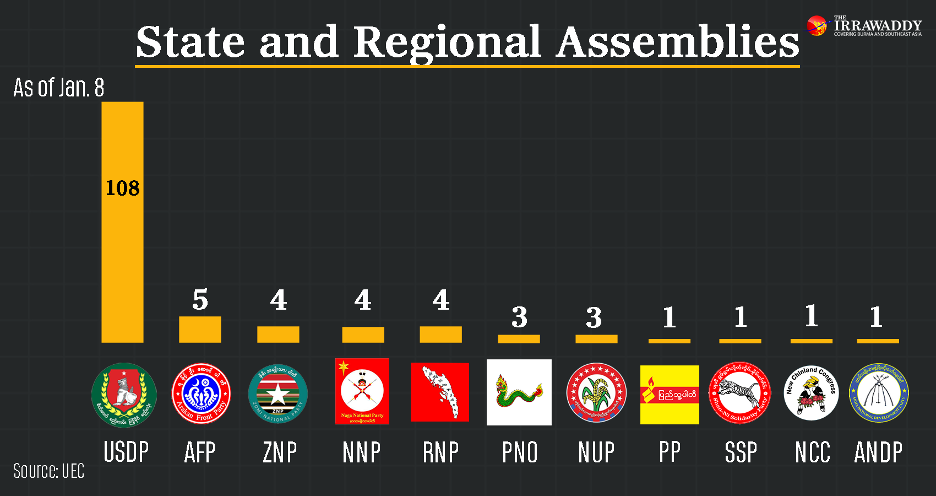
By Jan. 7, the UEC had confirmed 135 seats in state and regional assemblies. The USDP won 108, while ethnic and local parties shared the remainder:
- Arakan Front Party (5 seats)
- Zomi National Party, Naga National Party, and Rakhine Nationalities Party (4 seats each)
- Pa-O National Organization and National Unity Party (3 seats each)
- People’s Party (PP), Shan-ni Solidarity Party, New Chinland Congress and Akha National Development Party (one seat each)
Key figures and defeats
Almost all USDP leaders and junta ministers who took part in the Dec. 28 vote secured victories. They include party chairman Khin Yi, vice chairman Myat Hein, Naypyitaw chair Hla Swe, hardliner Maung Myint, Information Minister Maung Maung Ohn, Transport and Communications Minister Mya Tun Oo, Health Minister Dr. Thet Khaing Win and junta Electricity Commission chair and President’s Office Minister Tin Aung San.
However, not all prominent figures prevailed. Former Bureau of Special Operations 2 chief and current Shan State Chief Minister Aung Aung lost in Taunggyi to the Pa-O National Organization, while former deputy information minister and current USDP secretary Pike Htwe was defeated in Magwe’s Taungdwingyi by the National Unity Party—a successor to the Burma Socialist Programme Party through which Myanmar’s first military dictator Ne Win ruled the country for decades.
In Rakhine State, well-known ethnic politicians Dr. Aye Maung and U Ba Shein lost to USDP candidates.
Another vote overshadowed by advance ballots
Opposition parties have challenged the USDP’s victories, citing a lack of transparency and failure to follow the electoral law in the way advance ballots were handled.
These concerns were raised during a Jan. 5 meeting between the UEC and political parties. The UEC promised improvements in phases 2 and 3, but party representatives said the body made no commitment to investigate or address problems that occurred in Phase 1.
In the 2010 general election, which was widely criticized as heavily rigged, many USDP candidates won with advance ballots that only arrived after polling stations were closed. Parties are complaining that the USDP is fiddling with the advance vote again.
Independent monitoring group Data for Myanmar reported that the junta-backed USDP received more advance votes than any other party in Phase 1, winning over 340,000 ballots or a whopping 17 percent of its votes from these mysterious absentee voters.
In some constituencies, including Thandaunggyi, Bawlakhe and Hakha, the USDP secured more than half its votes from advance ballots.
The People’s Party (PP), SNDP and Myanmar Farmers Development Party (MFDP) have sent formal complaints to junta chief Min Aung Hlaing.
Outlook
The second phase of voting takes place on Jan. 11 in 100 townships, followed by a final round on Jan. 25 in 63 townships.
With the National League for Democracy (NLD) dissolved and relevant laws amended in favor of the USDP, observers say there is little genuine competition. The electoral process itself—a confusing hybrid of first-past-the-post and proportional representation—is designed to ensure the military’s proxy USDP secures a majority and forms a government.
A total of 57 parties and several independents are contesting the election. Six parties are competing nationwide, including the USDP, the National Unity Party, Daw Thet Thet Khine’s People’s Pioneer Party, U Ko Ko Gyi’s PP, Sai Aik Pao’s SNDP, and the pro-military MFDP.
The junta is using the election to seek legitimacy after its 2021 coup. But domestic and international organizations and foreign governments — including the European Union, the United Kingdom and the United Nations — have long dismissed the process as neither free nor fair.
Infographics by Naung