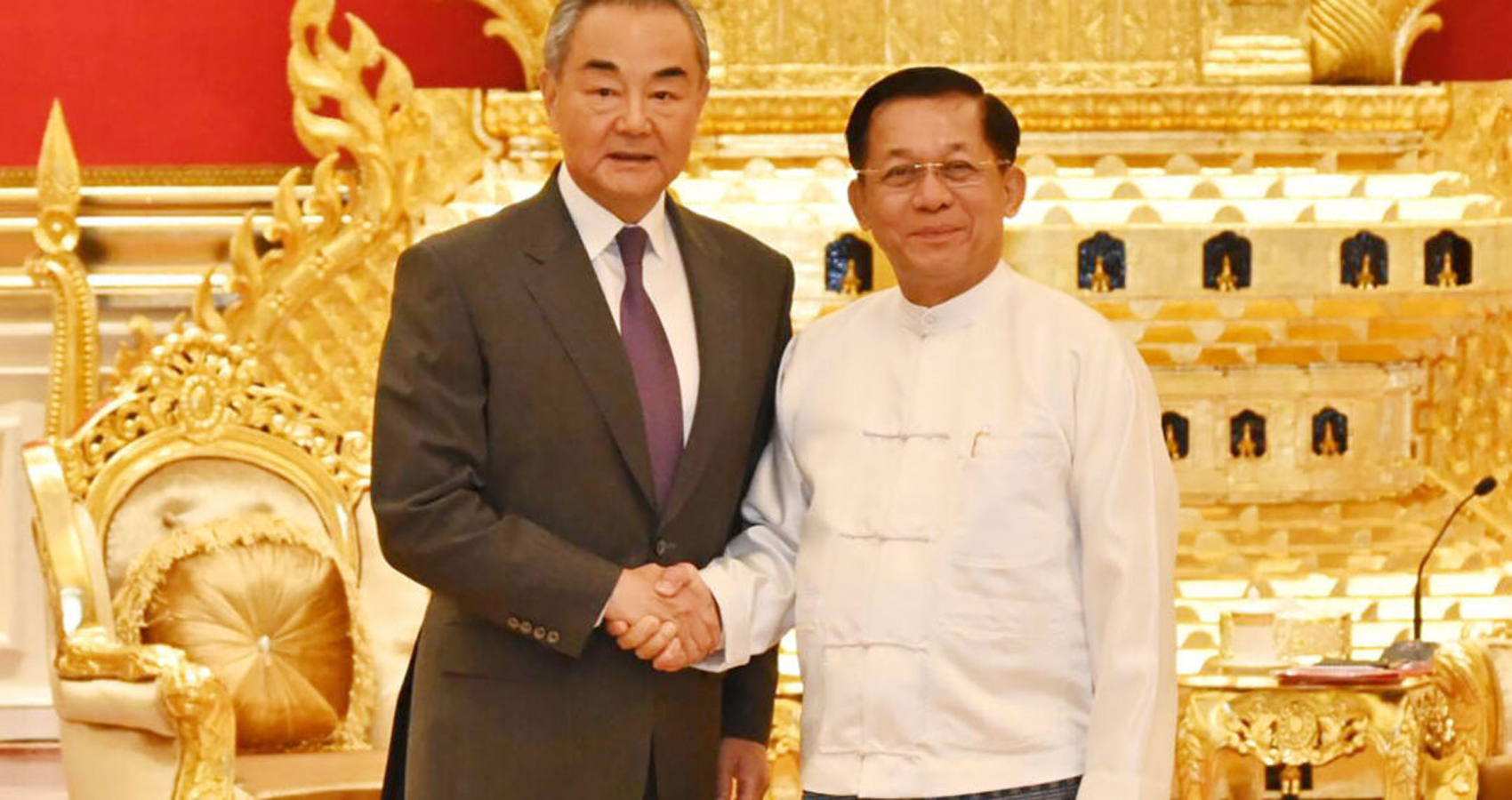
China’s interventions in Myanmar have become increasingly visible since the junta’s battlefield setbacks in late 2023 and 2024. Many argue that Beijing’s actions are driven by a desire for stability in Myanmar, not their preference its military rulers. Yet in practice, China has repeatedly intervened to protect the regime—militarily, economically, politically, and even over transnational crime.
Military Lifeline
China stepped in decisively in 2024 after the regime lost the northern Shan State capital of Lashio and appeared close to collapse. Beijing cut supplies to territory held by the Myanmar National Democratic Alliance Army (MNDAA) and Ta’ang National Liberation Army (TNLA), forcing them to stop fighting and withdraw from captured towns. It also succeeded in pressuring the United Wa State Army to halt aid to resistance forces and warned other groups not to cooperate with Spring Revolution forces in the Bamar heartlands.
China doubled down by providing the cash-strapped regime with financial aid and modern weapons, adding drones to its existing arms shipments.

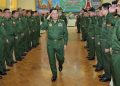
These measures had a visible impact: resistance offensives in central Myanmar slowed, and the regime recaptured 13 towns, including Mongmit and Mogoke in the Mandalay-northern Shan battle zone. In return, the regime has vowed to protect Beijing’s Belt and Road investments, even passing a law that permits Chinese security troops to operate on Myanmar soil.
Political Cover
China has handed the regime a platform at international forums, shielded it at the UN, and endorsed elections widely condemned as fraudulent. By defending polls boycotted by much of the population and rejected by ASEAN, the UN, and Europe, Beijing has sought to confer legitimacy on a regime attempting to rebrand itself.
The three-stage vote has been dismissed as a sham designed to entrench military rule. Pro-democracy parties are barred, opposition leaders jailed, and campaign rallies have drawn little public interest.
China’s support for the election signals its desire for a pliant government in Myanmar, but one that has international legitimacy.
Scam Syndicates and U.S. Pressure
China’s protection extends to the junta’s ties with transnational scam syndicates operating in Kokang and Myawaddy, on the border with Thailand.
Washington announced a crackdown in November, identifying the junta-aligned Karen State Border Guard Force (BGF) and Democratic Karen Benevolent Army (DKBA) as targets of its new anti-scam strike force. The junta, long complicit in the multibillion-dollar fraud industry, grew nervous.
Scam operations in Kokang came under scrutiny around the time of the anti-regime Operation 1027 in late 2023. The regime promptly announced a joint crackdown and handed over to China members of four criminal clans—the Bai, Ming, Wei, and Liu families—who had served as local administrators, lawmakers of the military’s proxy Union Solidarity and Development Party, and local police and border guard chiefs under the military’s command. The arrested men knew the scam industry involved Myanmar’s top generals, but China has remained silent.
Similarly, the large scam compounds under BGF control in Myawaddy could not have operated without military approval. China’s assistant minister for public security led inspections of Myawaddy and oversaw repatriation of Chinese scam workers, but never once mentioned the BGF and DKBA.
When Washington threatened direct action, the junta shifted focus from fighting the Karen National Union (KNU) to dismantling the scam hubs, even forming a “Central Supervisory Committee on Combatting Telecom Fraud and Online Gambling”. The regime raided compounds, destroying buildings along with computers and phones. Yet the operation looked more like evidence disposal than genuine enforcement. The scam masterminds remained untouched and operators simply relocated to other BGF- and DKBA-controlled areas, rebuilding with military assistance.
China acted swiftly to combat Washington’s move, dispatching its assistant public security minister, pledging cooperation with the junta, and loudly rejecting “external interference” in the scam crackdown.
Myanmar’s military rulers fear being targeted if Washington finds hard evidence of their involvement in scam operations—a concern shared by China. The junta’s spokesman has admitted as much, claiming the US may have a hidden agenda in its scam crackdown.
China’s approach reflects caution. The regime could have focused blame on BGF leader Saw Chit Thu, the same way it scapegoated the four Kokang clans. However, removing him would have handed territory to the Karen National Union (KNU), an armed group beyond the influence of both China and the regime, which relies on the BGF to contain the KNU in Karen State.
Thus, Beijing has avoided decisive action, preferring to shield the junta from U.S. pressure while tolerating the scam operations.
How Long Will Beijing Back the Regime?
China’s interventions have bought the junta time, but not solved Myanmar’s crisis. Great powers have tried before to prop up unpopular regimes—in Vietnam, Afghanistan, Syria, and elsewhere—only to suffer humiliating failure.
Beijing now faces the same dilemma. By defending Myanmar’s generals in the name of “stability,” China risks prolonging their rule while deepening instability. How long Beijing can continue to shield the junta against the will of Myanmar’s people remains uncertain—but history indicates the effort will prove counterproductive.
Thet Htar Maung is a Myanmar affairs analyst.