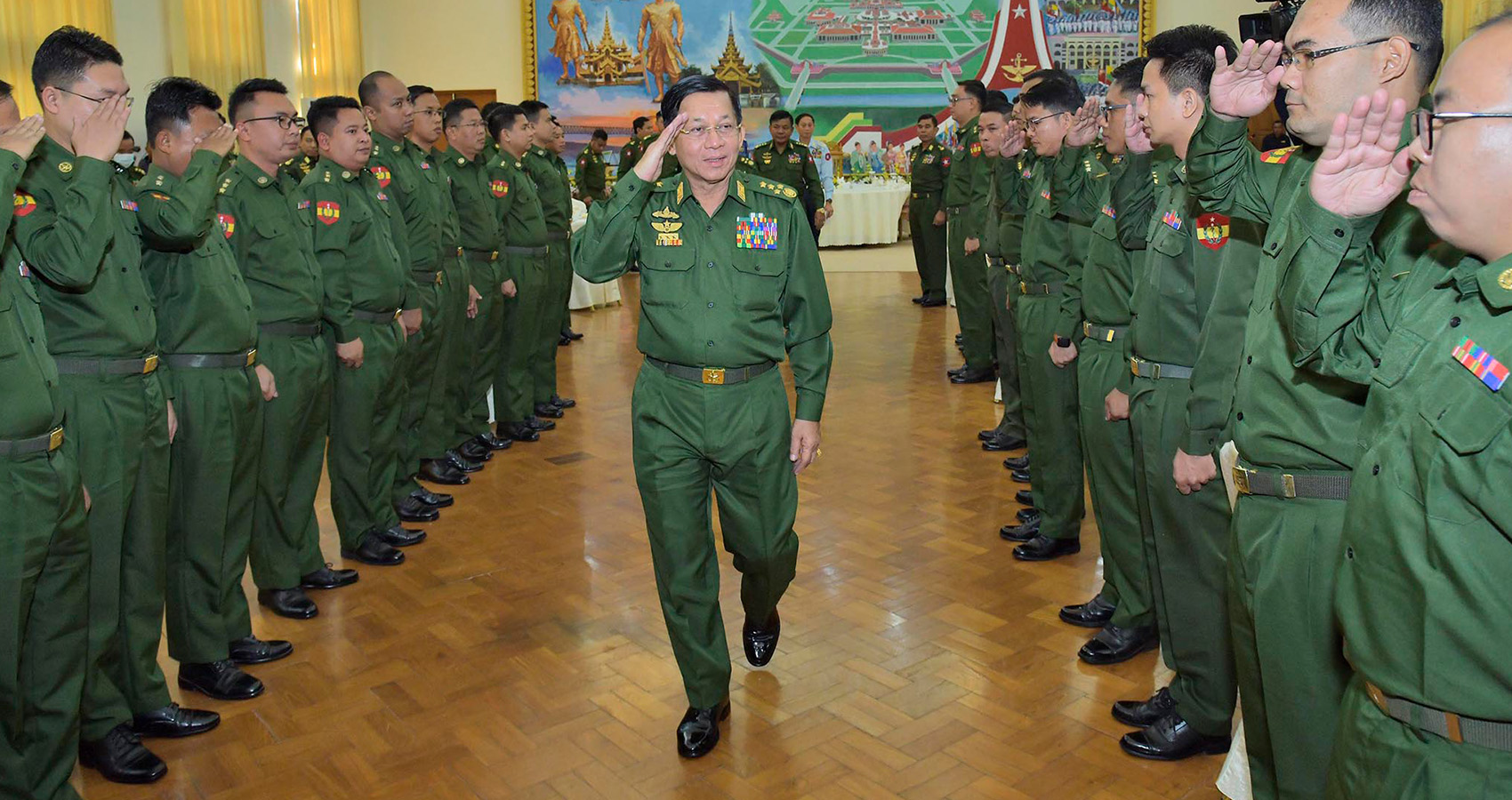
Junta boss Min Aung Hlaing has reshuffled several senior military positions right in the middle of the election period, appointing loyalists to key posts in air defense, military training and supply.
According to military sources, Naypyitaw Commander Major General Soe Min has been promoted to lieutenant general and named chief of the Air Defense Forces.
Lieutenant General Zaw Hein, who had been serving as quartermaster general, has been reassigned as adjutant-general, and is replaced in his old job by Lt-Gen Zaw Myo Tin, recently recalled from his role as Karenni (Kayah) State chief minister. Zaw Hein is a former personal aide to the junta leader, and Zaw Myo Tin is a trusted associate too.

Former Air Defense Forces chief Lt-Gen Myo Moe Aung has been appointed ambassador to Russia, a major arms supplier to the junta. He is a nephew of the previous junta’s No. 2, Maung Aye.
A military source in the capital said the reshuffle is part of the junta leader’s move to secure the presidency for himself after the election by filling critical posts with loyalists.
Other reshuffles include Western Command chief Major General Kyaw Swar Oo as chief of military training, and Defense Services Medical Academy Commandant Brig-Gen Soe Nyunt as his deputy.
Maj-Gen Kyi Thaik from Southern Command has been reassigned as Naypyitaw Command chief, while DSA Commandant Brig-Gen Zaw Lwin Soe has been named Southern Command chief. Zaw Lwin Soe led the junta’s offensive to retake Hsipaw in northern Shan State.
Defense Services Technological Academy Commandant Brig-Gen Aung Htay has been reassigned as DSA chief and is replaced by the commander of the Pakokku-based 101st Light Infantry Division, Brig-Gen Zaw Min Htet.
Brig-Gen Thant Lwin Soe, who previously headed No. 18 Military Operations Command, in turn replaces him as 101st LID chief.
Soe Min and Zaw Hein are from the relatively recent 39th and 38th intake of the elite Defense Services Academy. But the Thailand-based Institute for Strategy and Policy–Myanmar last August forecast that nothing will change in the military’s core ideology as a younger generation of officers takes the helm.
In a study examining who might emerge as the next generation of military leaders after the election, it concluded that the so-called “fourth generation” will likely mirror their predecessors in both mindset and practice. “They see themselves as the nation’s guardian, inheriting their predecessors’ mindset. Their ambitions center on reviving military dominance, reasserting Burman nationalist ideology, and pledging absolute loyalty to Min Aung Hlaing,” it wrote.