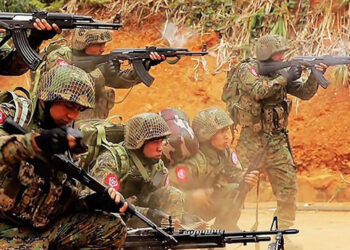
Nawnghkio is the first significant town that the Myanmar military has retaken from an ethnic armed organization (EAO) since launching major counteroffensives this year.
Located along the strategically vital Mandalay-Lashio highway and railway, this corridor serves as a crucial trade and military logistics route linking central Myanmar to the Chinese border at Muse.
The town was initially seized by the Ta’ang National Liberation Army (TNLA) during the second phase of Operation 1027, launched on June 25, 2024, in cooperation with the Danu People’s Liberation Army (DPLA) and the People’s Defense Force-Mandalay (PDF-MDY). However, the military retook control on July 16 this year.

While pundits attribute the Myanmar military’s recent success to its growing use of advanced technologies—particularly drones—and Chinese pressure on the TNLA, these factors alone do not account for the loss of Nawnghkio. Three major missteps by the TNLA contributed significantly to this strategic setback.
Following its initial capture of Light Infantry Battalions 114 and 115 and Missile Battalion 606 in Nawnghkio town, the TNLA launched operations against the No. 902 Artillery Operations Command (AOC-902) in Taungkham Village, approximately 32 km south of Nawnghkio. This command oversees multiple artillery units, including Battalions 206, 354 and 406. Although the TNLA successfully seized Battalions 206 and 406 by late August 2024, it failed to complete its objective by leaving other strategic bases untouched.
This pattern repeated in Thabeikkyin, a town north of Mandalay and west of Mogoke, which was also captured by the TNLA and its PDF allies. Despite establishing territorial control, the TNLA did not move against several nearby military installations, including the No. 2 Basic Military Training Unit, Kyaukkyi Technical Corps and No. 13 Advanced Training School, all located within 11 km of the town. The military is steadily advancing toward Thabeikkyin town as part of its counteroffensive. If it succeeds in reclaiming Thabeikkyin, Mogoke town will likely become vulnerable to further military operations.
The TNLA has not publicly explained its decision to halt these offensives, but the strategic logic appears to be rooted in the notion of buffer zones. Both Nawnghkio and Thabeikkyin seem to serve as soft territorial barriers between the Myanmar military and the TNLA’s strongholds in the far north. In the past, the TNLA has treated Nawnghkio, particularly its eastern segment beyond the Mandalay-Muse highway, as a demilitarized or low-intensity zone. This may be attributed to the fact that these areas are predominantly inhabited by ethnic Danu and Shan communities.
This buffer doctrine has also led to the marginalization of other resistance groups. In early 2022, when a newly formed PDF—later designated PDF Battalion 510 under the National Unity Government—began operating in Nawnghkio under Kachin Independence Army (KIA) command, the TNLA compelled the unit to relocate, either east of the highway or into Mandalay Region. By September 2022, the PDF had retreated to Mandalay, reflecting the TNLA’s reluctance to share operational space in what it considered its buffer territory. Consequently, the TNLA made minimal efforts to push the military further into adjacent areas, such as Pyin Oo Lwin, leaving this responsibility to its allies, including the DPLA and PDF-MDY.
A second major misstep lies in the TNLA’s growing tensions with long-time ethnic allies, notably the KIA and the Shan State Progress Party/Shan State Army-North (SSPP/SSA-N). Following rapid territorial gains in Operation 1027’s first and second phases, the TNLA reportedly began asserting administrative control over areas previously held jointly or informally by other EAOs. This effort to consolidate administration and influence was carried out through the gradual displacement of the KIA and SSPP/SSA-N from the area.
For instance, the TNLA dismantled KIA checkpoints and outposts, including the liaison office in Kutkai town, and detained KIA troops, including officers. Although these actions have not yet escalated into open warfare with the KIA, they reflect a broader trend of assertive behavior that undermines alliance cohesion. Tensions with the SSPP/SSA-N have been more severe. A series of armed clashes between the TNLA and SSPP/SSA-N have already resulted in casualties, indicating that the TNLA has prioritized territorial consolidation over further territorial gains from the Myanmar military. In essence, the TNLA focused on strengthening control over its captured areas by deploying additional troops, rather than expanding its offensives against the junta.
On the eve of the junta’s recapture of Nawnghkio, the TNLA began reinforcing its positions by redeploying troops from other captured towns. According to a TNLA member who spoke on condition of anonymity, approximately 1,500 soldiers from Namhkam and 500 from Kutkai were dispatched to Kyaukme on July 15, with additional reinforcements expected from other townships. The stated objective is to deter further military advances into the territories controlled by the group. However, these reinforcements would have been more effectively deployed earlier to secure Taungkham Village and consolidate control over Nawnghkio, rather than being stationed in already-captured areas to confront allies. This redeployment reflects a misallocation of strategic resources at a critical juncture.
The TNLA’s final strategic error lies in its mismanagement of territory under its control, particularly in natural resource governance, inter-group relations and forced recruitment. In Mogoke, a ruby-rich town, the TNLA has been accused by residents of monopolizing gemstone mining through partnerships with Chinese investors and cronies, excluding local communities. Their mismanagement of natural resources even led to public protests in Namhkam Township.
Furthermore, the TNLA has frequently engaged in confrontations with local communities, particularly those belonging to the Shan and Kachin ethnic groups. A notable instance occurred in Hsipaw in February 2025, where the TNLA removed the Shan flag and replaced signage in the Shan language with the Ta’ang language on the town gate—acts that symbolically undermined the cultural identity of the Shan population. Similarly, in 2024, the TNLA occupied public schools in Galai and Mang Ping villages in Kutkai Township, which were operated by the local Kachin community. This forced community members to seek temporary alternative arrangements to ensure the continuation of education for local children.
Additionally, the TNLA has faced a growing public backlash for its alleged mistreatment of Burman PDF units. The TNLA has restricted these groups’ operational autonomy, confiscated weapons and denied logistical access, particularly in areas such as Nawnghkio and the Lashio corridor. Leaked video footage allegedly showing the detention and abuse of Burman PDF fighters by TNLA troops has circulated on social media, triggering widespread criticism.
The aforementioned actions have been widely perceived as manifestations of ethno-rebel dominance, leading to accusations of ethnic chauvinism and eroding the broader spirit of revolutionary unity. Consequently, support for the TNLA has waned among local Shan and Kachin communities, as well as among segments of the Burman resistance who had previously viewed the group favorably. A Lisu resident from Mogoke recounted, “We used to inform the TNLA about [junta] troop movements, but we are now deeply disappointed with the group and no longer wish to support them.” This sentiment reflects the broader disillusionment within local communities, suggesting limited sympathy for the TNLA’s setbacks, including its recent withdrawal from Nawnghkio.
The junta’s advance is unlikely to stop at Nawnghkio. It is poised to continue toward either Mogoke or Kyaukme, with strategic intent. Since regaining control of Lashio from the Myanmar National Democratic Alliance Army (MNDAA) through Chinese mediation in April 2025, the regime now seeks to consolidate its hold over the Mandalay-Lashio corridor. Securing Kyaukme and Hsipaw would effectively reestablish this critical logistical and military route between central Myanmar and the northern border.

Indeed, the fall of Nawnghkio should not be interpreted solely as a demonstration of Chinese pressure and the regime military’s superiority in drone warfare; rather, it reflects more profound strategic shortcomings. This includes the incomplete neutralization of military bases, the misallocation of forces to internal conflicts with allied ethnic armed groups, and the alienation of local civilian populations and Burman PDF allies. Collectively, these missteps have significantly undermined the TNLA’s operational effectiveness.
Unless addressed, these structural weaknesses are likely to further erode both the legitimacy and capacity of the TNLA within the broader anti-junta resistance movement.
Joe Kumbun is the pseudonym of an independent political analyst.