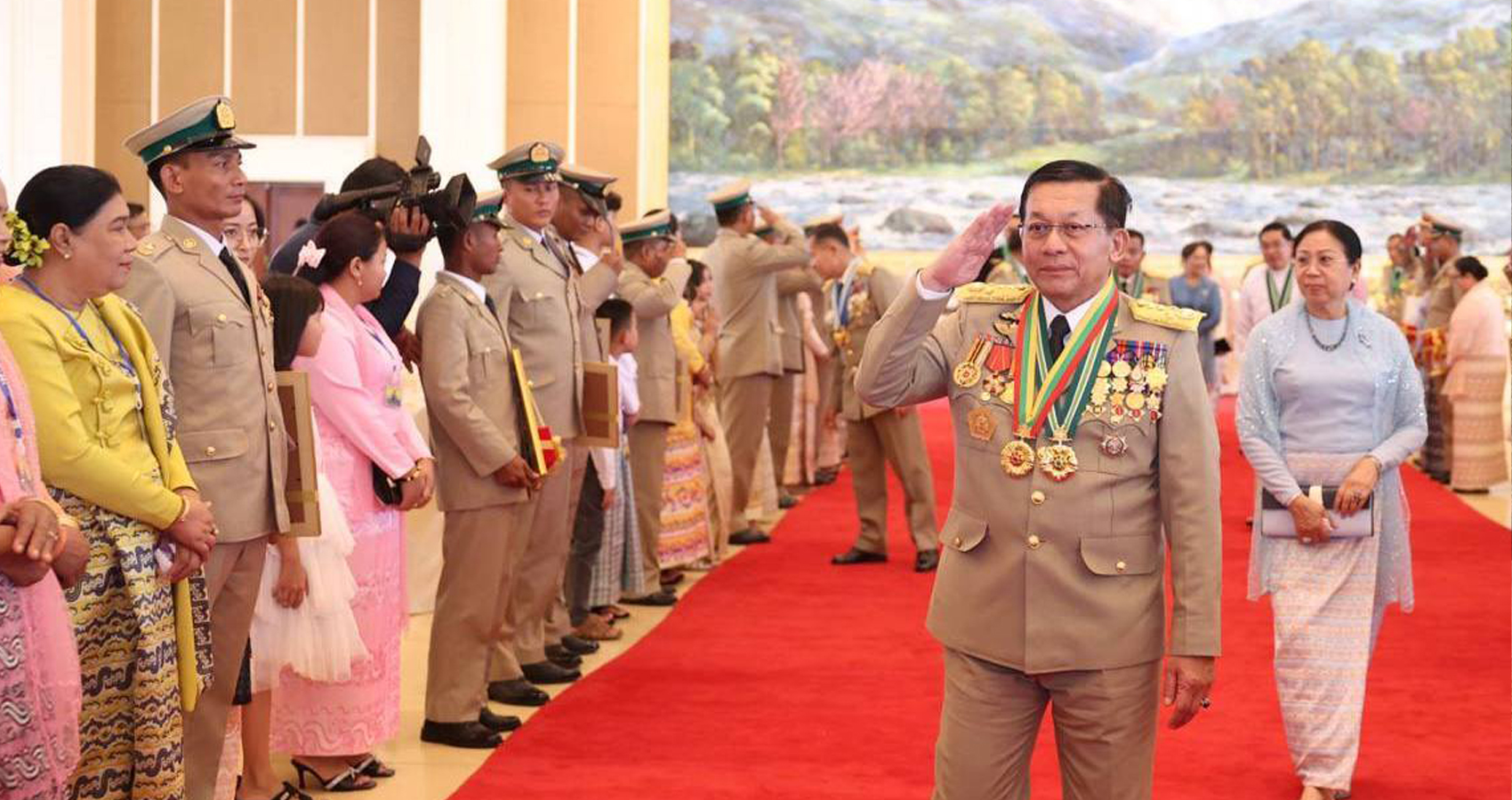
While much of Myanmar describes the military as a “fascist army” for bombing civilian targets, torching villages, and committing mass killings and rape, junta chief Min Aung Hlaing used Independence Day to declare he is building a “standard army” capable of fighting conventional wars and rivaling global powers.
Speaking at a ceremony to reward loyalists and soldiers with honorary titles and gallantry medals on Sunday, Min Aung Hlaing complained of “too much bullying and exploitation” on the international stage.
He claimed his military is being shaped into a modern, disciplined, and patriotic force that can resist exploitation or manipulation in the global arena.

His call for a modern fighting force is not new. He repeatedly aired his vision for a standard army long before staging the 2021 coup. Last month, he urged combat readiness among his troops while boasting of domestically built frigates, submarines, dual‑use combat vehicles, and a steady supply of weapons, aircraft, and helicopters.
Yet the junta chief’s rhetoric stood in stark contrast to the reality. Min Aung Hlaing himself orchestrated the 2021 coup that plunged the country into civil war. He faces international sanctions and war crimes allegations, while his forces have suffered a series of humiliating defeats on the battlefield.
During the resistance Operation 1027 offensive launched in late 2023, the Army ceded control of more than 80 towns and surrendered two entire regional commands in Shan and Rakhine—unprecedented setbacks in the history of Myanmar’s military.
Senior officers defected or surrendered in large numbers, while troops fled across borders into India, China, Thailand, and Bangladesh to escape advancing resistance forces. The debacle prompted a public admission from Min Aung Hlaing that his troops were overwhelmed by superior tactics and technology in northern Shan.
The junta responded by enforcing military service under the long‑dormant Conscription Law—a measure not even considered by previous dictators Ne Win or Than Shwe—as it scrambled to replenish the ranks.
Analysts note that despite wielding air power, heavy artillery, and advanced weaponry, the military is unable to defeat lightly armed People’s Defense Forces (PDF) and ethnic armed organizations.
“This shows a lack of combat prowess. The military would have lost the war had it not been for the air force and artillery,” said one analyst.
“If the military cannot win against domestic resistance forces, how can it claim the status of a ‘standard army’ on the world stage?”
The Myanmar military’s reputation has been scarred by decades of well-documented atrocities against civilians, including village burnings, looting, rape, and extrajudicial killings. However, those crimes have escalated since the 2021 coup, with attacks on hospitals, schools, and civilian areas under resistance control prompting the public to label it a “fascist army.”
“With such low levels of discipline, how can Myanmar’s armed forces compete with global powers?” the analyst asked.
Despite receiving financial, military, and technological aid from allies China and Russia, the junta has only managed to claw back limited territory in northern Shan. Nationwide control remains a distant goal, forcing the fragmentation of its election into three separate phases while battling resistance on multiple fronts.