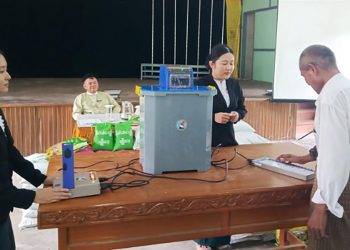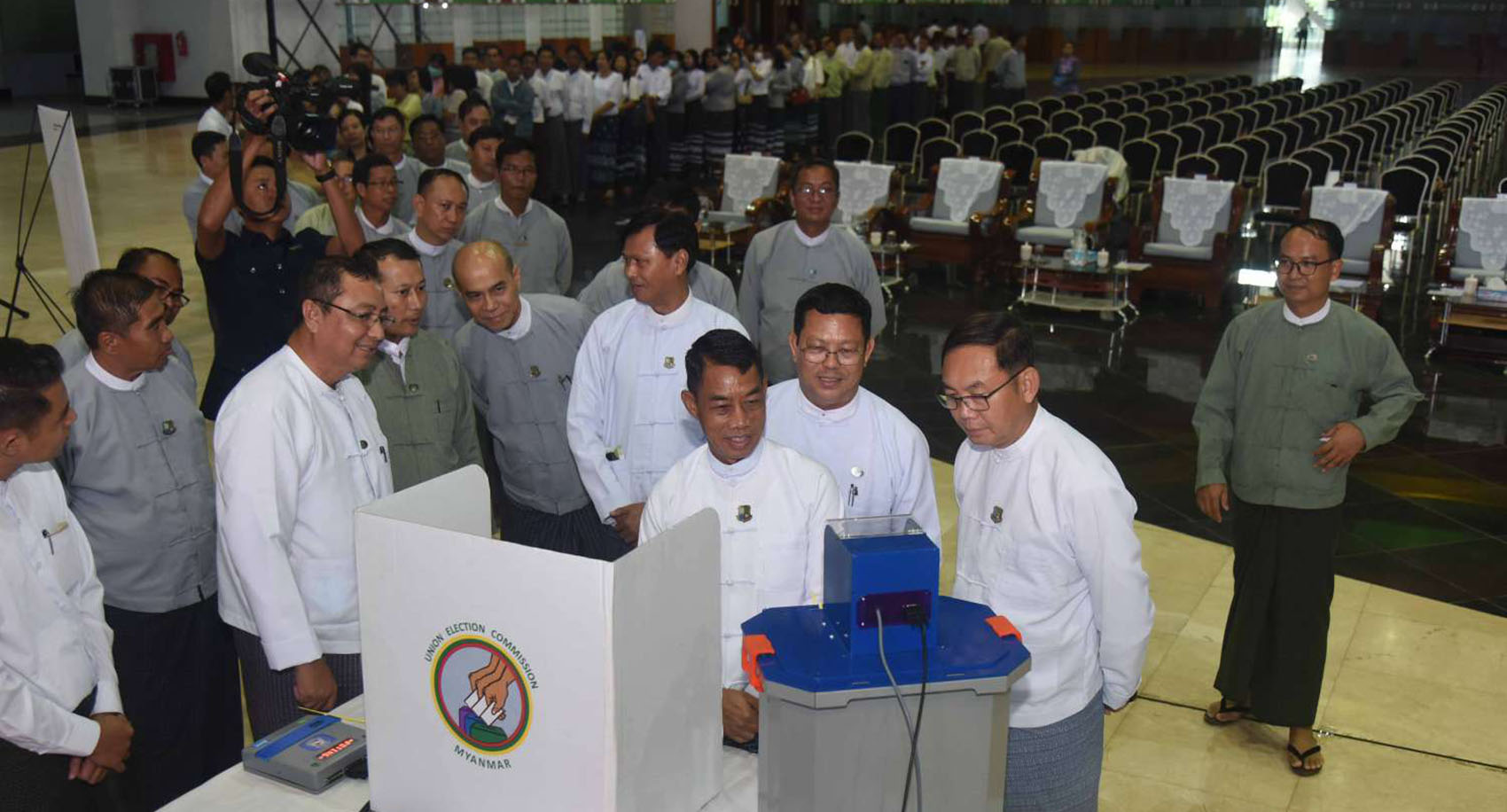
In announcing Dec. 28 as the first phase of nationwide elections, Myanmar’s military junta is attempting to lock the populace into a system designed less to enable transition than to suffocate dissent. The opposition, including the National Unity Government (NUG), has fallen largely silent, issuing little beyond recycled statements about “sham elections” as it becomes clear that the polls will proceed regardless of resistance. Meanwhile, the junta, rebranded as the State Security and Peace Commission (SSPC) on July 31, is banking on elections to secure a measure of international and regional recognition.
Myanmar’s opposition now finds itself caught in a legal and political stranglehold. The junta’s planned election presents the NUG and resistance groups with an existential bind. To campaign openly against the polls risks exposing supporters to arrest, imprisonment or even execution under draconian provisions such as Articles 16 and 27 of the junta’s new Law on Protecting Multi-Party Democratic General Elections from Obstruction, Hindrance, and Destruction. Yet remaining silent risks ceding political space to the regime, allowing the junta to claim a new mandate and further eroding the NUG’s legitimacy. For ordinary citizens, no safe path exists: open resistance invites punishment, participation lends the regime a veneer of legitimacy, and silence risks complicity.
On July 31, the SSPC ended Myanmar’s state of emergency after four years of extensions. It was hailed by some as a sign of political transition. Yet within hours, the junta’s National Defense and Security Council imposed martial law in 63 townships deemed opposition strongholds. Far from loosening its grip, the junta consolidated power, abandoning the careful choreography that its predecessor the State Peace and Development Council staged for the 2010 elections, when at least a facade of transition was maintained.



The regime has effectively gamed the system in its favor, manipulating both institutional mechanisms and the legal framework to enforce repression. The Union Election Commission (UEC) remains toothless. It was never fully independent, and after the 2021 coup, the military reappointed the UEC with loyalists who endorsed the junta’s claims of electoral fraud in the 2020 election without credible evidence. While Section 419 of the Constitution empowers the regime to legislate during a state of emergency, it does not authorize bypassing all consultative processes. The UEC, as the designated electoral body, should have been central in reviewing legislative changes. Instead, the junta introduced sweeping amendments, including SAC Law No. 48/2025, the “Law on the Protection of Multiparty Democratic General Elections from Obstruction, Disruption, and Destruction”, enacted in late July 2025 before the UEC’s formal reconstitution in August. This underscores the UEC’s rubber-stamp role and removes a crucial institutional check on electoral integrity.
Law No. 48/2025 also criminalizes dissent. Section 16 imposes a minimum three-year sentence for any “expression in writing” deemed disruptive. Even a peaceful “no-vote” campaign, online or offline, could qualify, carrying a custodial sentence. The deliberate ambiguity forces citizens into self-censorship, pre-emptively stifling dissent. The law also institutionalizes surveillance: Chapters 3 and 4 establish central and regional committees to supervise election security, extending unusually beyond law enforcement to include the Ministry of Transport and Communications and Myanmar Post and Telecommunications. This gives the SSPC direct authority to monitor dissent across both physical and digital spaces.
The Cyber Security Law (SAC Law No. 1/2025), which entered into force on July 30, goes brazenly further in suppressing opposing voices. Framed as aligning with new election laws, it bans VPN use and strips away privacy safeguards, effectively criminalizing access to social media behind firewalls. Though the jurisdictional debates continue, the law allegedly applies extraterritorially to Myanmar nationals abroad, further restricting speech through legally licensed surveillance beyond the country’s borders.
Together, the two laws constitute a pincer movement: Law No. 48/2025 prosecutes citizens for content, while Law No. 1/2025 criminalizes the means of communication. Even private “no-vote” opinions risk persecution. The civic space for resistance has virtually disappeared.
Unlike its earlier anti-sham election campaigns, the NUG has remained conspicuously silent in recent weeks. This reflects a grim calculation: that any organized civic action, even basic Facebook engagement, would give the junta grounds to jail its supporters. Yet silence risks ceding political space, enabling the junta to claim a new mandate and undermine the NUG’s legitimacy rooted in the 2020 election results. Speaking out against the new rules, whether offline or online, leaves the NUG and its supporters vulnerable to prosecution.
This silence also reveals a deeper problem: the NUG may be trapped in a cycle reminiscent of the National Coalition Government of the Union of Burma’s struggles decades ago. The NUG’s legitimacy derives entirely from the 2020 election via its parent body, the Committee Representing Pyidaungsu Hluttaw (CRPH). This mandate has been its strongest counter to the junta’s international diplomatic efforts. Yet by denouncing the 2008 Constitution outright, the NUG has closed off legal and symbolic options for organizing a parallel election before the 2020 mandate expires in late 2025—regardless of the regime’s staged poll. The push for an Alternative Federal Transitional Arrangement (AFTA), though admirable in aspiration, will likely be utopian in practice. Delays in the National Unity Consultative Council process and the NUG’s lack of governance capacity in the areas under its control have already undermined the faith of the people. Realistically and legislatively, without the grounds laid by the 2008 Constitution, the CRPH would not be able to even pass a symbolic “State Counsellor Act” to extend Daw Aung San Suu Kyi’s mandate. If their primary reliance is now solely on the Federal Democracy Charter, there would arguably be no need for such a role. This removes the opportunity for the opposition to keep her not only as diplomatic figurehead but also as their public face—a move that would ensure their popular legitimacy since their strongest supporters still appear to vest their faith in her person more than in the performance of the CRPH or NUG.
Seen in this light, the junta’s election plan should be less a looming inevitability than a wake-up call. The NUG’s activist diplomacy has, until now, blunted the SAC’s legitimacy push, but relying on moral pleas to the international community is no longer enough. To prevent its fall from relevancy, the NUG must act now to find a realistic and grounded approach to craft its forthcoming political narratives rather than simply holding on to the aspirational Naypyitaw cabinet structure while the junta cloaks itself in electoral theater and expands its war economy.
The Association of Southeast Asian Nations (ASEAN)’s role, though secondary in the junta’s calculus, remains symbolically and normatively significant; and the existential bind also extends to the bloc as some of Myanmar’s influential neighbors back the SSPC’s election plans, providing diplomatic cover or quiet support. It is imperative to note that, for some opposition forces, the logic that “elections will happen anyway” was not taken in defeat and idle exasperation. Without acknowledging the possibility of pre- and post-election violence, any suggestion that this election could pave a path to peace is dangerously naïve. A tacit recognition of the polls would expose ASEAN’s failure to uphold its people-centered commitments and damage its credibility as a regional body bound by its Charter to democratic values. ASEAN would also risk being considered complicit in the repression its Five-Point Consensus (5PC) was meant to address. What is unfolding in Myanmar is not a democratic exercise, but a carefully constructed trap designed to ensnare the opposition, silence the people, and lure the international community into complicity. ASEAN can still resist this trap—rather than sleepwalking into it.
Surachanee Sriyai is a Visiting Fellow with the Media, Technology and Society Program at ISEAS – Yusof Ishak Institute. She is the interim director of the Center for Sustainable Humanitarian Action with Displaced Ethnic Communities (SHADE) under the Regional Center for Social Science and Sustainable Development (RCSD), Chiang Mai University.