The regime is going out of its way to try and revive the controversial Myitsone Dam, with junta ministers making a beeline for Kachin State to call for the Chinese-funded hydropower project to be built at last.
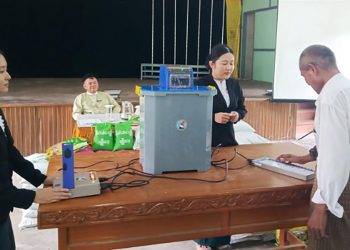
President Office Minister Tin Aung San, who chairs the Electricity and Energy Development Commission, in a speech at Kachin State Day celebrations in the state capital Myitkyina on Sunday, insisted that hydropower “is the most cost‑effective option” and reiterated the junta’s mantra that the mega project must be “reviewed and implemented.”
He argued that the series of dams to be sited where the confluence of the Mali and N’Mai rivers forms the Irrawaddy, would boost power generation and “deliver long‑term benefits for both Kachin State and the country as a whole.”

Last month, junta No. 2 Soe Win during a visit to Myitkina also outlined plans to restart the project, claiming that the dams would be earthquake-resistant and perfectly safe.
During the same trip, Deputy Electricity Minister Aye Kyaw told locals that the junta had already begun discussions with Chinese companies to move the project forward.
Tin Aung San was accompanied by Electricity Minister Nyan Tun and a seismologist from the Electricity Ministry. According to junta media, Nyan Tun promised that technical teams would be formed to manage flood risks and maintain the Irrawaddy’s flow as he “detailed measures to ensure river navigation and prevent disruption to livelihoods,” while the scientist “presented seismic calculations” to the effect that the dam could withstand major earthquakes.
Local sources report that Chinese teams have already resumed technical assessments and outreach activities in preparation for restarting the project.
One of its most contentious points is that very little of the electricity is intended for Myanmar, let alone local needs. Under the original agreement, 90 percent of the power was to be exported to China, with Myanmar receiving just 10 percent. In recent meetings with locals, junta officials have claimed that the arrangement has been “revised” but did not disclose the ratio.

The shadow National Unity Government (NUG) has condemned the junta’s efforts to revive the project. The NUG’s Interim Board for Heritage Administration on Saturday declared the Myitsone area a protected natural and cultural heritage site to coincide with Kachin State Day.
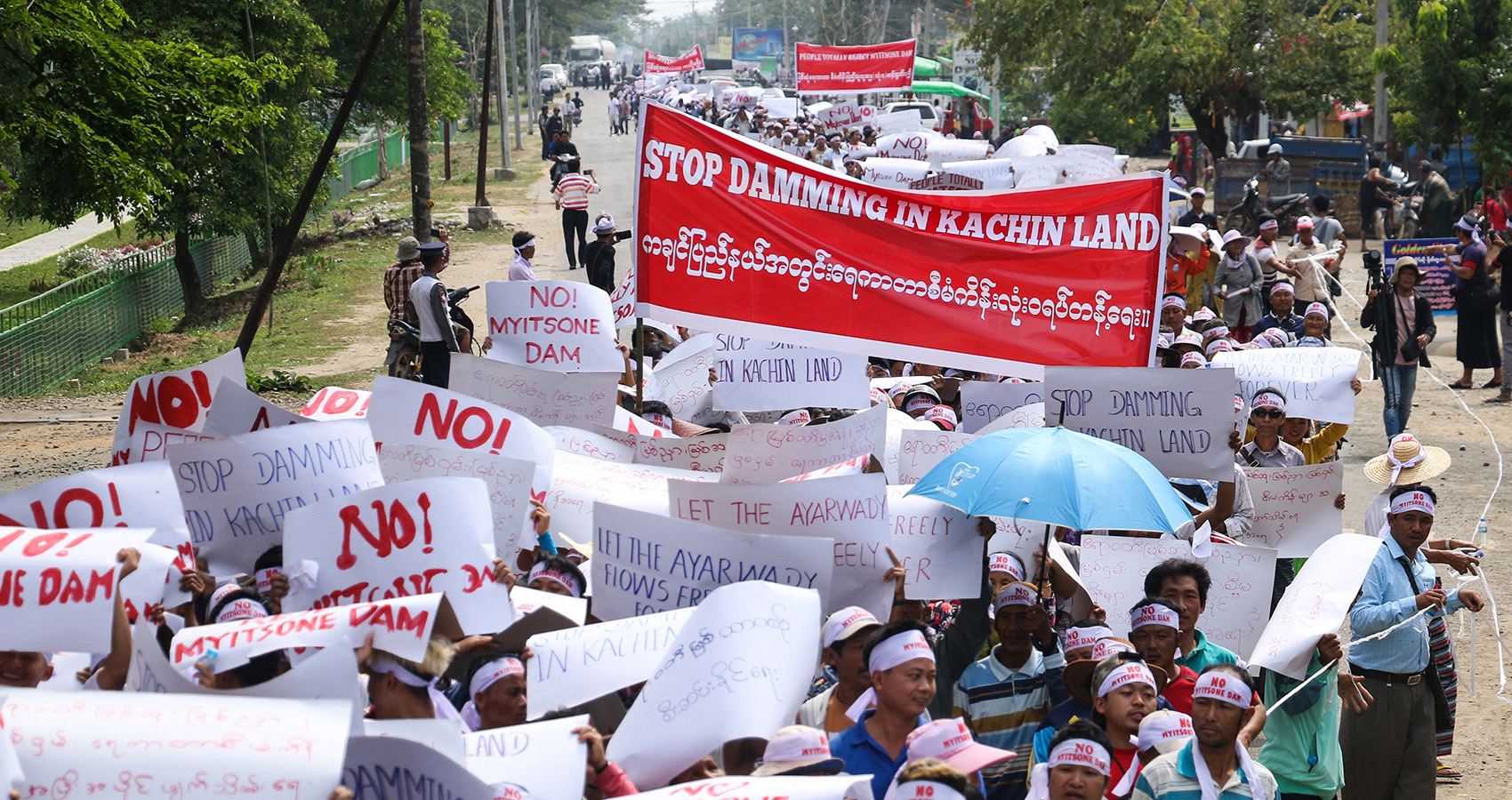
That means large‑scale hydropower projects would now be banned within a 20 km radius of the confluence. The same day, some Myitkyina residents staged a small protest against the plans’ revival.
Meanwhile, junta chief Min Aung Hlaing used a Kachin State Day message to urge ethnic armed groups—including the powerful Kachin Independence Army (KIA)—to “halt fighting and prioritize peace in the interests of their region and local people.”
But the KIA remains firmly opposed. “This concerns the people deeply,” KIO spokesman Colonel Naw Bu told The Irrawaddy after Soe Win’s December visit. “It was strongly opposed before, and public sentiment remains central to the KIO’s position.”
Launched in 2009 under the previous junta, the Myitsone Dam is a massive China‑backed scheme involving seven dams along the Mali and N’Mai with a combined capacity of 20,000 MW of electricity. The largest, at the confluence, was designed to produce 6,000 MW, though Soe Win said in December that this would be scaled down to 5,600 MW for safety reasons.
The project was suspended in 2011 by then‑President Thein Sein after unprecedented nationwide protests over environmental threats, seismic risks, and displacement of thousands.
During construction of the first of the seven dams at Chiphwe in 2009, more than 15,000 people were forcibly relocated.
Seismologists and environmental experts argue that no redesign can eliminate the inherent dangers of building in a high‑risk seismic zone just 25 km from the Sagaing Fault. They warn of catastrophic risks to biodiversity, livelihoods downstream, and the Irrawaddy’s flow.
Observers say the junta’s renewed push is linked to Min Aung Hlaing’s efforts to secure Beijing’s support in mediating a truce with the KIA.