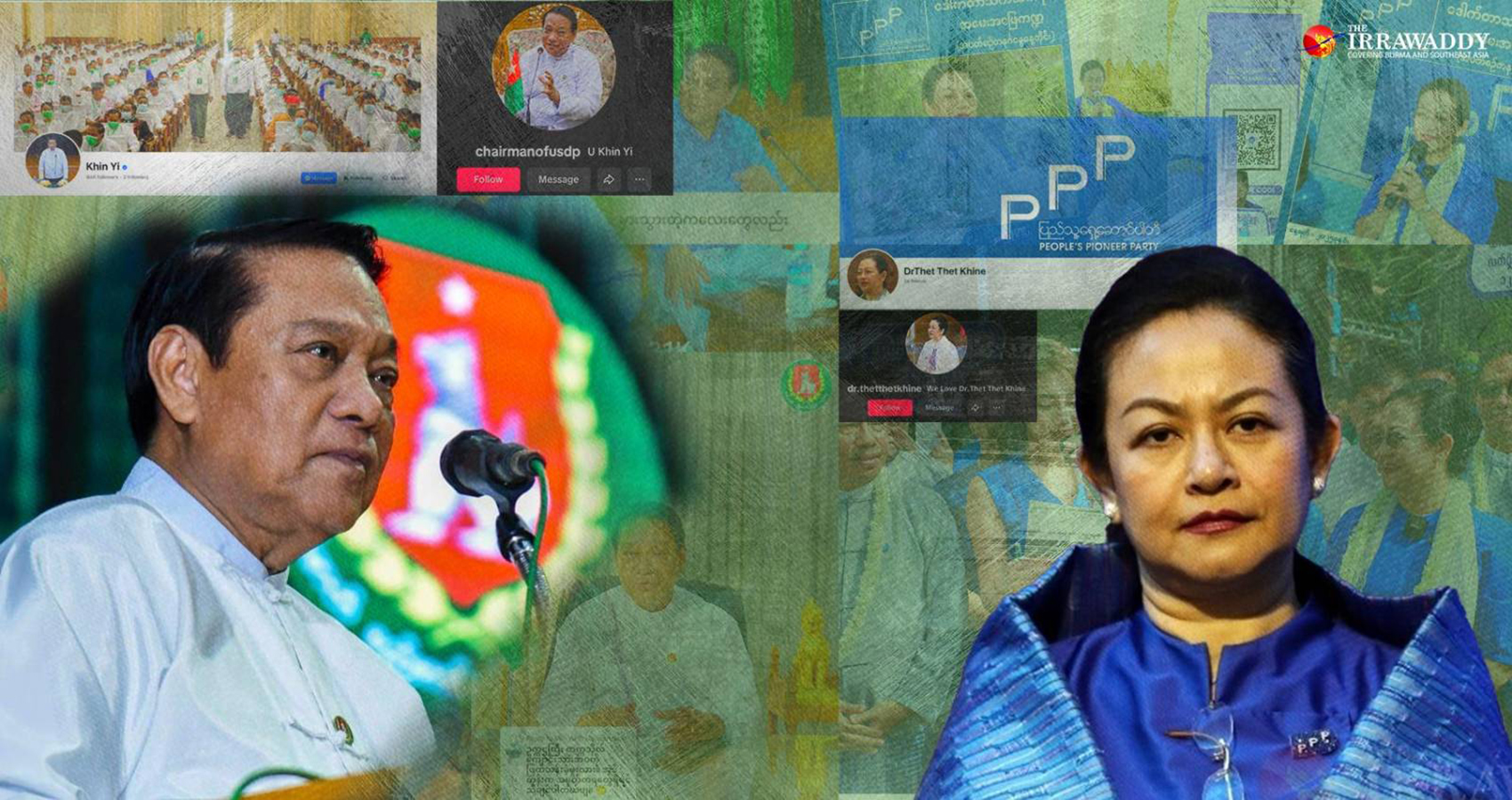
Junta-aligned political parties are intensifying their online propaganda campaigns as the year-end election looms, using Facebook and TikTok to promote themselves while attacking the ousted democratic government and resistance.
A total of 57 political parties will contest the polls, excluding the National League for Democracy (NLD), the winner of the 2020 election. Six—including the military’s proxy Union Solidarity and Development Party (USDP) and Thet Thet Khine’s People’s Pioneer Party (PPP)—are fielding candidates nationwide, while the rest will compete only in individual regions or states.
USDP chairman Khin Yi, a former police chief and long-time junta loyalist, has emerged as one of the most active online presences. Since September, he has ramped up his social media activity, posting video clips in which he answers pre-arranged questions and boasts of his “experience” and “service to the nation.”



In one video, he claimed that he still carries two bullets in his body.
Khin Yi also maintains visibility through regular meetings with party members, pro-military artists, nationalists, and sympathetic media outlets, while consistently praising the military and vilifying the opposition.
Since the beginning of the year, he has been posting updates on both his personal Facebook page and the USDP’s official page, but it was at the beginning of September that he went into overdrive, launching a steady stream of short “Reel” videos on Facebook and TikTok.
He now uploads three or four clips a day, showcasing his activities and party messaging.
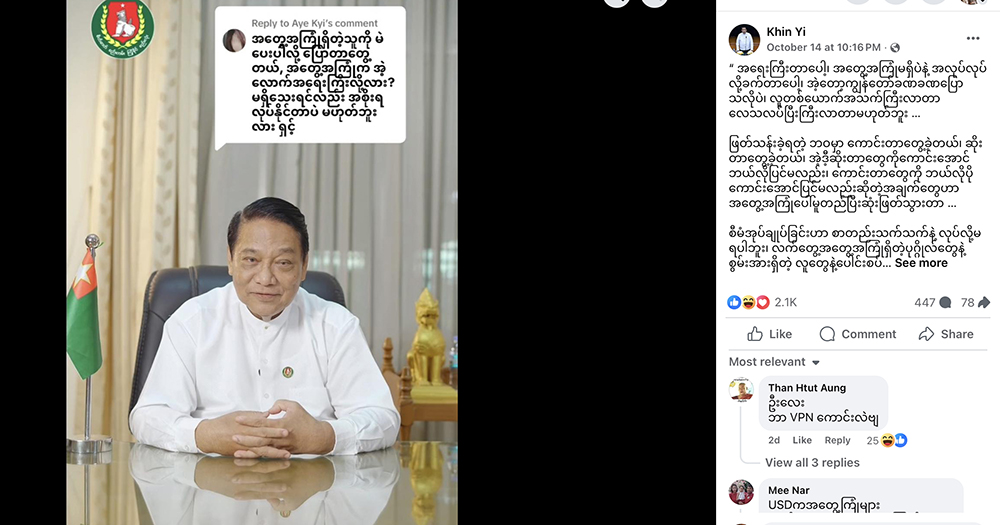
Tech experts point out, however, that many of the accounts engaging with his content were newly created last month, suggesting an orchestrated digital campaign.
Other prominent USDP figures, such as propagandist Hla Swe—a.k.a. “Bullet”—and veteran politician Maung Myint, are also increasingly active online, regularly posting videos and commentary attacking the NLD and resistance.
Former Lieutenant General Thet Pon, who is running on the USDP ticket in Magwe Region, also shares personal stories as part of his campaign. As commander of Bureau of Special Operations (BSO) No. 5, responsible for security in Yangon, Thet Pon played a leading role in the violent suppression of peaceful protests following the 2021 military coup. He was sanctioned by the European Union in 2022. He also oversaw the arrest, torture, and execution of resistance members across Yangon Region.

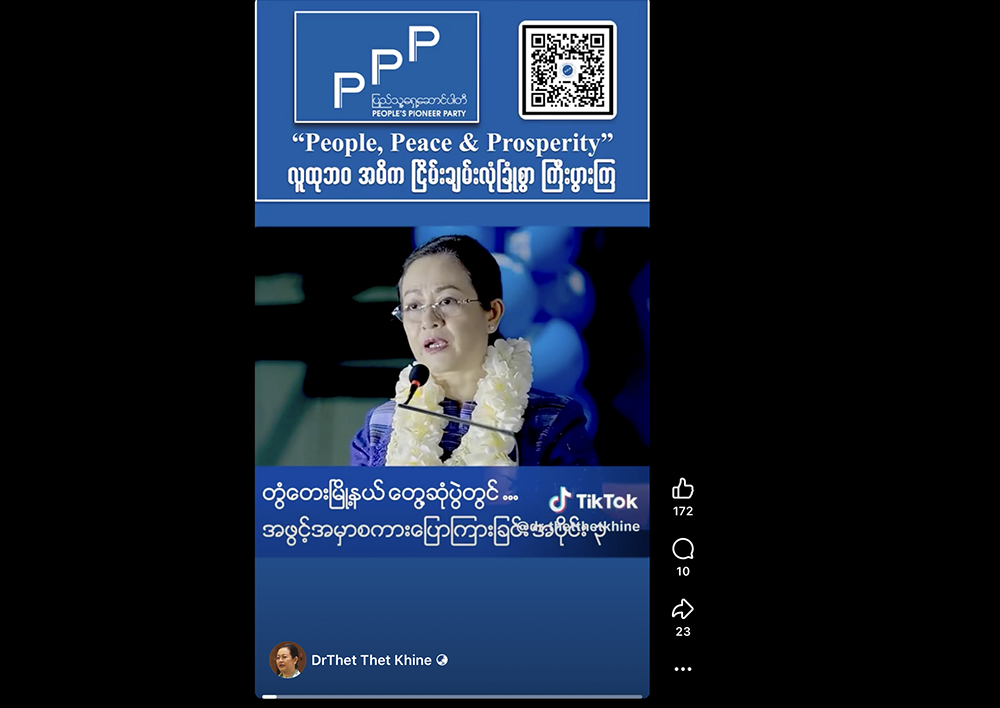
PPP chairwoman Thet Thet Khine—a former NLD lawmaker expelled in 2018 who later served in the junta cabinet after the 2021 coup—has likewise stepped up her online presence. She relies on pro-military media interviews, press briefings, weekly Q&A sessions about her party, and training sessions for her candidates, while using pre-arranged questions to draw public attention.
She mixes political messaging with personal content, frequently posting about her family and daily activities. At times, she uploads as many as 17 posts in a single day.
She recently insisted that ousted President U Win Myint and State Counselor Daw Aung San Suu Kyi were guilty of corruption rather than jailed for political reasons. She also complained that the junta had rejected her request to allow active military personnel to contest the election on the PPP’s platform, even as many high-ranking officers are set to run under the USDP banner.
By contrast, former political prisoner Ko Ko Gyi’s moderate People’s Party, the National Unity Party, and the Shan and Nationalities Democratic Party seem far less online-savvy, limiting their posts mainly to photos of party office openings.
But the junta-aligned parties’ heavy reliance on social media may also reflect the volatile climate amid nationwide civil war, which precludes large-scale political rallies.
Campaigning proper only starts on Oct. 28, two months before the first election date, so online activity is bound to heat up.
Paradoxically, Facebook has officially been blocked by the military but remains the most widely used platform in Myanmar since nearly everyone has VPN, including the junta leadership.
Other than that, TikTok has become the primary tool for propaganda and campaigning. Some 58.68 percent of Myanmar’s 33.4 million internet users are active on TikTok, according to the Myanmar Internet Project. The platform saw a significant surge after the February 2021 coup.
More than 5,000 candidates have registered for the election. Khin Yi will run in Naypyitaw’s Zeyarthiri Township and Thet Thet Khine will contest an Upper House seat in Yangon Region.