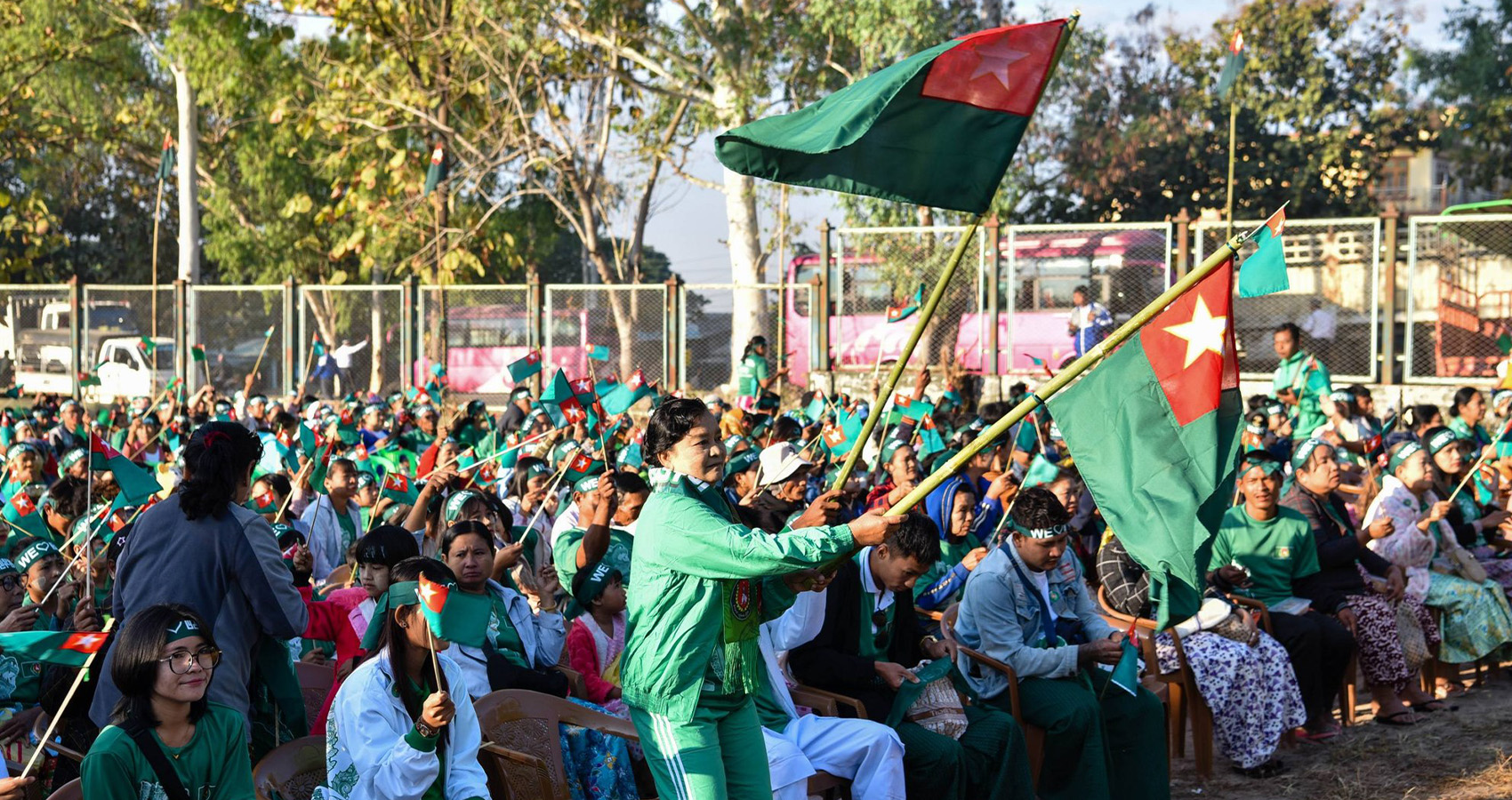
The Myanmar military’s proxy Union Solidarity and Development Party (USDP) has secured the majority of parliamentary seats in Rakhine and Chin states, after benefiting from advance votes and proportional representation (PR) tallies in elections held under heavy restrictions.
In Rakhine State, where voting was only held in three of 17 townships, the USDP won 19 seats. The regime was only able to organize elections in Manaung Township and urban areas in Sittwe and Kyaukphyu; the 14 other townships are now controlled by the ethnic Arakan Army.
The three townships saw first-past-the-post (FPTP) contests with the USDP securing two of three seats in the Lower House (Pyithu Hluttaw), while the Rakhine Nationalities Party (RNP) took one. In the Upper House (Amyotha Hluttaw), the USDP again claimed two seats, with the Arakan Front Party (AFP) winning one. In the Rakhine State Assembly, the USDP secured two seats and the AFP one.


When seats for all of Rakhine State were allocated under the PR system based on results from those three townships, the USDP got nine of 17 seats in the Rakhine State Assembly, with the RNP and AFP each taking four. In the Upper House, the USDP gained three of six seats, the AFP two, and the RNP one. The USDP also captured the ethnic Chin affairs minister post in the Rakhine legislature.
In Chin State’s nine townships, elections were held only in Tedim and Hakha towns due to armed conflicts. The USDP won both Lower House seats, while in the Upper House, the USDP and Zomi National Party (ZNP) took one seat each. The Chin State Assembly also saw one seat each go to the USDP and ZNP.
PR allocations gave the USDP four of six Upper House seats, with the ZNP taking two. In the nine-seat State Assembly, the USDP won five, the ZNP three, and the Chin State Congress Party one.
Advance voting—manipulation of which by the previous regime delivered the USDP a decisive victory in the 2010 general election, boycotted by the pro-democracy parties—also boosted USDP candidates. The junta’s Chin Chief Minister Vungh Suan Thang, who contested a Lower House seat in Hakha, clearly benefited from advance votes. His advance ballot count alone exceeded the threshold required for PR seat allocation.
Despite elections being held in only about 20 percent of Rakhine and Chin territory—most of which remains under resistance control—the results mean the regime is set to form “elected” state governments and assemblies through its proxy party and military appointees, who hold 25 percent of seats in the national and sub-national legislatures.