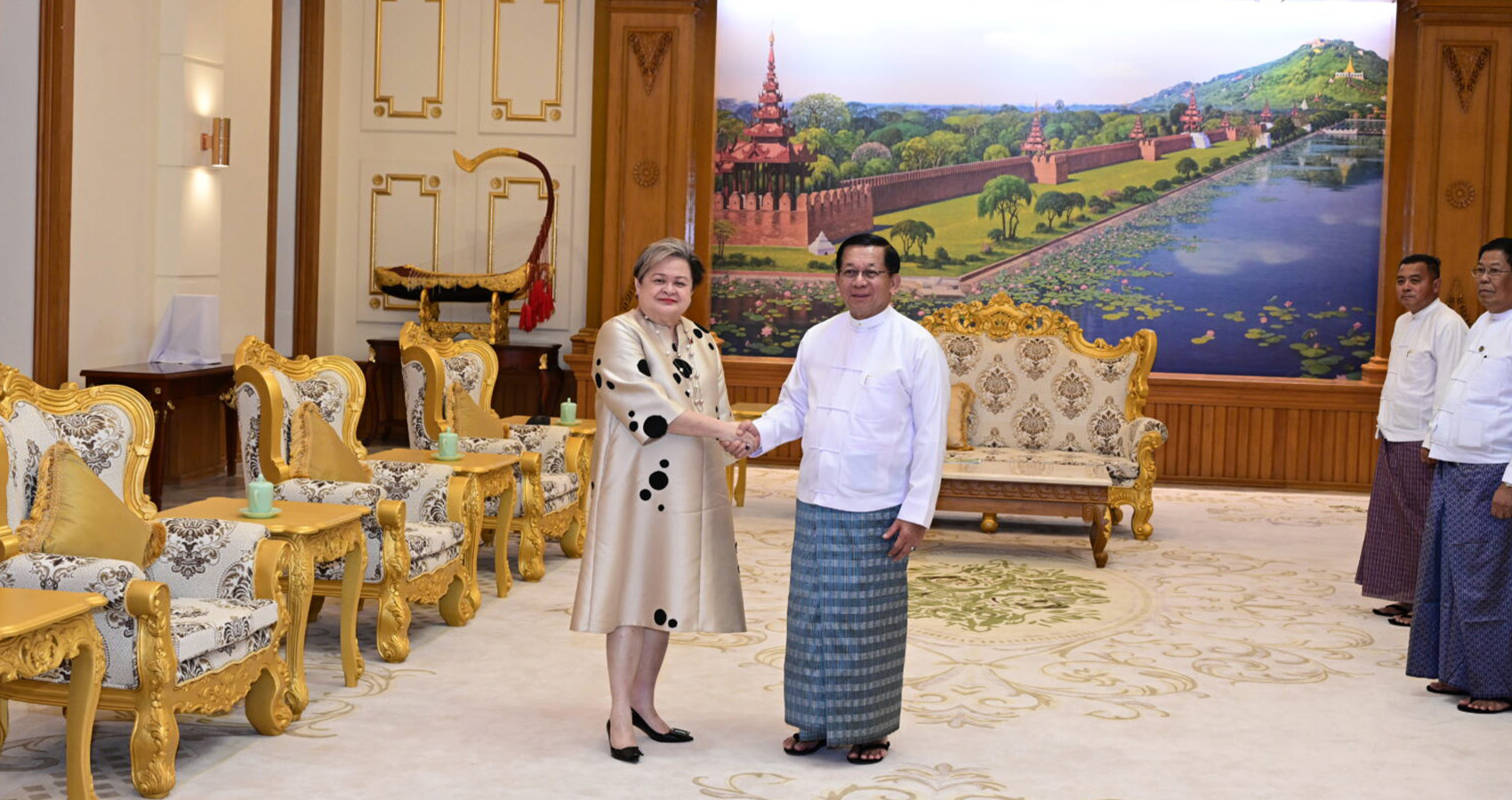
Everything about the surprise visit of Theresa Lazaro—the foreign secretary of the Philippines and special envoy of the Association of Southeast Asian Nations (ASEAN) chair—to Naypyitaw, and her meeting with junta leader Min Aung Hlaing, is deeply problematic. The talks reportedly addressed Myanmar’s conflict, the regime’s disputed elections, and ASEAN’s Five-Point Consensus (5PC).
The trip was more than a surprise; it was shocking. It revealed a troubling lack of strategic grounding in ASEAN’s own agreed norms and sequencing for addressing the Myanmar crisis. Far from advancing peace, the visit risks signaling not only the premature normalization of military rule in Myanmar, but also a dangerous erosion of ASEAN’s coherence, leverage and institutional credibility.
To begin with, the timing was profoundly wrong.


Wrong timing, wrong signal
Lazaro’s first mission to Myanmar as the ASEAN chair’s special envoy took place amid an unfinished, three-phase election process organized by the junta. Whatever her intentions, the practical effect of stepping into the middle of this process is to tilt ASEAN toward endorsing and legitimizing polls conducted under conditions of war, coercion and exclusion.
This runs directly counter to ASEAN leaders’ most explicit guidance. In the ASEAN Leaders’ Review and Decision on the Implementation of the Five-Point Consensus, adopted in Kuala Lumpur on Oct. 26, 2025, leaders stated unambiguously: “We emphasize that the cessation of violence and inclusive political dialogue must precede elections.”
The first phase of these fabricated elections was meant to be the easiest for the regime to stage. Voting occurred in townships that Naypyitaw claims to control firmly, selected to impress foreign “observers” and international media. Even there, the exercise became a conspicuous failure.
Turnout was so low that the polls became a non-event. While the regime announced a figure of 52 percent, journalists and informal citizen observers consistently reported participation rarely exceeding 20 percent at visible polling stations. Leaked information from insiders in Naypyitaw—so-called “watermelons”—suggests genuine turnout may have been closer to 15 percent, with the remainder digitally manufactured through opaque “advance voting” mechanisms.
Parties other than the junta-backed Union Solidarity and Development Party were humiliated by collaboration. Despite accepting the stigma of betraying public trust merely to operate, they were still defeated everywhere through fabricated “advance votes.” The few foreign “observers” who appeared were low-ranking and insignificant; their itineraries often consisted of little more than courtesy meetings with Min Aung Hlaing, rendering the notion of observation almost farcical.
Meanwhile, resistance forces conducted multiple operations during election days, underscoring that the junta has not regained control and that opposition momentum remains strong. International media coverage largely reflected this reality, emphasizing that the regime is not regaining control through electoral theater.
Given such underperformance, it is now uncertain whether the regime can conduct a second phase to the extent it announced, and highly unlikely that a third phase will occur in any meaningful form.
This was the context of Lazaro’s arrival. The elections had already been exposed as fraudulent, yet Min Aung Hlaing desperately needed to project normality and control. The visit offered him precisely that opportunity.
Engaging a likely ICC defendant
The timing is further compromised by looming international legal developments.
In November 2024, International Criminal Court (ICC) Prosecutor Karim Ahmad Khan requested an arrest warrant for Min Aung Hlaing, alleging criminal responsibility for crimes against humanity, including the deportation and persecution of the Rohingya population in 2017. Victims, Myanmar civil society organizations, international human rights groups, and Myanmar’s UN Ambassador Kyaw Moe Tun have called for swift judicial action.
There have been indications that the ICC’s Pre-Trial Chamber review could take place as early as February this year. In this context, basic diplomatic prudence—and consistency with ASEAN’s stated concern for civilian protection and accountability—would have counseled restraint before conferring high-level visibility on a figure who may soon face international justice.
When envoy practice erodes leverage
During the visit, Lazaro stated that the Philippines would build on previous efforts to advance the 5PC. Yet the visit itself departed from the engagement principles ASEAN leaders reaffirmed only months earlier.
The October 2025 Leaders’ Decision stressed the importance of inclusive engagement with all relevant stakeholders, close coordination among current, previous and incoming ASEAN chairs, and consistency and continuity in implementing the 5PC.
These were not procedural formalities; they were safeguards designed to preserve ASEAN’s unity and leverage after years of non-compliance by the Myanmar military.
It remains unclear whether ASEAN partners—particularly Malaysia and Indonesia, whose envoys invested significant political capital in building carefully balanced engagement formats—were fully consulted before Lazaro’s visit. Neither the National Unity Government nor ethnic revolutionary organizations were informed in advance. They were caught off guard, as were the people of Myanmar, when junta media published images of Min Aung Hlaing warmly shaking hands with the ASEAN special envoy.
Beyond Myanmar, the implications for ASEAN itself are serious. High-level, publicly framed engagement with Min Aung Hlaing in Naypyitaw risks signaling—intentionally or not—that Myanmar’s military leadership may be on a pathway back toward full political representation within ASEAN, including participation at summit level.
Since October 2021, ASEAN’s decision to exclude the junta from summits and ministerial meetings—while allowing only non-political representation—has been its clearest and most consequential leverage point. Actions that blur the line between facilitation and recognition weaken that leverage, create dangerous ambiguity about the conditions for re-admission, and risk conveying that continued violence and obstruction may ultimately be rewarded with restored access to ASEAN’s highest decision-making forums.
Ceremonial recognition is not mediation
The format of the meeting compounded the problem. Lazaro spoke of facilitating dialogue with all parties, yet the visit treated Min Aung Hlaing as if he were the head of a legitimate central government.
Photographs were staged in the opulent, kitschy interiors of Naypyitaw’s pseudo-imperial palaces. The imagery conveyed confidence, normalcy and authority—not mediation. This is the opposite of what ASEAN leaders described when they emphasized trust-building, neutrality and inclusive dialogue.
A genuinely balanced approach would require comparable, publicly visible engagement with all sides of the conflict. Indonesia and Malaysia previously demonstrated this discipline. Their envoys communicated planned visits in advance and ensured prompt meetings with senior National Unity Government (NUG) representatives. When Malaysian Prime Minister Anwar Ibrahim, the previous holder of the ASEAN chair, met Min Aung Hlaing in Thailand—deliberately avoiding Naypyitaw—he immediately followed it with an online meeting with NUG Prime Minister Mahn Winn Khaing Thann.
That approach protected not only balance among Myanmar stakeholders, but ASEAN’s own credibility.
Myanmar society has already expressed its will clearly: through nationwide silent strikes, through 1.7 million online votes rejecting the electoral farce, through sustained protest, and through the refusal of genuine political forces to legitimize military rule.
Do no harm
Lazaro has said she remains committed to ending violence, promoting dialogue and expanding humanitarian assistance. Yet ASEAN leaders themselves have acknowledged the lack of substantive progress by Myanmar’s military authorities and have repeatedly reaffirmed that violence reduction and inclusive dialogue must come first.
Accepting sham elections violates the most basic principle of doing no harm. Normalizing fabricated results will not de-escalate the conflict; it will escalate it. For the junta’s hardliners, elections are not a compromise mechanism but a tool to gain legitimacy, time and resources to pursue intensified war.
Whitewashing atrocities—however unintentionally—is not mediation. It is appeasement, and it undermines both Myanmar’s prospects for peace and ASEAN’s institutional authority.
Restoring ASEAN’s credibility
The damage caused by the Naypyitaw visit is not irreversible, but it requires swift correction.
First, the ASEAN chair’s special envoy should undertake publicly visible engagement with the NUG and ethnic revolutionary organizations, at a level and in a format comparable to her engagement with the junta.
Second, ASEAN should clearly and publicly affirm that it does not endorse or recognize electoral outcomes conducted under conditions of ongoing violence, coercion and exclusion. Silence risks being exploited as consent.
Third, the special envoy should explicitly reaffirm ASEAN’s agreed sequencing under the 5PC: meaningful reduction of violence and inclusive political dialogue must precede any electoral process.
Without such corrective action, the risk extends far beyond Myanmar. What is at stake is ASEAN’s ability to uphold its own decisions, preserve its leverage and remain a credible regional actor whose words are matched by disciplined practice.
Igor Blazevic is a senior adviser at the Prague Civil Society Centre. Between 2011 and 2016 he worked in Myanmar as the head lecturer of the Educational Initiatives Program.