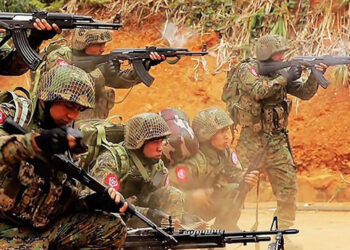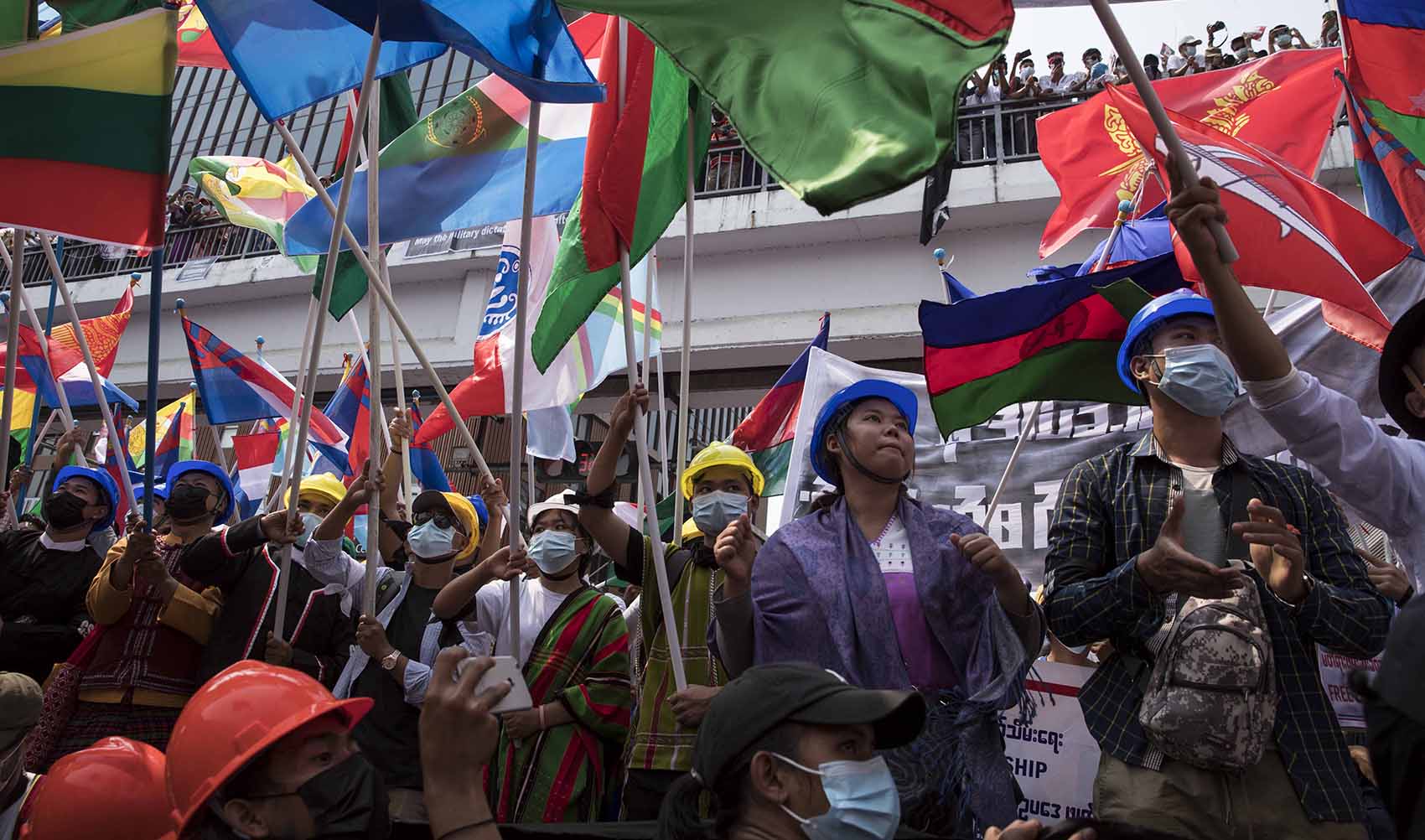
The military coup of February 2021 and the popular uprising it sparked broke the fragile constitutional order created under the 2008 charter. What started as a peaceful protest quickly turned into widespread armed resistance—a conflict often called a civil war.
But to characterize it solely as a civil war is to overlook a crucial defining feature of this era: Myanmar is undergoing a profound and irreversible political transition toward a federal democracy. This transition is not a peace process or a managed negotiation. It is a violent, decentralized, and bottom-up state-formation project rooted in the total rejection of the Bamar-centric, centralized military state.
The current moment is defined by three overlapping and mutually reinforcing dynamics: the systemic collapse of the military junta’s central administrative control, the institutionalization of parallel federal structures by the resistance forces, and the unprecedented territorial expansion and functional collaboration among ethnic armed organizations (EAOs) and People’s Defense Forces (PDFs). The convergence of these factors demonstrates that the future state, irrespective of the timeline, will be fundamentally different, decentralized, and federal.


Collapse of central authority
The key requirement for any major transition is the collapse of the current power structure. Since 2021, the junta has lost effective administrative control over large parts of the country, and this loss of control signifies the erosion of the state apparatus itself.
The Civil Disobedience Movement (CDM) immediately after the coup effectively shut down public administration. Teachers, doctors, railway workers, and thousands of civil servants left their posts, refusing to work for the junta. This was not a temporary strike but a complete break between the state and its officials. Without state personnel, the junta has struggled to collect taxes, provide public services (including healthcare and education), or administer justice outside major cities and key garrison towns.
The vacuum created by the CDM and the increasing frequency of attacks by resistance forces on police stations, local administration offices, and junta supply lines has fatally undermined the junta’s authority. Its main attention shifted from governance to survival and protecting strategic assets.
What governance there is takes the form of repression—and when the state’s only way of interacting with its people is through violence, it loses legitimacy and the ability to govern effectively. This absence of administrative presence, especially in areas now controlled by resistance groups, shows a collapse of the state that calls for the creation of new governing bodies—the key feature of a political transition.
Erosion of military dominance
For decades, the military held undisputed power, and the 2008 Constitution formalized this dominance. But the current conflict has revealed significant vulnerabilities. Operation 1027, launched by the Brotherhood Alliance of the Arakan Army (AA), Myanmar National Democratic Alliance Army (MNDAA) and Ta’ang National Liberation Army (TNLA) in late 2023, showed a level of military coordination, strategic planning, and success that was previously unimaginable.
Their gains revealed the junta’s inability to defend important towns, border crossings, and even regional command centers. The loss of border trade points, along with the successful defense of resistance-held areas, has both demoralized junta forces and severely limited the junta’s revenue streams, further weakening the central government’s ability to project power or rebuild its administration. When the military—the very foundation of the central government—is clearly losing ground and legitimacy, the shift to a new form of state structure becomes inevitable. The conflict really becomes about dismantling the centralized military apparatus that supported the 2008 system.
Institutionalization of parallel structures
The case for a federal transition is strengthened by the development of political alternatives. Unlike previous uprisings that lacked political coordination or a unified vision for a post-conflict state, today’s resistance has clearly outlined, agreed upon, and started to implement a framework for a future federal democracy.
The National Unity Government (NUG), formed by elected lawmakers and representatives of the resistance, functions as a legitimate alternative executive body. There is also a broader coalition, the National Unity Consultative Council (NUCC), which brings together the NUG, a diverse range of EAOs, civil society organizations, and various revolutionary forces.
The NUCC is committed to creating the foundational documents for the new state, and its Federal Democracy Charter represents the clearest ideological commitment to federalism in Myanmar’s history. It acknowledges the principle of self-determination and the right of constituent units to govern themselves, fundamentally diverging from the Bamar-centric unitary state model of the past. The consensus reached on this charter, despite historical mistrust between Bamar democracy activists and EAOs, marks a significant political turning point.
From resistance to public administration
The most persuasive evidence of this transition is the move from solely military resistance to the creation of public administration bodies. In areas controlled by the NUG and its PDF allies, often working in conjunction with EAOs, structures are being established to provide basic governance.
They are forming local councils, managing security, and trying to coordinate relief efforts, effectively replacing the functions of the vanished junta administration.
Parallel judicial structures are also emerging, aiming to dispense justice and enforce the rule of law under extremely difficult conditions. This replacement of the junta’s courts, which are viewed as illegitimate tools of repression, is a direct challenge to state sovereignty.
Revolutionary schools and clinics, often backed by the NUG or EAOs, are providing crucial services, further widening the physical and psychological gap between the people and the junta.
These parallel structures are the nascent units of a decentralized, federal system. They are being built by necessity, not by decree, and demonstrate a practical commitment to local governance and self-management, the cornerstones of federalism.
The decentralizing power of EAOs
The political path of Myanmar has traditionally been influenced by the aspirations of its diverse ethnic groups. The current change is mainly driven by the new stance of the EAOs, which have taken the opportunity to claim territorial control and political independence on an unprecedented level.
Powerful EAOs, such as the Karen National Union (KNU), the Kachin Independence Army (KIA), the Karenni National Progressive Party (KNPP), and especially the AA have consolidated and expanded their control zones, often called “liberated areas.” These regions operate as autonomous political entities, with established administrative systems, strong tax collection, independent justice systems, and effective defense forces.
The AA for example has established a sophisticated governance structure in Rakhine State, managing civil affairs and providing stability in areas where the junta has been marginalized. This is an exercise of sovereignty, driven by the principle of ethnic self-determination. The transition to federalism is therefore not just a political ideology adopted by the Bamar resistance but a political reality in the territories of the EAOs.
Military and political unification
Crucially, the coup provided the catalyst for unprecedented coordination between the Bamar heartland resistance and the long-established EAOs. This coalition is structurally federal. While the NUG attempts to provide overarching coordination, the EAOs maintain operational independence within their respective territories, training and equipping PDFs while simultaneously achieving their own strategic goals of territorial consolidation.
This de facto federal military structure unifies the core goal of overthrowing the junta but decentralizes command and control based on regional ethnic autonomy. The political price for this military cooperation is the guaranteed establishment of a federal state where EAOs retain control over their territories based on genuine decentralization and equity.
Ideological paradigm shift
The 2008 Constitution was the ultimate expression of the unitary, centralized, Bamar military state, granting the military veto power over any constitutional change and enshrining military dominance. The current revolution is defined by the complete abandonment of this paradigm.
The Federal Democracy Charter calls for a multi-ethnic, multi-party federal union founded on democracy, equality, and the right to self-determination for its constituent units. This ideological shift signifies a political victory that cannot be undone, no matter the outcome of the conflict. Even if the junta remains in control, the concept of a centralized, Bamar-dominant state has been ideologically defeated in the minds of most of the population and the armed resistance.
The resistance’s political imagination is now permanently focused on:
- Constituent unit autonomy: Granting meaningful legislative, executive, and judicial powers to regional and state governments.
- Fiscal federalism: Ensuring revenue-sharing mechanisms that empower states and allow them to manage their own economic development.
- Multi-ethnic representation: Establishing political institutions at the federal level that guarantee fair representation for all ethnic groups, ending the historical marginalization of non-Bamar peoples.
The physical fighting is the means to enforce this political reality.
Painful transition
Myanmar’s political transition to federal democracy is undeniably brutal, non-linear, and faces immense challenges, including a worsening humanitarian crisis, the potential for state fragmentation, and the sheer destructive power of the military junta.
The regime is not defeated and will continue to fight fiercely for its survival. However, the evidence strongly suggests that the transition is already in motion and is fundamentally irreversible—and being violently implemented on the ground. The collapse of the junta’s administrative power has created a vacuum, and the revolutionary forces are filling it with nascent, decentralized structures committed to federalism.
The political question, then, is simply how many more lives must be lost before this new political reality is universally accepted and established. The current armed conflict is the bloody birth of a genuinely federal, democratic union.
Khin Maung Win is a freelance journalist and observer of constitutional and ethnic affairs. He was a member of the Federal Constitution Drafting Committee of the Democratic Alliance of Burma/National Council of the Union of Burma from 1990 to 2000.