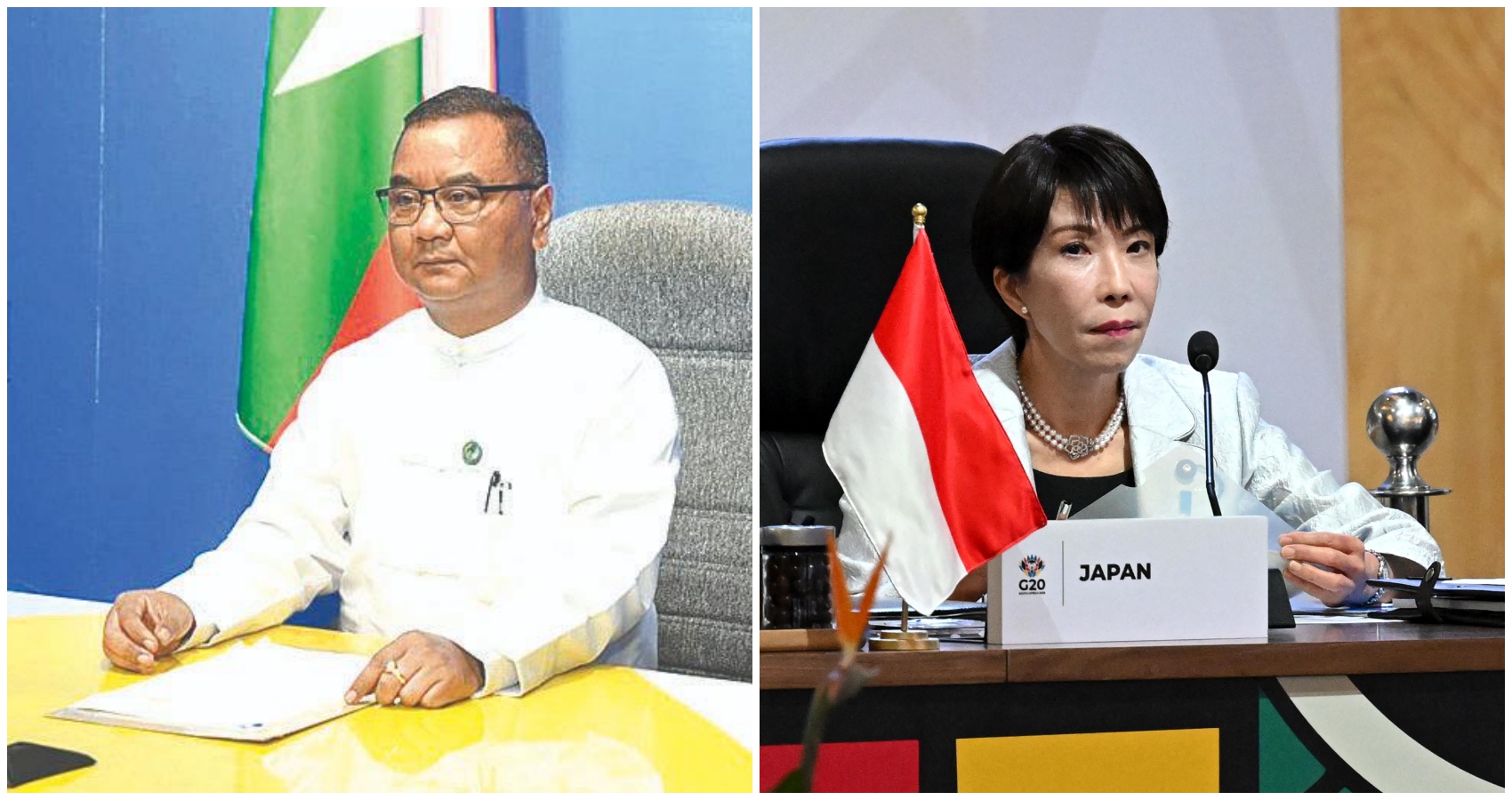
Myanmar’s military regime has joined Beijing’s condemnation of Japanese Prime Minister Sanae Takaichi’s recent remarks on Taiwan, reaffirming its adherence to the One China policy and its loyalty to Beijing as tensions between China and Japan escalate.
Junta spokesman Zaw Min Tun not only publicly stated the regime’s stance on its propaganda outlets but also told China’s state-run Xinhua on Saturday that Takaichi’s comments showed “no lessons learned from history” and “no remorse” for Japan’s wartime crimes across Asia, including Myanmar.
“Myanmar firmly condemns any possible resurgence of fascist tendencies in Japan,” said Zaw Min Tun, the public face of an army widely viewed as “fascist” by Myanmar civilians.


Zaw Min Tun accused Tokyo of encouraging “Taiwan independence” forces and reiterated Myanmar’s adherence to the One China policy, a position coup leader Min Aung Hlaing has repeatedly reaffirmed during his meetings with Chinese leaders.
The spokesman stressed that Myanmar respects China’s sovereignty and territorial integrity, values its “comprehensive strategic cooperative partnership” with Beijing, and will continue to support China’s efforts to safeguard national unity.
His remarks were not only reported by Xinhua, but also amplified by the Chinese Embassy in Myanmar, which welcomed Zaw Min Tun’s condemnation of the recent “erroneous remarks by the Japanese Prime Minister.”
China has already escalated the feud with Tokyo to the United Nations, warning that any Japanese armed intervention in the cross-Strait crisis would be “an act of aggression.” The row began after Takaichi told Japan’s legislature, the Diet, on Nov. 7 that a Chinese blockade of or attack on Taiwan could trigger a Japanese military response—remarks that drew immediate protests from Beijing.
The dispute has since spiraled into a trade war. China issued a no-travel advisory for Japan, and stepped up coast guard patrols near the disputed Senkaku/Diaoyu Islands. Tokyo condemned the “violation” of its waters, while both sides summoned ambassadors in tit-for-tat protests.
Taiwan is regarded by Beijing as a rebel region that must be reunited with the mainland, by force if necessary. The island has formal diplomatic ties with only a handful of countries due to China’s insistence that nations cannot recognize both Beijing and Taipei. Yet Taiwan, officially the Republic of China, has become one of Asia’s major economic players and a global leader in computer technology, with the US as its most important de facto ally.
In September, Min Aung Hlaing traveled to Beijing at the invitation of Chinese President Xi Jinping to attend a military parade marking the 80th anniversary of Japan’s defeat in World War II. During that trip, he pledged firm support for the One China policy—now reaffirmed by Zaw Min Tun.
Many Myanmar citizens quickly pushed back online against Xinhua’s coverage and the Chinese Embassy’s Facebook posts, noting that the junta does not represent the people. Commenters stressed that it was the military—not the public—condemning Japan, and argued that ordinary citizens in fact condemn China’s support for the regime rather than share Beijing’s stance on Taiwan.
The junta similarly voiced support for Beijing’s One China policy in August 2022, when then-US House Speaker Nancy Pelosi visited Taiwan. At the time, the regime declared its full backing for the One China principle and described Taiwan as an inseparable part of China.
Analysts note that Beijing has not yet extended the level of military, financial and technological support the regime hopes to secure from it, suggesting the junta’s statements were aimed at currying favor with Beijing.
Since seizing power in 2021, the internationally isolated regime has leaned heavily on Beijing. Japan, meanwhile, has downgraded diplomatic ties with the junta and maintained contacts with Myanmar’s pro-democracy forces.
Following the junta’s heavy defeats in northern Shan State in the anti-regime Operation 1027, it lost control of more than 80 towns across Shan, Rakhine, Kachin, Karenni, Karen and Chin states and central Myanmar. In response, China stepped in with financial aid, weapons and technical support. The regime, in turn, pledged to back the One China policy and prioritize China-Myanmar Economic Corridor projects, while joining China’s anti-fraud efforts and declaring it a “national duty” to fight online scam operations.