Thailand’s view of Myanmar as a single, unified state no longer reflects the federalized political landscape emerging over the border, according to a top Thai scholar.
Dr. Fuadi Pitsuwan, a lecturer in International Relations at Thammasat University’s Faculty of Political Science, added that Thai policy makers tend to see Myanmar – and especially the border – through a security lens.
This ignores political and economic changes that are reshaping the country, including its frontier with Thailand, the Oxford-educated academic said.



“By that, I mean the emergence of [autonomous authorities in] Karen and Karenni states, which are now providing social services and economic planning.”
Situated in southeastern Myanmar along the border with Thailand, both states are under partial resistance control. Fuadi refers to the resistance-held areas as mini-states or statelets. In Karenni State, the resistance has installed an Interim Executive Council to provide public services.
“Thailand has an option to help [the statelets] plan, stabilize, and shape their economies. You know, it could be Thai companies that operate those rare earth mines too,” he said, referring to the states’ rich mineral deposits. “There is potential benefit,” he added.
Thailand and Myanmar share a border of over 2,000 km. Decades of conflict have driven waves of Myanmar refugees into Thailand, the latest surge triggered by fierce fighting between the junta and ethnic armed groups following the 2021 military coup.
“We used to characterize [Myanmar] in terms of security supplies and the arms trade but I think that’s outdated. A more forward-looking and productive approach is to help these mini-states forge their own economic development, government, and administrative departments – which would benefit Thailand in the long run,” explained the academic, who also served as a foreign policy advisor to Thailand’s Move Forward Party, which has rebranded as the opposition People’s Party and now holds the highest number of parliamentary seats.
“I’m trying to push this idea that we should not view them simply as a security threat, but as economic opportunities.”
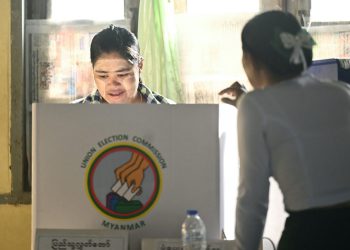
Faudi has no illusions about the junta’s planned December-January election, calling it a sham designed to legitimize military rule and ease international pressure.
“But it will happen.”
The Association of Southeast Asian Nations (ASEAN) has yet to decide whether it will send election observers to its renegade member for the first-phase vote on December 28.
Asked whether Bangkok would send observers, Fuadi said it may be hatching a compromise designed to keep all sides happy.
“But Thailand also faces pressure from its ASEAN friends. … So, maybe what we are seeing is a good cop-bad cop strategy coordinated with ASEAN. If we take the optimistic view, maybe there’s some calculation behind it,” Fuadi said.