The Union Solidarity and Development Party (USDP), the political arm of Myanmar’s military, is ramping up outreach to ultranationalist groups and pro-military communities as the newly rebranded junta prepares for nationwide polls in late December.
The push is seen as part of a coordinated campaign to mobilize election support, monitor anti-election activities, and quash dissent.
On Saturday, USDP chair Khin Yi met with pro-military artists in Yangon, urging them to promote public participation in the junta’s planned vote.
Khin Yi is one of a handful of people to have served in both the previous and current military regimes as well as the quasi-civilian government of former General Thein Sein in the early 2010s. He played a key role in junta boss Min Aung Hlaing’s 2021 coup, orchestrating dozens of pro-military rallies in the months leading up to the takeover.
Present at Saturday’s meeting were artists and celebrities known as staunch military supporters. Among them was Min Oak Soe, an actor, director and editor who was sentenced to life in 2014 for murdering a female editor of his magazine. Freed under a junta amnesty after the 2021 coup, he swiftly reinvented himself as an outspoken military loyalist, using social media to praise the regime while hurling insults and threats at anti-regime groups.
Saturday’s meeting followed at least two previous gatherings of military supporters at the USDP’s Yangon office. On July 31, Khin Yi met with prominent artists who have starred in junta propaganda films. A few days later, he met with hardline nationalists and called on them to show loyalty to the nation by backing the regime’s planned vote.
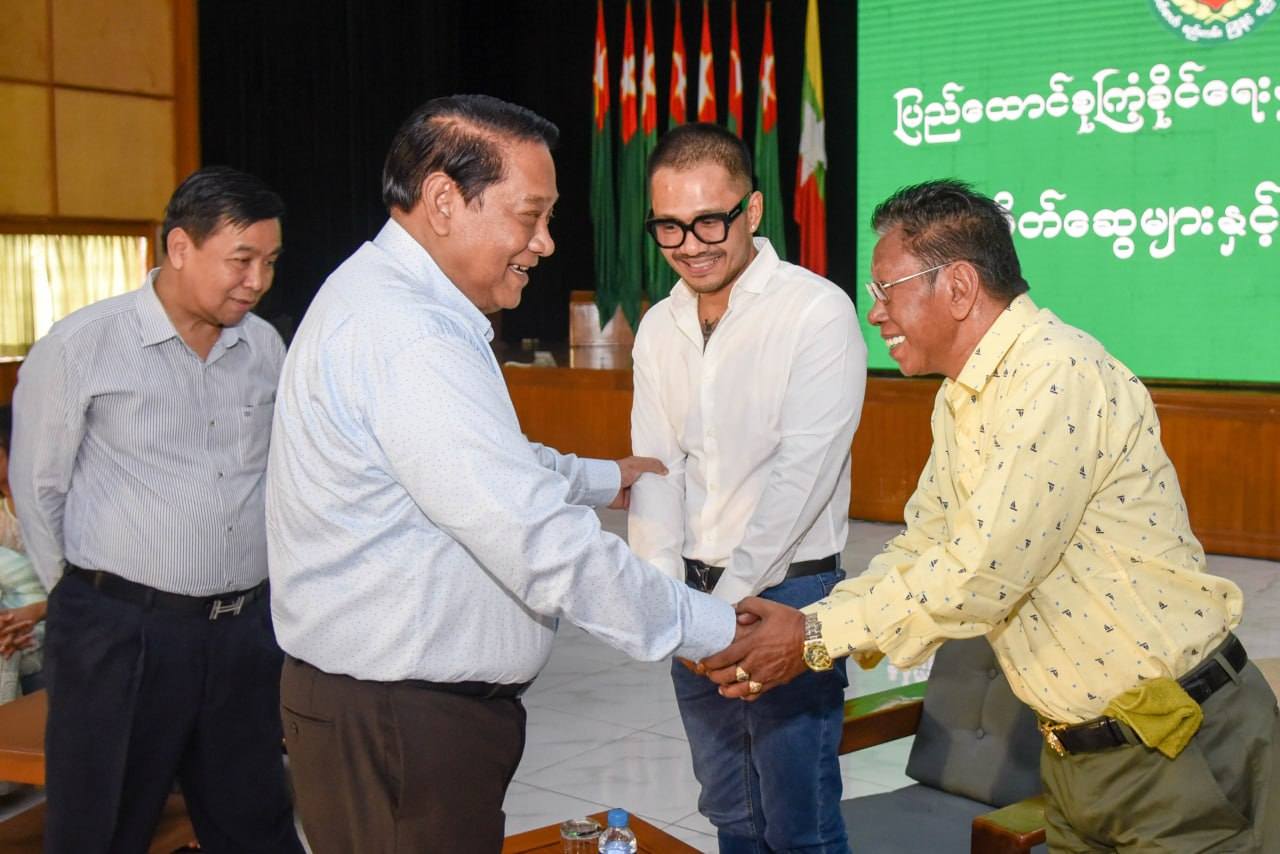
Among prominent ultranationalists present were Khin Waing Kyi, former Upper House lawmaker for the National Democratic Force party; Win Ko Ko Latt, disciple of firebrand monk U Wirathu; and Myat Phone Moh, who once praised the 2017 assassination of Daw Aung San Suu Kyi’s lawyer, U Ko Ni, at Yangon airport.
Those present at the meeting played key roles in Min Aung Hlaing’s coup—helping Khin Yi to stage pro-military protests against the 2020 general election result that paved the way for the takeover. Domestic and international observers declared the election free and fair.
The rallies targeted the Union Election Commission (UEC) after it announced a landslide victory for the National League for Democracy (NLD). Yet witnesses noted that the few hundred people mustered for each protest shouted only pro-military slogans.
During a pro-junta rally in downtown Yangon on February 25, supporters of the military beat and stabbed people after being booed by bystanders. A dozen people were injured in the attack.
The prominent nationalists wooed by Khin Yi were regulars at protests against the anti-regime Operation 1027, which saw junta forces almost eradicated from northern Shan State, rallies denouncing the Timorese president for engaging with the parallel National Unity Government; and gatherings backing the junta’s 2022 execution of four pro-democracy figures, including veteran activists Ko Jimmy and Ko Phyo Zeya Thaw.
Khin Yi referred to the ultranationalists and artists as “friends.”

The meetings fueled speculation that ultranationalists may be recruited for the poll’s security crackdown, serving on election supervisory committees under the junta’s Election Protection Law, enacted last month.
They could also be enlisted to monitor activities of local and foreign organizations during the vote, as required by the law, observers say. Under the law, punishment for actions deemed disruptive to the election range from three years’ imprisonment to death.
On August 12, Min Aung Hlaing ordered tight security for political parties and candidates during a regime meeting, following a string of assassinations targeting prominent junta supporters, and threats from resistance groups against election participants. The civilian National Unity Government says around 144 out of the country’s 330 townships are controlled by anti-regime groups while 79 townships report ongoing conflict.
Despite growing concerns, Khin Yi—buoyed by support from military loyalists and ultranationalist groups—declared at a Yangon press conference last Thursday that there is “nothing to worry about” ahead of the December poll.
Min Aung Hlaing has vowed to press ahead with the election “no matter what.”