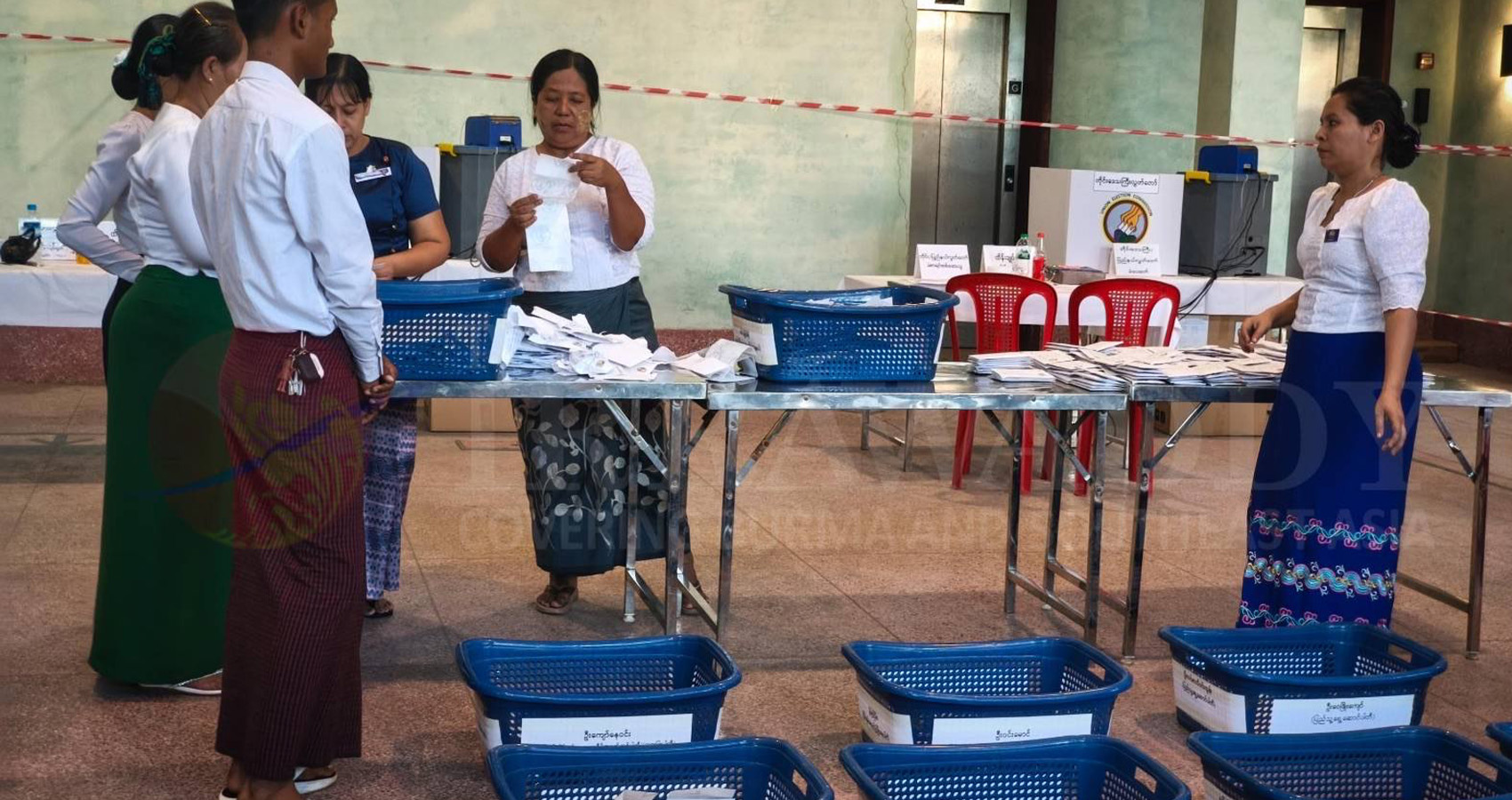
The Union Election Commission shows no sign of taking action over mounting complaints of advance voting irregularities in the junta-organized election, offering only assurances that procedures will improve in the remaining rounds.
At a meeting in Naypyitaw on Monday, political parties contesting the three-phase election raised complaints about irregularities in advance voting for the first phase, citing a lack of transparency and failure to follow electoral law.
The UEC promised improvements in the remaining phases 2 and 3, but party representatives said the body made no commitment to investigate or address problems that occurred in Phase 1, for which official results have already been released.
The first phase was held on the ground in 102 townships on Dec. 28 and was predictably won by the junta’s proxy Union Solidarity and Development Party (USDP), which took as many as 90 percent in the lower house, upper house and regional and state parliaments.
After their wipeout, the other parties complained that the USDP is fiddling the advance vote again—like it did in the heavily rigged 2010 election. Advance voting took place in October and November, and overseas voting in early December.
Candidates complained that they were not informed when absentee ballots arrived in their constituencies and were denied the right to observe the count. They also complained of irregularities in the way votes were handled.
“In my township, we received no notice at all” when or how advance votes were collected, said one candidate from Yangon. Citing the observably low voter turnout in many constituencies, he said he is suspicious that no-shows were counted as advance votes.
Kyaw Soe, a candidate from the Shan and Nationalities Democratic Party (SNDP) contesting Bago Region’s Yedashe Township on social media called the process “unfair” and “unilateral.”
“I totally reject it,” he said. “We were not told when ballots would be counted, and none of our representatives took part in sealing the ballots.”
Under election law, township election commissions must notify candidates when advance ballots from outside their constituencies arrive, keep them at the township police station, and count them in front of party representatives.
As for the collection of advance ballots from inside their constituencies, candidates are entitled to monitor the process. But contesting parties said these regulations were not followed.
Ye Tun, the chair of the 88 Generation Student Youths Party, said: “Almost every party reported irregularities they had experienced. The UEC promised improvements in Phases 2 and 3.”
Bago Region’s election commission chair said instructions have now been issued requiring advance ballots to arrive before 6 a.m. on polling day, and that late arrivals will be excluded from the count.
But election law requires advance ballots to reach the respective township election commissions no later than 4 p.m. two whole days before polling day.
Hnin Hnin Hmwe, a joint general secretary of the Democratic Party for a New Society (DPNS), described the advance vote as a tool the regime is using to ensure electoral victory. “The regime does not have legitimacy to organize elections, and the election commission is handpicked by the regime,” she said. “They’ve already repeatedly amended the election laws in favor of their party. How can the advance votes now arrive late?”
Independent monitoring group Data for Myanmar reported that the junta-backed USDP received more advance votes than any other party in Phase 1, winning over 340,000 ballots or a whopping 17 percent of its entire votes from these mysterious absentee voters.
In some constituencies, including Thandaunggyi, Bawlakhe and Hakha, the USDP secured more than half its votes from advance ballots.
The PP, SNDP and Myanmar Farmers Development Party (MFDP) have sent formal complaints to junta chief Min Aung Hlaing.