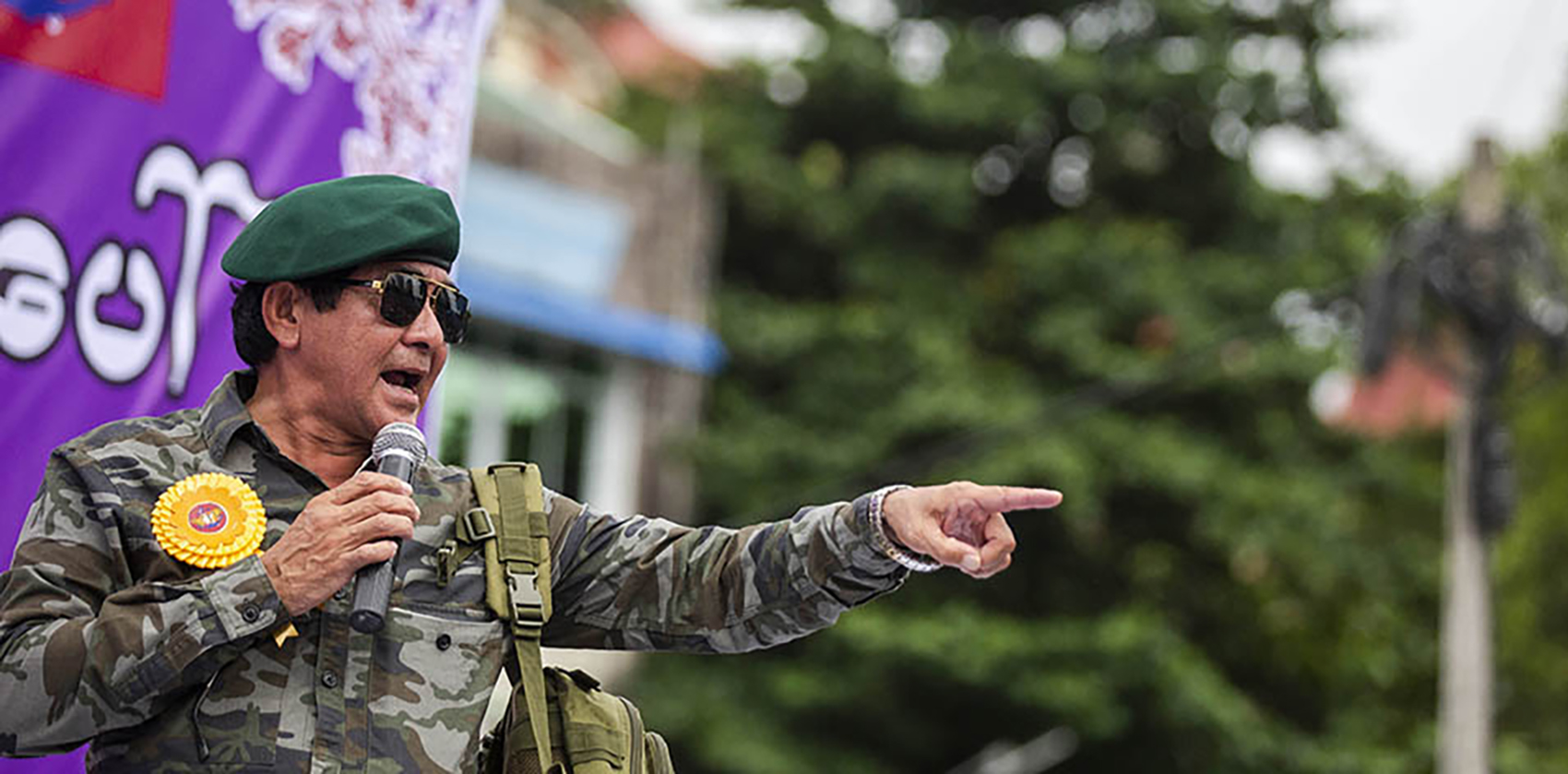
As Myanmar’s military-backed Union Solidarity and Development Party (USDP) steps up campaigning for the December-January election, its ties to the country’s hardline nationalists are becoming more evident than ever.
Ma Ba Tha has strong prospects [in the coming poll], said Hla Swe, chair of the party’s Naypyitaw chapter.
“Ma Ba Tha means the USDP, which is close to the nationalists,” he wrote in his Bullet Journal late last month.

Ma Ba Tha is a Burmese acronym for the Association for the Protection of Race and Religion, a Buddhist ultranationalist group founded under the USDP regime in 2012. It quickly became notorious for inciting communal tensions by organizing anti-Islam protests including boycotts of Muslim-owned businesses.
The group also successively lobbied USDP president Thein Sein to pass laws on race and religion that appeared to target Muslims by imposing restrictions on interfaith marriage, childbirth, polygamy, and conversion.
Hla Swe attempted to draw a parallel between Myanmar’s military rule and democratically elected right-wing governments elsewhere.
“Japan’s new prime minister is Japan’s Ma Ba Tha, Donald Trump is America’s Ma Ba Tha, and the USDP is Myanmar’s Ma Ba Tha,” he wrote.
The former Lt-Col went on to declare that the “liberal-minded NLD is dead,” referring to the National League for Democracy government whose leaders, including Daw Aung San Suu Kyi, were ousted and imprisoned by the military in 2021.
“There is no longer a place for liberalism in today’s world. Nations will now embrace only those who protect race and religion,” he added.
Underscoring the USDP’s renewed embrace of Ma Ba Tha, party chairman Khin Yi has been meeting frequently with nationalist figures. In August, he met ultranationalists such as Win Ko Ko Latt, a disciple of firebrand monk Wirathu; Myat Phone Moh, who cheered the 2017 assassination of Daw Aung Suu Kyi’s legal advisor U Ko Ni; and former Ma Ba Tha stalwart and lawmaker Daw Khin Waing Kyi, among others. The meetings focused on election-related coordination, according to reports.
In October, Myat Phone Maw posted a photo of himself shaking hands with Khin Yi on Facebook, writing, “Hand in hand… we will move forward together.”
As the official campaign period kicked off in late October, Ma Ba Tha nationalists targeted a Muslim candidate from the Labor Party in Yangon. They accused U Kyaw Thura (Mamed Anisuraman) of supporting the anti-regime Civil Disobedience Movement (CDM) and asked why he had not been disqualified by the junta’s election commission.
Pro-junta media outlets quickly amplified the accusations, and nationalist users flooded his campaign page with comments referencing his past use of the three-finger salute. It remains unclear whether the candidate ever supported the CDM.
In the days surrounding the 2021 coup, Ma Ba Tha members joined the USDP in organizing pro-military rallies in Yangon and Naypyitaw—events coordinated by Khin Yi, then the party’s vice-chair.
Criminal charges of inciting hatred and violence filed by the NLD government against ultranationalists including Hla Swe and Wirathu – dubbed the “Buddhist Bin Laden” – have been dropped since the military seized power.
Meanwhile, Hla Swe helped organize rallies supporting the junta’s execution of pro-democracy activists Ko Jimmy and Phyo Zeya Thaw in 2022, as ultranationalist mobs besieged the slain activists’ homes.
Another Ma Ba Tha monk, Pauk Kotaw, has been stoking ethno-religious violence under military rule, collaborating with pro-junta Pyu Saw Htee militias and invoking religion to justify persecution.
With the NLD barred and opposition groups suppressed, the USDP appears positioned to dominate the upcoming election — prompting fears that Ma Ba Tha could return to shape national policy under military patronage.
A Yangon resident said he was worried that ultranationalist groups could regain influence under a USDP government, triggering a resurgence of religious and racial conflicts.
“Blood is already being shed in the ongoing armed conflicts. I don’t want to see more blood spilled because of religious or racial strife. But these nationalists are aggressive and unpredictable, so it’s hard to feel reassured,” he said.
During the previous USDP administration, ultranationalist movements were behind a series of religious and racial riots—including deadly clashes in Mandalay Region’s Meikhtila in 2013—that saw mob killings and arson attacks. Yet Thein Sein’s government did little to suppress them.
Ultranationalists are also gaining influence through the Pyu Saw Htee, according to a political analyst, who described the junta-backed militia as essentially “Ma Ba Tha in uniform.” He added that Ma Ba Tha extremists move swiftly in whenever the military gives them room to operate.
“However, they have no real support among the public. If Ma Ba Tha were genuinely popular, the USDP wouldn’t even need to campaign. But most people will never vote for the USDP—they’re not even interested in the election,” he said.