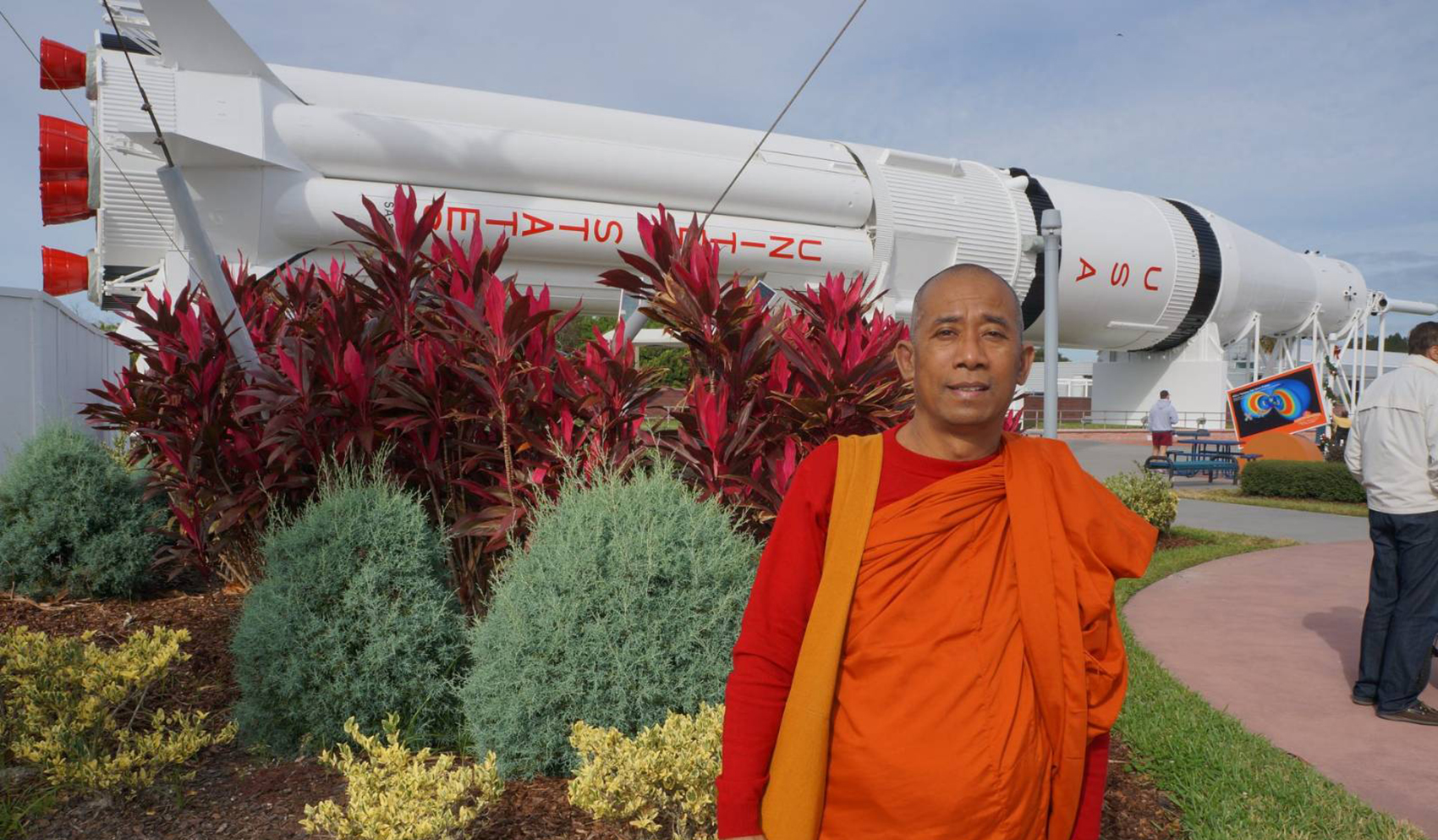
Buddhist monk Shwe War Yaung Sayadaw Nat Zaw, also known by his monastic name U Pyinnya Zawta, was released from Myanmar’s Insein Prison on Oct. 29 under a government amnesty after nearly a year in detention.
A leading figure in the 2007 Saffron Revolution and a founder of the Young Monks Union in Myanmar, he fled persecution after the crackdown on the monk-led protests and later became a US citizen. He now serves as the abbot of Metta Parami Monastery in Buffalo, New York.
In November 2024, he returned to Myanmar to conduct religious and charitable activities. While traveling in Yangon, his vehicle was intercepted and rammed by a car operated by military personnel, after which he was forcibly detained. He was charged under Penal Code Section 505(a), the Telecommunications Law, and Section 50(j) of the Counter-Terrorism Law, and sentenced to 15 years in prison.

During his eight-day interrogation at the Ye Kyi Ain military intelligence interrogation center, he was tortured and physically assaulted.
Now safely back in the United States, he spoke with The Irrawaddy about the circumstances of his arrest, detention and imprisonment.
Why did you come back to Myanmar?
The cool season had arrived, it was halfway through November. It was the clear, bright season — also the Kathina festival season.
One of my friends, a monk, was holding a Kathina celebration at his monastery and invited me to attend. So, to help with the monastery’s construction, I went to make some small donations and take part in the Kathina festival.
In my native village in Magwe Region, I used to perform many charitable works, mainly village electrification and road and school building projects. I went back to the country to complete that work. That was my main intention.
Why were you detained?
It appears that someone might have been monitoring me [in the US]—perhaps not. If so, then so be it.
Later, I officially applied for a visa at the Myanmar Embassy, and it was granted. When they informed me that the visa was ready to be issued, they asked when I would travel and whether I had already bought a ticket.
Around 2021 and 2022, there were small anti-junta demonstrations in my area [where he lived in the US]. In my region too, such protest activities were happening, so perhaps they were watching me. Still, I didn’t think I would be detained. I was only going for religious and charitable work.
When I arrived at the airport on Nov. 6, 2024, no one took me into custody. From Nov. 6 until Nov. 13, everything was fine. Since I wasn’t doing anything unlawful, nothing happened at first. But on Nov. 13, I was detained.
How did the junta detain you?
I had saved some money to help with the monastery’s construction. On that day, I was using part of that money—not all of it—for a school project.
Then I had another small matter to handle in South Okkalapa [Township in Yangon Region], so I went out again.
As I left, a car started following my vehicle. Whenever we changed lanes, that car did the same.
We were near Mingaladon, heading toward Yangon. At one point, I told the driver to turn toward the North Okkalapa Bus Terminal to run an errand. Our car turned inside, and the car followed us right in. I told the driver to go back while I inquired about bus tickets.
When I came out again, there was a taxi stand. I got into one of the taxis to go to North Okkalapa. When my taxi stopped, waiting for the traffic to clear, another car caught up with us and rammed us from behind.
That was when I was detained.
Men from the other car jumped out shouting, “Get down! Get down!” I got out as they ordered. They immediately blindfolded me, handcuffed me and forced me into their vehicle.
They had driven up and deliberately rammed the taxi I was in from behind. My taxi driver and I were shocked. My first thought was that it was a simple accident—but then I heard voices shouting, “Get out! Get out!” and realized it was an arrest. I was shocked.
After the detention, were you tortured in the interrogation center?
Because I was still in monastic robes, I was not beaten while wearing them.
I was detained on Nov. 13. By the night of Nov. 15, they pulled off my robes. That was nothing new—in the 1990s, I had seen senior monks disrobed, and now the same thing happened to me.
Once I was disrobed, the beatings intensified—continuing until I gave the answers they wanted.
But there wasn’t much to tell. I only spoke about the monastery construction that I was helping with. That was all I could explain.
The military interrogation lasted eight days, from Nov. 13 to 21. I was held at the Mingaladon Ye Kyi Ain interrogation center.
On the morning of Nov. 21, around 9 o’clock, an officer called me for questioning. I was kept on the lower floor of a two-story building; upstairs were staff and doctors—young men who stayed there.
I was confined downstairs in a holding room. They came and again covered my face right there, without telling me where I was being taken. With my face covered, they carried me into a vehicle.
Later, I realized they had taken me to the Aung Thapyay Guest Center, around the Eight-Mile, Thamine area. When I arrived, there were many staff inside—I didn’t see any ordinary prisoners.
They brought me to the upper floor and locked me in a small room for about an hour. The men were in civilian clothes. At noon, they gave me lunch.
Around that time, two officers appeared. I didn’t know who they were, but later I learned they were from Htauk Kyant Police Station. One of them was well-built; I can’t recall his name.
The officer who had brought me handed me over to the Htauk Kyant Police Station chief. Around 2:30 p.m., I was placed inside the Htauk Kyant police lock-up, where I was confined … from Nov. 21 to 26.
During that period, the next day was a weekend—maybe Friday or Saturday. The following day they brought me to the Mingaladon Township Court for the first hearing. It wasn’t a full trial yet, just a remand hearing. I was remanded in custody.
The next few days were another weekend, so the police didn’t question me until Monday. On Monday, they brought me again to court and extended my remand. When I appeared, they asked for my father’s name and other personal details.
On Nov. 26, I was transferred to Insein Prison and placed in a confinement cell.
Initially, the Mingaladon Special Court convicted me under Section 505(a) and sentenced me to three years, and under Section 13(1) to one year—a total of four years, plus a fine of 500,000 kyats [US$238].
Later, at the District Court, of the charges under Sections 50(j) and 52(a), [the one under] Section 52(a) was dropped and only Section 50(j) remained. After that, the court added 11 years to the sentence, for a total of 15 years’ imprisonment.
What did you see inside the prison?
Inside the prison, I observed three main groups of inmates.
First, the political prisoners—people charged under political sections, such as PDF [People’s Defense Force] members, protesters—including some with injuries—or those who had supported the resistance financially. They were the largest group.
Second, there were countless military and police deserters—soldiers and officers who had left their posts and were arrested, including those who had joined the Civil Disobedience Movement.
Third, the drug offenders—people imprisoned for selling narcotics. For every 10 inmates, about seven were drug-related cases.
How were you released?
Eventually, under Article 401(a) [of the Code of Criminal Procedure] the authorities announced a general amnesty, declaring that certain prisoners were being released “in consideration of friendship and goodwill between nations” and “on the basis of humanitarian sympathy.” The prison warden read the announcement aloud.