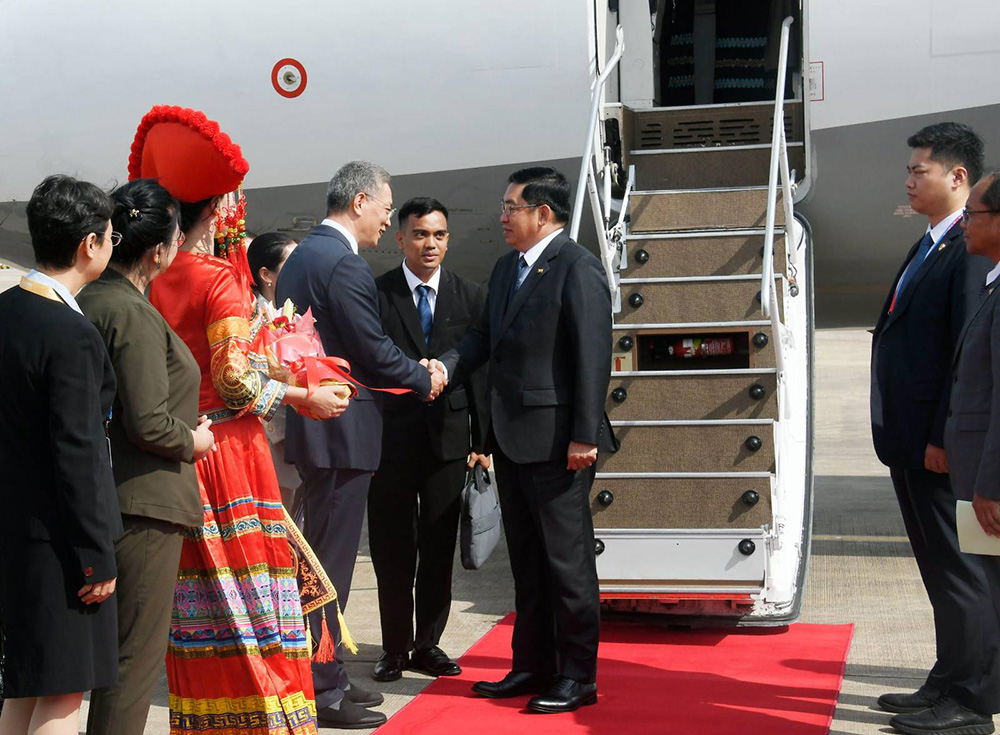
In mid-September, the Myanmar junta’s senior leadership staged a diplomatic “parade” in China. Over the course of a single week, at least eight officials—six cabinet ministers, the commander-in-chief of the navy, and the Central Bank of Myanmar (CBM) governor—crisscrossed Beijing, Shenzhen, Shanghai and Nanning for conferences, forums and “friendship visits.”
On the agenda: joint security operations, artificial intelligence cooperation, cross-border health data sharing, rural development, and progress on the China-Myanmar Economic Corridor.
This was no ordinary round of ministerial travel. It was a coordinated push to secure Beijing’s lifeline across every sector that matters for the cornered junta’s survival: finance, defense, industry, surveillance and diplomacy. Their agenda revealed that Naypyitaw is not just courting Chinese support, it is wiring Myanmar’s future into China’s digital and security order and also a strategic opportunity for Beijing to tighten its grip.



Digital trade and the corridor state
At the 22nd China-ASEAN Expo in Nanning, Myanmar regime Prime Minister Nyo Saw called for closer cooperation on digital trade, AI-driven logistics, and cybersecurity cooperation.
The rhetoric was polished, but the script was all too familiar. Myanmar was not welcomed as an equal stakeholder in regional digital trade; it was paraded as a corridor state, a conduit for Chinese infrastructure and data flows.
Beijing dressed up the Digital Silk Road as the backbone of ASEAN (Association of Southeast Asian Nations) connectivity, but for Naypyitaw the calculus was far more desperate. The generals do not seek integration to lift Myanmar’s economy—they seek China’s political shield at a moment of near-total international isolation.
This is why the glossy language of “connectivity” rings hollow. For Beijing, it means leverage: locking Myanmar’s networks, trade and surveillance capacities ever tighter into China’s orbit. For the junta, it means control: new tools to police dissent at home while clinging to Beijing’s patronage abroad.
Cross-border settlements in digital RMB
The most pressing agenda emerged in Shenzhen and Shanghai, where Myanmar’s central bank governor endorsed cross-border settlements in digital RMB at Huawei’s Digital Finance Summit and the Senior Finance Officials Meeting. For Naypyitaw, this was not about innovation or future-proofing—it was about financial survival. With sanctions cutting off access to global markets, foreign exchange reserves drying up, and the kyat in freefall, digital RMB payments appear as a narrow bridge to stabilize trade and remittances.
In practice, the CBM’s main agenda is to link Myanmar’s domestic CBM Net system with China’s Cross-Border Interbank Payment System (CIPS). In 2023, the Industrial and Commercial Bank of China (ICBC)’s Yangon Branch became the first direct participant in CIPS, enabling seamless yuan-denominated transactions across borders with Myanmar. This was only the first step; the CBM is not yet fully linked with CIPS.
By linking Myanmar’s domestic CBM Net system to CIPS, the junta gains a direct financial conduit to China, bypassing traditional Western-controlled channels like the SWIFT network. With Western sanctions restricting dollar-based transactions and targeting revenue streams such as natural gas exports, timber and other state enterprises, the junta has long sought alternative financial pathways to maintain its grip on power.
By integrating its financial arteries into China’s system, Myanmar risks surrendering its monetary sovereignty altogether. Beijing’s gain is strategic and enduring: a neighbor whose economy becomes inextricably wired into its digital currency.
Industrial dependence and technological lock-in
In Nanning, the Myanmar regime’s industry minister, Dr. Charlie Than, joined the China-ASEAN Digital Economy and Smart Manufacturing Forum, endorsing AI-powered production and energy systems.
Officially, this was a pitch for industrial upgrading. In reality, it showcased Chinese standards as the default regional model. Myanmar’s industrial sector, already stagnant and battered by conflict, has no domestic capacity to absorb or adapt these technologies independently.
What looks like modernization today could trap the country in a state of technological lock-in, where it becomes permanently reliant on Chinese systems it neither controls nor fully understands.
Health data and sovereignty
Even in health cooperation, a seemingly benign area, the same pattern holds. At the China-ASEAN Health Cooperation Forum in Nanning, Myanmar Health Minister Thet Khaing Win discussed collaboration on epidemic monitoring and AI-driven medical data sharing. The rhetoric was about collective security against future pandemics.
However, beneath the facade of health diplomacy may lie a quieter transaction: the possibility that Myanmar’s sensitive medical data could flow across borders into China’s biotech and AI ecosystems.
In a country with virtually no safeguards or regulatory infrastructure, Beijing could gain access to a cheap reservoir of health data to fuel its industries. Naypyitaw, for its part, stands to receive equipment, limited access, and rhetorical solidarity. Yet the exchange appears lopsided: Myanmar risks trading sovereignty over critical information for only marginal returns.
Education and workforce dependence
The education front reveals an even more subtle dimension of dependency. At the China-ASEAN Vocational Education Cooperation Conference, Myanmar’s deputy education minister, Dr. Zaw Myint, discussed collaboration on AI-integrated training platforms designed by China.
On the surface, this may appear to be a straightforward exercise in skills development.
But such initiatives could shape the very foundations of Myanmar’s future workforce, steering young professionals into systems and standards set by Beijing. What appears to be an investment in human capital may in practice become an investment in dependency at the intergenerational level.
Myanmar’s next wave of workers might emerge more adept with AI tools—but primarily with tools owned, operated and controlled by Chinese companies.
Defense and surveillance integration
One notable twist was Defense Minister General Maung Maung Aye’s meeting with Chinese arms manufacturers during Beijing’s most important annual defense conference, the Beijing Xiangshan Forum. It is a signal that military procurement and technological dependence are moving hand in hand. Accompanying him were other third-generation members of Myanmar’s military elite, including Home Affairs Minister Lieutenant General Tun Tun Naung, underscoring the generational stakes.
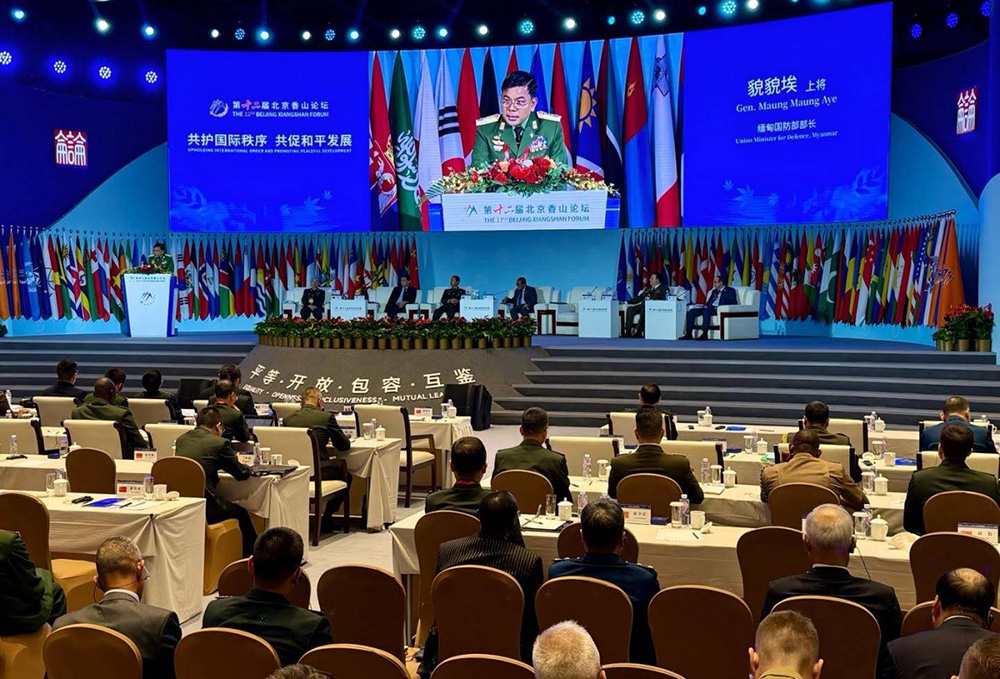
Perhaps the most alarming element of September’s diplomacy lay in the least-publicized meetings. Myanmar’s home affairs and defense ministers quietly convened with their Chinese counterparts to discuss “joint law enforcement” and “border security.” The jargon is familiar, but the implications are sharper: an expansion of Chinese surveillance exports into Myanmar. “Safe city” technologies, predictive policing software and electronic monitoring systems are not just tools of public order—they are instruments of repression.
Combined with China’s earlier support in 2024 for AI-powered personal monitoring, biometric tracking, and voter registration assistance, the trajectory is clear: the junta’s surveillance apparatus is becoming increasingly reliant on Beijing. For the military, these systems enhance its ability to monitor, intimidate, and silence dissent. They will not empower Myanmar’s citizens; they will empower the regime, offering a new digital shield for authoritarian control.
The pattern across all these forums is clear. For Beijing, Myanmar is a pliant partner willing to accept digital RMB, adopt Chinese AI tools, and serve as a showcase for the Digital Silk Road in ASEAN. For Naypyitaw, the agenda is about short-term survival: securing trade channels, technological assistance, and political cover. But the imbalance is stark. Beijing is building structural leverage that will outlast the junta. Myanmar is trading away long-term sovereignty for immediate relief.
Digital subordination
September’s diplomatic sprint reveals a stark reality: Myanmar’s ruling generals are trading long-term sovereignty for their own short-term survival.
The risks are clear. First, loss of digital sovereignty: financial systems, health records, education platforms, and industrial data increasingly fall under Beijing’s control. Second, entrenchment of authoritarianism: surveillance technologies and AI censorship empower the junta to crush dissent.
Third, geopolitical capture: Chinese standards dominate, locking Myanmar out of alternative alignments. Fourth, economic dependency without development: Myanmar consumes technology but cannot build its own innovation ecosystem. Fifth, regional security risks: Chinese surveillance extends across borders, alarming neighbors. Sixth, vulnerability to coercion: Beijing can restrict access or apply pressure at will.
For the regime, Chinese technology offers immediate survival; for Beijing, it builds structural control over Myanmar’s economy, security, data and workforce. For the country itself, it deepens dependency, narrows civic space and erodes sovereignty. Short-term relief for the generals comes at a long-term cost for the nation: Myanmar risks becoming digitally subordinate, its future shaped more by Beijing’s interests than its own.