China maintained a cautious distance from the unfolding crisis in the early phase of Myanmar’s Spring Revolution. Preoccupied with internal affairs—particularly President Xi Jinping’s term extension—and convinced that the Myanmar military would ultimately regain control, Beijing chose to observe rather than intervene throughout 2021 and 2022.
But that changed dramatically after the launch of the ethnic Brotherhood Alliance’s Operation 1027. As the Myanmar military suffered repeated defeats and began losing strategic urban strongholds, many observers started to suggest that the Myanmar military could ultimately collapse. China could no longer stay neutral. It began providing extensive support to preserve the junta’s position and became visibly entangled in Myanmar’s internal dynamics.
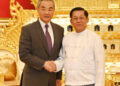
Within days of the fall of the Northeastern Command in Lashio, Chinese Foreign Minister Wang Yi was in Naypyitaw. During the visit, he met with junta chief Min Aung Hlaing, and voiced support for the regime’s political roadmap and election plan—pivoting from its previous endorsement of ASEAN’s Five-Point Consensus.


China also gave political legitimacy to the junta by inviting Min Aung Hlaing to the Lancang-Mekong regional meeting in Kunming, Yunnan Province. This provided a diplomatic platform for the junta boss, who is barred from ASEAN summits, among the five ASEAN countries in the Mekong sub-region. China’s efforts signaled a calculated push to help the junta rebrand as a civilian government through elections, paving the way for renewed recognition within ASEAN and the UN.
Economic lifeline: the $1 billion infusion
Beyond military and political pressures, the junta was facing a severe economic crisis. Soaring commodity prices, high inflation, and hard currency shortages had gripped the country. By mid-August 2024, when Wang Yi arrived, the junta was deeply mired in it.
Although reports surfaced that China provided financial aid or loans during Wang Yi’s visit, no official confirmation was released. Yet in the year following his trip, Myanmar’s foreign currency shortage mysteriously eased, fuel imports stabilized, and inflation slowed.
From August 2024 to mid-2025, the exchange rate hovered around 4,500 kyats per dollar—neither rising nor falling significantly. According to a credible source I spoke to in July 2025, China had given US$1 billion to the junta during Wang Yi’s visit. Analysts suggest this was not a loan but an advance payment for oil and gas pipelines operated by China. It offered relief both economically and militarily.
The junta has been able to launch counteroffensives in certain regions not because of conscription alone, but because of Chinese financial aid. Without such funding, operations would have stalled regardless of manpower.
Still, the regime’s budget deficit is projected to exceed 8,300 billion kyats in the 2025–2026 fiscal year, according to a junta media report on July 2, so China’s financial assistance only served as a short-term lifeline.

Military support and influence
China has long supplied the junta with military equipment, including fighter jets. After Wang’s visit, it reportedly sold it advanced drones as well. According to a July 16 report by the UN’s Special Advisory Council for Myanmar (SAC-M), state-owned China South Industries Group Corporation and two subsidiaries were involved in producing aerial bombs at the Myanmar military’s Ordnance Factory (KaPaSa) No. 21 in Seikphyu Township, Magwe Region. The Chinese firm reportedly supplies not only raw materials but also technicians and technology.
China’s support for the regime extended beyond arms sales and technical assistance—it actively worked to dismantle resistance coalitions. It disrupted alliances among the seven ethnic armed organizations (EAOs) in northern and northeastern Myanmar and the Brotherhood Alliance that launched Operation 1027.
China also obstructed cooperation between EAOs near the Chinese border and Spring Revolution forces like the National Unity Government (NUG) and People’s Defense Forces (PDF). It deployed police and intelligence agents to monitor border checkpoints in territory controlled by the United Wa State Army, preventing arms shipments from Wa and Mongla areas from reaching the western banks of the Salween River.
While the Myanmar military is known for its “four cuts” policy designed to sever insurgents’ access to funding, food, intelligence, and recruits, China applied “five cuts” by blocking supplies to the local population in areas controlled by EAOs as well.
This forced the Myanmar National Democratic Alliance Army (MNDAA) to halt its offensive in northern Shan State and return the strategic town of Lashio to the regime. The Ta’ang National Liberation Army (TNLA) also halted its offensives by late 2024, while onslaughts by the Kachin Independence Army (KIA) in Kachin State’s Bhamo and the Arakan Army (AA) in Rakhine State’s Kyaukphyu slowed significantly.
While pressuring EAOs, China allowed the junta to continue its war crimes—attacks on schools, hospitals, religious sites, and residential areas.
China’s pressure has fractured the Brotherhood Alliance. The TNLA has lost momentum, eventually surrendering Nawnghkio last week. China is now pushing for the return of other towns in northern Shan State to junta control.
Why does China help the regime?
China views the NUG and Spring Revolution forces as pro-Western democratic forces and sees the military junta, which is opposed by the West, as a more reliable strategic partner.
Since Donald Trump’s presidential win in the U.S. and his confrontational stance toward China, Beijing has prioritized forming anti-Western alliances. While Myanmar’s military receives support from Russia and China, Spring Revolution forces have struggled to secure meaningful aid from the West. Under Trump, U.S. assistance to war refugees and independent media has been significantly reduced.
China is also deeply concerned that Myanmar’s democratic movement could inspire similar uprisings on its own soil. The memory of the 1988 uprising in Myanmar and the subsequent 1989 Tiananmen Square protests in China remains vivid, and Beijing wants to avoid a repeat at all costs.
China also seeks to control all governments in countries it considers part of its strategic backyard, especially those in the Mekong region—Myanmar, Laos, Vietnam, and Cambodia. And it seems to believe that supporting the embattled junta would lead to a pliant government that will dance to Beijing’s tune.
From an economic standpoint, China also finds that the junta gives it much less trouble than a democratic government might. Whether in resource extraction or broader investment ventures, Beijing can negotiate more favorable terms with a regime in crisis. The junta’s desperation makes it more likely to accept deals at discounted rates, giving China privileged access to natural resources and strategic infrastructure.

Chinese assistance and its results
China’s support has enabled the regime to assert its push for election and peace talks, creating an illusion that polls—which are expected to provide the regime with a veneer of legitimacy— are the only solution to Myanmar’s crisis. China’s influence has also diluted ASEAN’s consensus, weakening regional pressure on the regime.
Economically, Chinese financial aid has enabled the junta to expand its military operations despite budgetary constraints. Thanks to Chinese support, the military has intensified offensives, including indiscriminate attacks on civilian targets such as hospitals and schools, leading to rising civilian casualties.
Militarily, China has facilitated ceasefires between the junta and ethnic armed groups along the border.
But the junta has resisted sharing revenues from border trade with these groups, undermining China’s hopes for its swift resumption. The regime’s refusal to recognize territorial losses and its inability to reclaim key towns further complicate the situation. China’s assistance will therefore prolong the conflict rather than resolving it.
As the junta’s defeats mounted, many in Myanmar including supporters of the military hoped for a palace coup. But China’s support has provided the regime with a breathing space, and entrenched the position of Min Aung Hlaing, reducing the likelihood of a mutiny.
And despite all that help, the military remains distrustful of China. This tension was evident at the June 2025 Peace Forum in Naypyitaw, where Chinese envoy Deng Xijun openly discussed China’s role in facilitating the return of Lashio. His remarks were met with muted responses from junta generals and USDP officials, reflecting unease over China’s growing involvement.
Many within the military believe China has overstepped the bounds, and suspect Beijing’s hand in the current crisis.
The junta has instead deepened its defense ties with Russia and Belarus, particularly in arms procurement and military technology. This pivot underscores its lack of trust in China.
Ultimately, China’s backing of Myanmar’s military regime may have postponed its collapse, but it has not delivered a viable long-term solution. The war continues to grind on, and China’s economic interests—particularly cross-border trade—remain stalled.
Worse still, Beijing now finds itself the target of mounting public opprobrium inside Myanmar. Its support has alienated large segments of the population and resistance forces, while the junta itself remains guarded and wary of Chinese motives. The relationship, far from strategic alignment, is riddled with mutual suspicion.
In the long term, Chinese assistance for the regime will only harm its interests in Myanmar, while prolonging the armed conflicts and intensifying the humanitarian crisis. Soon, China will see, for example, that the online scam syndicates it fears have risen again under junta protection in towns only recently reclaimed with China’s help—including Lashio.
Thet Htar Maung is a Myanmar affairs analyst