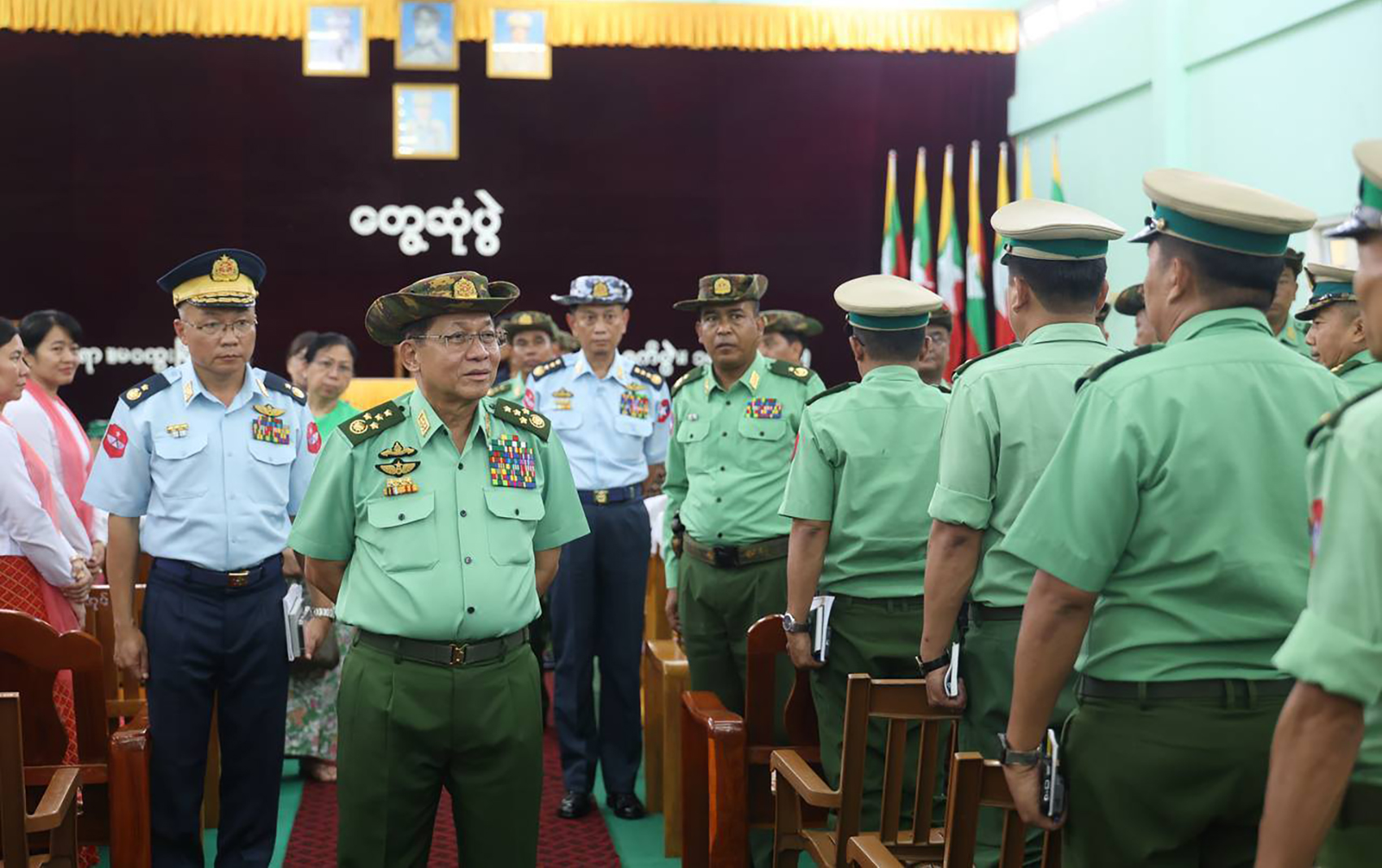
Myanmar junta boss Min Aung Hlaing has urged both military personnel and civilians to cast ballots “without fail” in a regime-organized election scheduled to be held in phases starting in December.
During a visit to Magwe on Monday, the junta leader met military personnel and their families at Central Command headquarters, as well as business owners and other local residents.
He urged them to “do the duty of a good citizen by casting a vote” and to vote for those with “capacity and commitment to national interests”.
As usual, he commended the Myanmar military and censured the elected government of the National League for Democracy (NLD), which he ousted in 2021. He criticized the NLD government for hiring foreign advisors, whose work he described as “foreign interference”, and accused it of “directly and indirectly inciting criticism of the Myanmar military.”
He said military appointees will play their part in parliament when the winning party takes office after the election, and that the military will continue to “safeguard the constitution”—confirming a widespread perception that the vote’s sole purpose is to lend the junta a veneer of legitimacy.
The 2008 Constitution was drafted by the military, for which it reserves 25 percent of seats in the national legislature.
The junta boss claimed that foreign countries support the poll, and that international observers would observe the voting.
Since last month, Min Aung Hlaing has been touring junta-controlled towns and cities—including Pyin Oo Lwin, Meiktila, Taungoo, Bago, Yangon and parts of eastern and southern Shan State—in what is being viewed as a campaign to rally support for the poll.
Despite his visit to Magwe, the region is one of the resistance’s strongholds in central Myanmar. Oil fields in northern Magwe are controlled by the resistance.
On August 15, the junta’s election commission announced electoral constituencies—330 for the Lower House, 110 for the Upper House, 364 for regional/state parliaments and 29 for ethnic minister positions. The constituencies include towns in resistance-held areas, which explains the junta’s intensified attacks on rebel-held towns as it seeks to enable voting there.
The regime has not yet announced a list of townships where it will not be able to hold voting.
During his Magwe visit, Min Aung Hlaing reiterated that the election would be held in phases due to instability across the country.