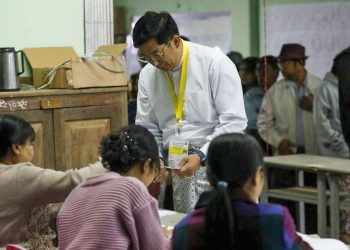
Locals in Sittwe report a disturbing rise in suicides linked to extreme poverty and hunger in the Rakhine State capital, where the military has imposed a sweeping blockade.
Between May and August, at least 14 people killed themselves in Sittwe, including two entire families, The Irrawaddy has learned.
The junta sealed off all land and sea routes to Sittwe in early 2024 as the ethnic Arakan Army (AA) was making gains throughout the state, leaving tens of thousands of civilians trapped with limited access to food or humanitarian aid.


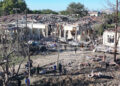
The junta also forcibly relocated villagers from outskirts into the town and barred minority Rohingya people from villages and refugee camps from leaving their shelter or working.
Many families survive on watery congee, which is typically made from inferior or broken rice.
In Min Gan Ward, a family of six reportedly took their own lives in June by eating poisoned congee. Neighbors said they had long struggled with poverty and lacked any support. “I heard they had been struggling and could not even afford to eat congee every day,” said a female neighbor.
Ko Maung Win, another Min Gan resident living with four relatives, described his family’s hardship. “If you don’t have a job, you don’t have food,” he said. “We’re surviving only because relatives outside the state are feeding us. If that stops, we’ll die too. We have no job here.”
In May, a struggling woman killed herself in Min Gan, and a Rohingya family of five in Thatkelpyin refugee camp took their own lives, according to a young Rohingya man from Sittwe who asked for anonymity.
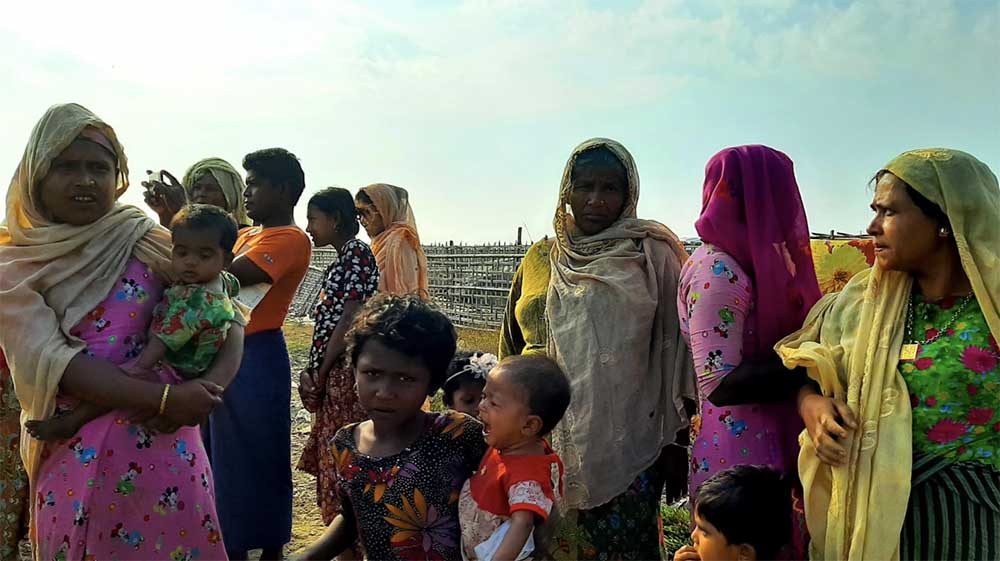
“People in the camps are starving,” he said. “We can’t fish, we don’t get rations like before. Everyone who’s still alive is just barely surviving. Malnutrition is everywhere. I believe there are more deaths than we know. We just don’t know because of communication blackouts.”
The regime has banned sea travel including fishing—the major source of livelihoods for residents in coastal Rakhine—for years.
On Aug. 4, two more deaths were reported at Mingala Nyunt Monastery in Ywar Gyi Myauk Ward, where a man and woman in their 50s who had taken refuge at the temple hanged themselves. Locals attributed their deaths to hunger.
The World Food Programme (WFP) issued a stark warning on Aug. 12 that food insecurity in Rakhine has reached alarming levels. In central Rakhine, the proportion of families unable to meet their basic food needs rose from 33 percent in December 2024 to 57 percent.
Families are being forced to take desperate measures to survive: rising debt, begging, domestic violence, school drop-outs, social tensions, and even human trafficking, the WFP reported.
Due to funding shortfalls, the WFP suspended aid to over 1 million people in Myanmar in April. The agency has called on international donors to increase humanitarian support and urged local authorities to allow unrestricted aid access.
While the regime has imposed restrictions on humanitarian operations, ongoing armed clashes have further disrupted the aid delivery.
Since the 2021 coup, basic commodity prices have skyrocketed in Myanmar. In Sittwe, where civilians make up roughly 75 percent of the population, food prices are now at least the triple those of the commercial capital Yangon.
Jobs are nearly nonexistent. A few residents work in the port or drive trishaws and motorbikes, but high fuel costs and low demand make these jobs unsustainable. One liter of fuel costs 25,000 kyats in Sittwe, compared to 3,000 kyats in Yangon.
Many families are only eating one meal a day, said a man in his 50s who makes a living as a rickshaw driver sheltering at a monastery.
“The daily wage I earn can only buy two or three tins of rice, but I need five tins for my family,” he said. “This is not just me. Many families around me are also struggling.”
Only a few wards in Sittwe have a phone signal, and that is unreliable. Those like Ko Maung Win, one of many who rely on remittances from relatives abroad, naturally fear losing contact.
“I’m not afraid of war,” he said. “I’m afraid of dying from hunger. If I lose contact with my relatives abroad, how will I eat? If that happens, I have decided to take my own life. I’m ashamed of myself for asking money from my relatives, but I can do nothing. There are no jobs here.”
Escape is nearly impossible. Brokers once charged between 500,000 and 2 million kyats per person to flee to Yangon or AA-controlled areas, but by mid-2024 even those routes were shut down entirely.
“We want to run, but it costs 1 to 1.5 million kyats per person. How can people who live day-to-day afford that?” said a woman from Chaung Nwe village.
Locals report that the junta raided around 20 villages on the outskirts Sittwe, killing civilians and forcibly relocating survivors to the town. Their homes were destroyed and military camps established in their place.
Sittwe hosts the state government office, the regional operations command, and a dozen junta battalions, including naval and engineering units. It also serves as the Western Command HQ, relocated from AA-occupied Ann.
On Aug. 14, the WFP’s Myanmar representative Michael Dunford met with Immigration Minister Myint Kyaing to discuss humanitarian access and the return of displaced persons. But aid remains blocked for most civilians in Sittwe and surrounding areas.
Meanwhile, over 100,000 Rohingya remain confined to camps and villages under military guard.
While the military reportedly stockpiles food for its own use, civilians—including Rohingya refugees—have gone without international aid for over six months. Occasional private donations offer limited relief.
The AA which now controls 14 of 17 townships in Rakhine, has so far only conducted limited attacks on junta positions in Sittwe Township over the past few months, though it has promised take full control Rakhine eventually.