• Burmese
Monday, January 12, 2026
No Result
View All Result
NEWSLETTER
The Irrawaddy
24 °c
Yangon
  • Home
  • News
    • Burma
    • Politics
    • World
    • Asia
    • Myanmar’s Crisis & the World
    • Ethnic Issues
    • War Against the Junta
    • Junta Cronies
    • Conflicts In Numbers
    • Junta Watch
    • Fact Check
    • Investigation
    • Myanmar-China Watch
    • Obituaries
  • Politics
  • Business
  • Opinion
    • Commentary
    • Guest Column
    • Analysis
    • Editorial
    • Stories That Shaped Us
    • Letters
  • Junta Watch
  • Ethnic Issues
  • War Against the Junta
  • In Person
    • Interview
    • Profile
  • Books
  • Donation
  • Home
  • News
    • Burma
    • Politics
    • World
    • Asia
    • Myanmar’s Crisis & the World
    • Ethnic Issues
    • War Against the Junta
    • Junta Cronies
    • Conflicts In Numbers
    • Junta Watch
    • Fact Check
    • Investigation
    • Myanmar-China Watch
    • Obituaries
  • Politics
  • Business
  • Opinion
    • Commentary
    • Guest Column
    • Analysis
    • Editorial
    • Stories That Shaped Us
    • Letters
  • Junta Watch
  • Ethnic Issues
  • War Against the Junta
  • In Person
    • Interview
    • Profile
  • Books
  • Donation
No Result
View All Result
The Irrawaddy
No Result
View All Result
Home Opinion Guest Column

China’s Mediation Is About Leverage, Not Peace

Rishan Sen by Rishan Sen
August 21, 2025
in Guest Column
Reading Time: 3 mins read
0 0
A A
China’s Mediation Is About Leverage, Not Peace

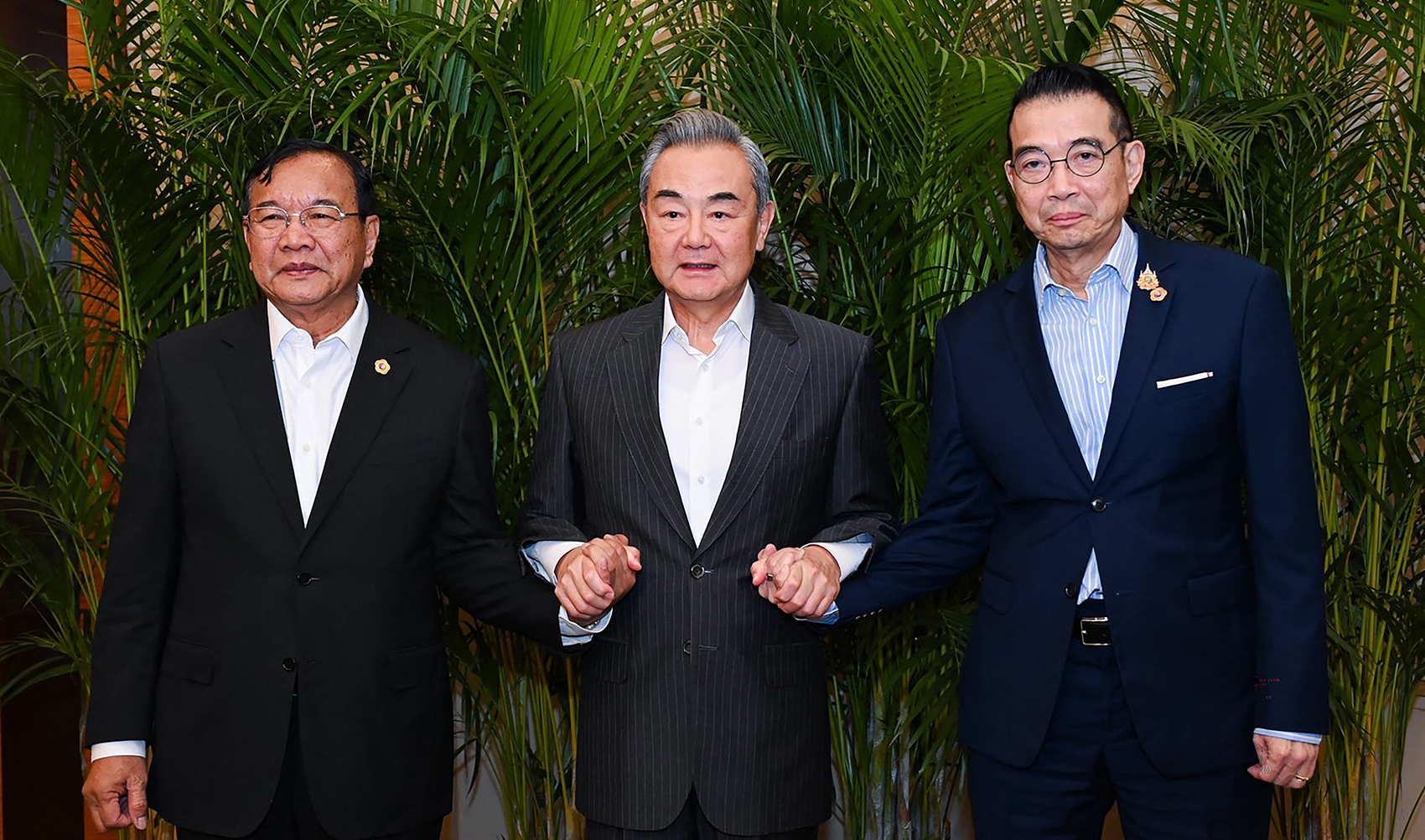
Chinese Foreign Minister Wang Yi (C) poses with his Thai counterpart Maris Sangiampongsa (R) and Cambodian counterpart Prak Sokhonn in Anning in China's Yunnan Province on the sidelines of the 10th Mekong–Lancang Cooperation Foreign Ministers' Meeting on Aug. 14, 2025. / AFP

652
VIEWS
Share on FacebookShare on Twitter

Mediation is usually cast as a noble exercise in international politics, easing tensions and preventing conflict from escalating. But when China positions itself as a mediator, the underlying logic is different. Beijing has turned mediation into a tool not of reconciliation but of resource extraction and strategic entrenchment. Its version of peace-making often comes wrapped in the language of harmony, yet the outcome consistently favours Chinese business and political leverage rather than the communities caught in conflict.

From borders to resource frontiers

The recent Thailand–Cambodia border conflict, the worst in over a decade, reignited long-standing territorial tensions. At least 38 people, mostly civilians, were killed and hundreds of thousands displaced. Against this backdrop, China emerged as an external mediator owing to its deep economic ties with both capitals. Foreign Minister Wang Yi offered to help “objectively and fairly” de-escalate tensions and promote dialogue, and during trilateral meetings he backed deeper cooperation in agriculture, energy, environmental governance, and law enforcement.

While these moves were presented as stabilizing efforts, they dovetailed neatly with Beijing’s interest in extending its investment footprint in infrastructure, rail, and surveillance. China did not act as a mediator in the impartial sense but was managing the relationship with a view to safeguarding its economic interests. Peacebuilding was not the priority. The priority was protecting Chinese investments, resource concessions, and infrastructure channels. Stability, in this calculus, became less an end in itself than a guarantee for Beijing’s long-term commercial reach.


RelatedPosts

Myanmar Junta Keeps Pushing Revival of China-Backed Hydropower Project

Myanmar Junta Keeps Pushing Revival of China-Backed Hydropower Project

January 12, 2026
136
Rohingya ‘targeted for destruction’ by Myanmar, ICJ hears

Rohingya ‘targeted for destruction’ by Myanmar, ICJ hears

January 12, 2026
152
‘Sever the Chain’: Scam Tycoons in China’s Crosshairs

‘Sever the Chain’: Scam Tycoons in China’s Crosshairs

January 9, 2026
464

Afghanistan tells a similar story. Since the Taliban’s return to power, China has cast itself as a bridge between Kabul and the international community, promising dialogue and regional stability. Yet beneath this rhetoric lies a clear strategic agenda. Chinese companies have secured oil extraction deals in the Amu Darya basin and reopened negotiations over Afghanistan’s vast copper and lithium reserves. Here, too, mediation is not about integrating Afghanistan peacefully into the global order but about ensuring that Beijing becomes the dominant external actor in its resource sector. Stability is treated as a prerequisite for resource extraction, not as a commitment to long-term peace. Dialogue is inseparable from China’s pursuit of the minerals that will fuel its industries for decades to come.

China’s mediation interests extend well beyond its immediate neighbourhood. In 2023, Beijing brokered the rapprochement between Saudi Arabia and Iran, a move that was hailed as a diplomatic triumph. Yet the underlying motive was clear: securing uninterrupted access to energy resources and projecting China as an indispensable power in the Gulf. What was celebrated internationally as a breakthrough in regional stability was also a strategic manoeuvre to entrench Beijing in the politics of oil.

In Africa, China has positioned itself as a facilitator in peace talks in both Sudan and South Sudan. Once again, the narrative was about stability, but the material reality was oil. Chinese state companies are heavily invested in Sudanese oil fields, and mediation served less to resolve deep-seated political conflicts than to protect the flow of crude essential to China’s economy.

Closer to home, Beijing’s role in Myanmar’s peace process with ethnic armed groups has similarly been driven by self-interest. By presenting itself as a broker, China has sought to shield its Belt and Road projects and cross-border trade routes from instability. Mediation in Myanmar is not about inclusive peace but about securing pipelines, infrastructure corridors and, more importantly, for a stable periphery for its southern provinces.

Resource architecture under the veil of peace

This consistent pattern reveals a deeper problem. Mediation is being redefined not as an impartial effort to resolve disputes but as a transactional instrument that locks weaker states into asymmetrical relationships. In Southeast Asia, governments manage tensions in ways that keep Chinese capital flowing. In Afghanistan, a fractured state is pulled further into dependency on a single outside power, with little accountability for how resources are exploited or whether ordinary Afghans benefit at all.

The risk is that China’s brand of mediation hollows out the very idea of peace-making. Instead of building trust, dialogue, and reconciliation, it has become about securing markets, extracting resources, and embedding influence. The rhetoric of harmony and shared prosperity conceals a harder truth: Beijing is less interested in constructing a peace architecture than in cementing a resource architecture that serves its strategic interests.

Smaller states must recognize that mediation cannot be divorced from the aims of the actor offering it. Accepting Chinese mediation without scrutiny could mean ceding both autonomy and leverage. The danger is not simply that peace becomes a byproduct: it is that peace itself is repurposed into an instrument for advancing Beijing’s economic and geopolitical ambitions.

Rishan Sen is a researcher focused on Chinese foreign policy and its strategic footprint across Asia.

Your Thoughts …
Tags: AfghanistanAfricaBelt and RoadChinaGeopoliticsGulfmediationMyanmarPeace-making
Rishan Sen

Rishan Sen

Rishan Sen is a researcher focused on Chinese foreign policy and its strategic footprint across Asia.

Similar Picks:

Exodus: Tens of Thousands Flee as Myanmar Junta Troops Face Last Stand in Kokang
Burma

Exodus: Tens of Thousands Flee as Myanmar Junta Troops Face Last Stand in Kokang

by Hein Htoo Zan
November 28, 2023
99.8k

Myanmar National Democratic Alliance Army troops are opening roads and pathways through forests for people to flee Kokang’s capital as...

Read moreDetails
Drone Attack at Myanmar-China Border Gate Causes Over $14m in Losses
Business

Drone Attack at Myanmar-China Border Gate Causes Over $14m in Losses

by The Irrawaddy
November 27, 2023
39.3k

Jin San Jiao is latest northern Shan State trade hub in crosshairs of ethnic Brotherhood Alliance.

Read moreDetails
Brotherhood Alliance Marching Towards Capital of Myanmar’s Kokang Region
Burma

Brotherhood Alliance Marching Towards Capital of Myanmar’s Kokang Region

by The Irrawaddy
November 25, 2023
31.1k

Chinese embassy urges citizens to flee Laukkai Town as ethnic armies prepare to drive Myanmar junta troops from Kokang’s capital.

Read moreDetails
Junta Battalion Controlling Myanmar-China Trade Route Surrenders to KIA 
Burma

Junta Battalion Controlling Myanmar-China Trade Route Surrenders to KIA 

by Saw Reh
January 26, 2024
22.8k

Kachin Independence Army seizes another base in northern Shan State, cutting off regime troops in the border trade town of...

Read moreDetails
Has China Lost Control of Ethnic Armies in Myanmar’s War-Torn Borderland?
Guest Column

Has China Lost Control of Ethnic Armies in Myanmar’s War-Torn Borderland?

by Bertil Lintner
November 6, 2023
21.5k

The Brotherhood Alliance’s offensive against the junta in northern Shan has shut down trade and resource access, but Beijing still...

Read moreDetails
Myanmar Regime Raises the White Flag in Kokang Zone on China Border in Shan State
War Against the Junta

Myanmar Regime Raises the White Flag in Kokang Zone on China Border in Shan State

by The Irrawaddy
January 5, 2024
20.6k

Surrender of headquarters in Laukkai town brings the Brotherhood Alliance another step closer to its goal of ridding northern Shan...

Read moreDetails
Load More
Next Post
Myanmar Junta Plans Voting in 102 Townships

Myanmar Junta Plans Voting in 102 Townships

Rabid Nationalists, Celebs, and a Murderer: The Faces of Myanmar Junta’s Election

Rabid Nationalists, Celebs, and a Murderer: The Faces of Myanmar Junta’s Election

No Result
View All Result

Recommended

China Steps Into Great-Power Trap With Myanmar Intervention

China Steps Into Great-Power Trap With Myanmar Intervention

4 days ago
879
Myanmar in 2026: Military Dictatorship in Traditional Burmese Jackets

Myanmar in 2026: Military Dictatorship in Traditional Burmese Jackets

4 days ago
877

Most Read

  • Low Turnout, Intimidation and Attacks Mark Phase 2 of Myanmar Junta’s Election

    Low Turnout, Intimidation and Attacks Mark Phase 2 of Myanmar Junta’s Election

    shares
    Share 0 Tweet 0
  • Myanmar Junta Election Official Killed as Blasts Rock Bago Region

    shares
    Share 0 Tweet 0
  • Live Updates: Junta’s Election Phase Two

    shares
    Share 0 Tweet 0
  • Myanmar Junta Election Inspector Killed in Magwe Ambush

    shares
    Share 0 Tweet 0
  • Myanmar Junta Suffers Heavy Losses in Bago Days Before Election

    shares
    Share 0 Tweet 0

Newsletter

Get The Irrawaddy’s latest news, analyses and opinion pieces on Myanmar in your inbox.

Subscribe here for daily updates.

Contents

  • News
  • Politics
  • War Against the Junta
  • Myanmar’s Crisis & the World
  • Conflicts In Numbers
  • Junta Crony
  • Ethnic Issues
  • Asia
  • World
  • Business
  • Economy
  • Election 2020
  • Elections in History
  • Cartoons
  • Features
  • Opinion
  • Editorial
  • Commentary
  • Guest Column
  • Analysis
  • Letters
  • In Person
  • Interview
  • Profile
  • Dateline
  • Specials
  • Myanmar Diary
  • Women & Gender
  • Places in History
  • On This Day
  • From the Archive
  • Myanmar & COVID-19
  • Intelligence
  • Myanmar-China Watch
  • Lifestyle
  • Travel
  • Food
  • Fashion & Design
  • Videos
  • Photos
  • Photo Essay
  • Donation

About The Irrawaddy

Founded in 1993 by a group of Myanmar journalists living in exile in Thailand, The Irrawaddy is a leading source of reliable news, information, and analysis on Burma/Myanmar and the Southeast Asian region. From its inception, The Irrawaddy has been an independent news media group, unaffiliated with any political party, organization or government. We believe that media must be free and independent and we strive to preserve press freedom.

  • Copyright
  • Code of Ethics
  • Privacy Policy
  • Team
  • About Us
  • Careers
  • Contact
  • Burmese

© 2023 Irrawaddy Publishing Group. All Rights Reserved

Welcome Back!

Login to your account below

Forgotten Password?

Retrieve your password

Please enter your username or email address to reset your password.

Log In
No Result
View All Result
  • Home
  • News
    • Burma
    • Politics
    • World
    • Asia
    • Myanmar’s Crisis & the World
    • Ethnic Issues
    • War Against the Junta
    • Junta Cronies
    • Conflicts In Numbers
    • Junta Watch
    • Fact Check
    • Investigation
    • Myanmar-China Watch
    • Obituaries
  • Politics
  • Opinion
    • Commentary
    • Guest Column
    • Analysis
    • Editorial
    • Stories That Shaped Us
    • Letters
  • Ethnic Issues
  • War Against the Junta
  • In Person
    • Interview
    • Profile
  • Business
    • Economy
    • Business Roundup
  • Books
  • Donation

© 2023 Irrawaddy Publishing Group. All Rights Reserved

This website uses cookies. By continuing to use this website you are giving consent to cookies being used. Visit our Privacy and Cookie Policy.