Police-State Polls

With resistance groups nationwide denouncing the junta’s planned December election as a sham, junta boss Min Aung Hlaing chose the 61st anniversary of Myanmar Police Day on Wednesday to deliver a message: the key to a “successful” vote lies not in public trust or political inclusion, but in tightening security and jailing would‑be disruptors.
Unable to stage a nationwide ballot due to multiple ongoing conflicts, the regime has established the “Central Committee on Security Supervision during the Multiparty Democracy General Election”—the first of its kind in Myanmar’s election history. Led by the junta’s Home Affairs Minister, its task is to ensure that elections at least appear to go smoothly in areas still under regime control.
The committee is responsible for guarding polling stations, protecting election staff and candidates, and monitoring, arresting, and prosecuting anyone accused of disrupting the process.
No election‑related prosecutions have been reported in areas under resistance control. However, in Yangon, southern Shan, and Karenni regions, at least a dozen people have already been detained under the new Election Protection Law, which carries punishment ranging from long prison terms to the death penalty. Min Aung Hlaing has ordered that such cases be handled “swiftly” during the election period, underscoring the regime’s determination to secure the ballot with handcuffs rather than consent.
In Myanmar’s long and troubled electoral history, disputed votes are nothing new. But an election held under the shadow of death sentences, mass arrests, and military checkpoints? That dubious distinction belongs solely to Min Aung Hlaing’s “historic” ballot.
Leading From the Rear

On Thursday, just one day after his military claimed to have retaken Kyaukme in northern Shan State, junta boss Min Aung Hlaing flew to the garrison town of Pyin Oo Lwin, just over the border in Mandalay Region. There, he posed for cameras while inspecting the Pyin Oo Lwin-Goteik-Kyaukme railway line, boasting of plans to restart train services.
Yet, the coup maker never touched down in Kyaukme—only minutes away in his military chopper.
Likewise, when his army recaptured nearby Nawnghkio in July, it was his deputy Soe Win who showed up, while Min Aung Hlaing stayed behind in the safety of Pyin Oo Lwin. To this day, the junta chief has never dared venture to Nawnghkio.
The explanation for his reluctance is simple. While his military has clawed back Nawnghkio, Kyaukme, and Lashio in recent months, most of northern Shan—including Hsipaw, Mantong, Namtu, Namhsan, Hseni, and Kutkai—remains firmly under the control of the Ta’ang National Liberation Army and Myanmar National Democratic Alliance Army (MNDAA).
Even Lashio, handed back to junta forces after China’s intervention in April, has not been graced by a visit from “the boss.” With MNDAA troops still surrounding the town, Min Aung Hlaing has preferred to admire it from afar.
In theory, a commander‑in‑chief should be on the ground, leading and encouraging his soldiers. But Min Aung Hlaing has chosen to perform the part from well behind the lines, happy to indulge in photo-ops in secure territory. He has even outdone predecessors like Ne Win and Than Shwe, appointing a personal photographer to capture his “best side.”
It comes as little surprise, then, that not just opposition groups but even figures within his own military and pro‑junta circles have derided him as a cowardly leader unfit for command.
And now, with Kyaukme supposedly secured, he has once again posed in Pyin Oo Lwin, talking up trains to Kyaukme without ever setting foot there. The labels of “coward” and “timid general” are unlikely to fade, as his actions keep proving them true.
Regime Claims Kyaukme Retaken

The Myanmar military regime said Thursday it had regained full control of the district-level town of Kyaukme in northern Shan State from the Ta’ang National Liberation Army (TNLA), following a 21-day counteroffensive.
Regime military columns managed to penetrate Kyaukme from several directions, engaging in fierce clashes with TNLA troops before taking complete control of the town on Wednesday, according to sources on the ground.
Several government buildings burned during Tuesday’s fighting, including the police station and fire service office.
Min Aung Hlaing Talks Border Trade, BRI in China

Junta boss Min Aung Hlaing stopped over in Kunming on Monday for talks on restoring border trade between Myanmar and Yunnan Province and progress on China-backed mega-projects in Myanmar.
The Myanmar putsch leader was summoned on return from a working visit to Kazakhstan and met Chinese officials in Kunming airport’s reception area. They included Deng Xijun, Beijing’s special envoy to Myanmar, and Hu Dapeng, a secretary of the Yunnan Province Communist Party.
Junta media said they discussed “key areas” including accelerating projects under Beijing’s Belt and Road Initiative and the China-Myanmar Economic Corridor (CMEC)—both topics that Min Aung Hlaing had discussed during his meeting with Chinese President Xi Jinping and Chinese business leaders in late August and early September.
IDPs Forced to Sign Election Pledge
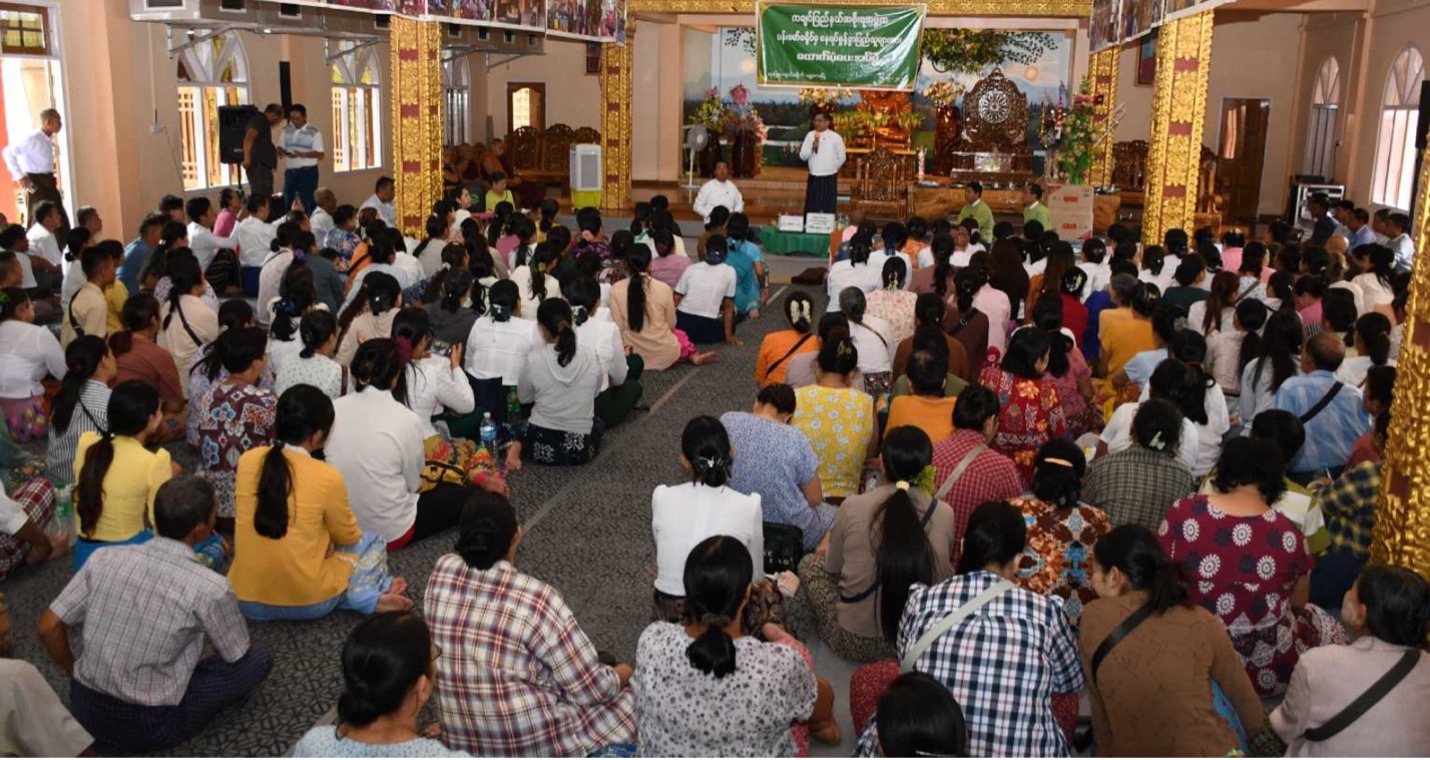
Myanmar’s military regime has made aid for internally displaced people (IDPs) in Mandalay and Sagaing conditional on signing a pledge to vote in its December-January elections, residents told The Irrawaddy. More than 1.3 million IDPs are sheltering across the two regions.
Locals in Sagaing said displaced adults were each given 60,000 kyats last week—framed as three months of refugee support—but only after signing a contract to vote.
“[Authorities] distributed the handout at gathering points in exchange for recipients’ written guarantees to cast their ballot. To receive the money, IDPs had to sign documents pledging to vote,” said a Sagaing resident.