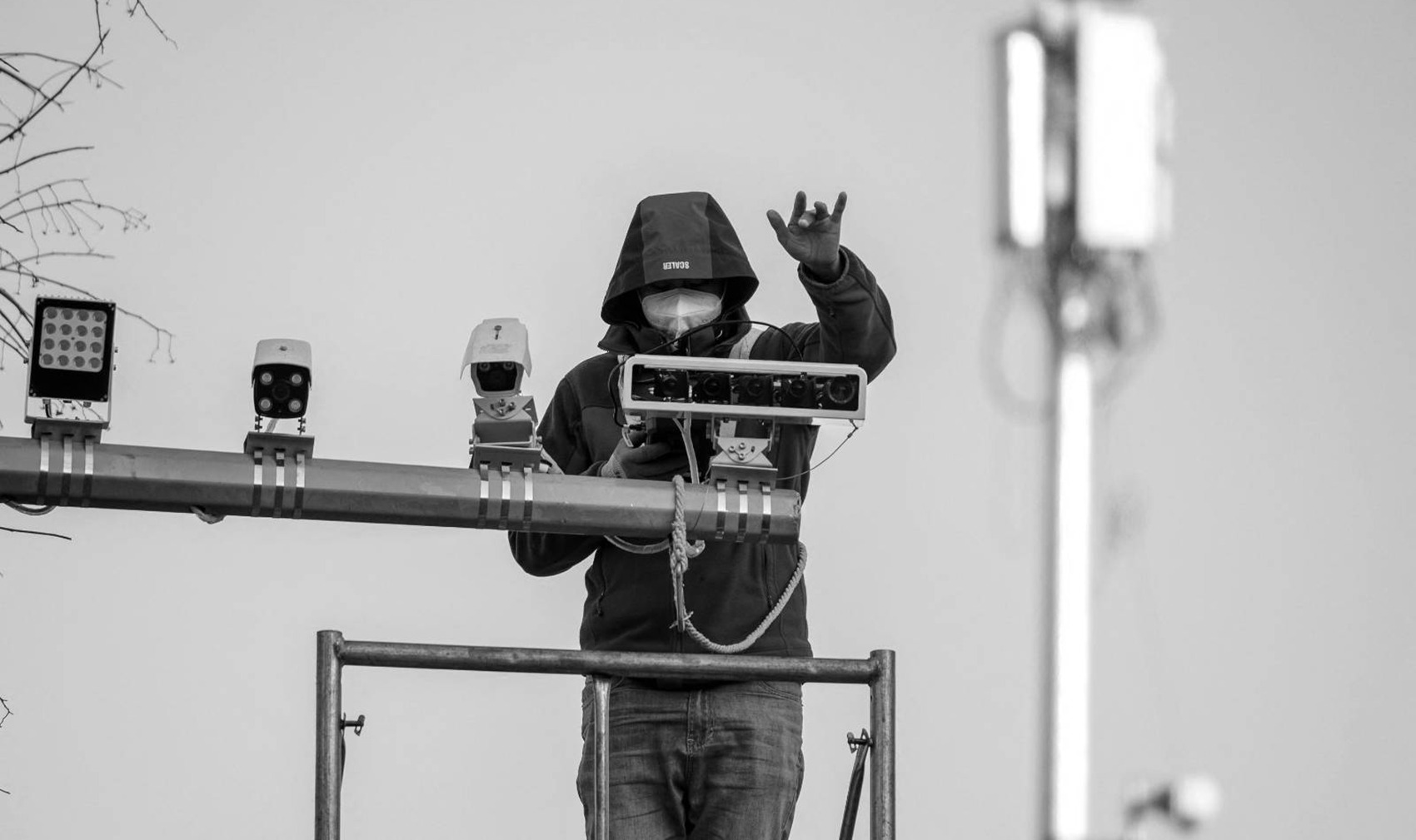
China’s surveillance apparatus has evolved from a domestic security measure into a global system of control that tracks, monitors, and intimidates Chinese citizens wherever they reside. This expansion of authoritarian reach is also a fundamental challenge to international sovereignty and human rights norms. The scale of China’s domestic surveillance infrastructure is unprecedented in human history. With over 500 million cameras nationwide – more than half the global total – the Chinese government has constructed a system achieving “full coverage, full network sharing, full-time availability and full control.” The Sharp Eyes Project, initiated in 2016, extends this coverage through grid-based management systems that divide communities into monitored zones, where designated personnel collect detailed information on residents’ daily activities, social interactions, and digital behavior.
The intensity of surveillance reaches its apex at politically sensitive locations. Tiananmen Square, site of the 1989 pro-democracy protests that ended in a deadly military crackdown, now exemplifies the fusion of historical memory and technological control. Foreign nationals must register 24 hours in advance to visit, while high-precision surveillance equipment monitors visitors’ blood pressure and emotional states to assess potential security threats. The square’s transformation from a space of political expression to one of absolute surveillance embodies China’s approach to preventing dissent through technological omnipresence. Annual commemorations of the June 4 events, impossible within China, have shifted entirely overseas, yet even these exile remembrances face monitoring and disruption by Chinese authorities.
This domestic foundation now supports extensive transnational operations. According to Freedom House, China was responsible for 253 of 854 documented incidents of physical transnational repression between 2014 and 2022, making it the world’s most prolific practitioner. These operations target pro-democracy activists, ethnic minorities including Uyghurs and Tibetans, Hong Kong dissidents, Falun Gong practitioners, and others deemed threats to Communist Party authority across 36 countries.



The mechanisms of overseas surveillance combine sophisticated technology with traditional intimidation tactics. Digital surveillance forms the core of these operations, with Chinese authorities deploying advanced spyware to compromise devices and telecommunications networks globally. WeChat, the messaging platform essential to Chinese diaspora communities, functions as a dual-use technology, facilitating communication while enabling state monitoring of overseas conversations and financial transactions.
Physical infrastructure complements digital surveillance. Between 2016 and 2022, Chinese public security bureaus established 102 overseas police service stations across 53 countries. While officially providing administrative services such as document renewals, investigations revealed these stations’ involvement in coercive operations. In documented cases from the Netherlands and the United States, station personnel pressured dissidents to return to China for prosecution, leading multiple governments to shut down these facilities.
The strategy of proxy repression through family members remaining in China proves particularly effective. Research by Amnesty International found that nearly one-third of overseas Chinese students experienced family harassment intended to silence their activities abroad. This tactic exploits emotional bonds and filial obligations central to Chinese culture, creating a chilling effect that extends far beyond direct targets to entire diaspora communities.
China’s technological capabilities in transnational surveillance continue advancing rapidly. Artificial intelligence systems analyze social media activity across platforms to identify potential dissidents, while sophisticated hacking operations compromise the devices of activists worldwide. The recently launched DeepSeek AI model and advances in quantum computing suggest future capabilities that could render current encryption obsolete, further endangering those who criticize Beijing from abroad.
The export of Chinese surveillance technology to allied authoritarian regimes creates a multiplier effect. North Korea relies heavily on Chinese equipment for population control, while other nations adopt Chinese models of digital authoritarianism. This proliferation not only expands Beijing’s indirect surveillance capabilities but normalizes comprehensive monitoring as a governance tool globally.
Democratic responses remain fragmented and often inadequate. While countries including the United States, United Kingdom, Canada, and Australia have begun recognizing transnational repression as a national security threat, enforcement mechanisms lag behind the sophistication of Chinese operations. Victims frequently report that local law enforcement lacks resources, expertise, or political will to provide meaningful protection.
The COVID-19 pandemic accelerated surveillance normalization within China, with health monitoring systems providing new justification for expanded state observation. Authorities successfully framed pervasive monitoring as essential for public safety, a narrative that resonated domestically even as the same systems tracked political dissidents. This blurring of public health and political control demonstrates how surveillance infrastructure, once established, inevitably expands beyond its original purpose.
Economic factors intensify these dynamics. As China’s growth slows, the government increasingly emphasizes “safety” and “security” to maintain legitimacy. This narrative frames surveillance as protection against crime and instability, a trade-off many citizens accept despite privacy costs. However, for overseas Chinese communities, this bargain is imposed without consent, transforming democratic nations into extensions of China’s surveillance state.
The implications extend beyond individual victims to challenge fundamental principles of sovereignty and human rights. When Chinese surveillance operates freely across borders, it undermines the protection that democratic nations traditionally offer to refugees and dissidents. The estimated 900,000 Chinese students abroad and millions more in diaspora communities face a reality where geographic distance no longer guarantees freedom from state monitoring. China’s model of digital authoritarianism represents a new form of governance that leverages technology to maintain control regardless of borders. Without coordinated international action to protect diaspora communities, restrict surveillance technology transfers, and hold Beijing accountable for violations of sovereignty, this model will continue expanding.
Ankit K is an Asst Professor in International Relations, National Defence University, Gujarat, India.