• Burmese
Wednesday, January 14, 2026
No Result
View All Result
NEWSLETTER
The Irrawaddy
27 °c
Yangon
  • Home
  • News
    • Burma
    • Politics
    • World
    • Asia
    • Myanmar’s Crisis & the World
    • Ethnic Issues
    • War Against the Junta
    • Junta Cronies
    • Conflicts In Numbers
    • Junta Watch
    • Fact Check
    • Investigation
    • Myanmar-China Watch
    • Obituaries
  • Politics
  • Business
  • Opinion
    • Commentary
    • Guest Column
    • Analysis
    • Editorial
    • Stories That Shaped Us
    • Letters
  • Junta Watch
  • Ethnic Issues
  • War Against the Junta
  • In Person
    • Interview
    • Profile
  • Books
  • Donation
  • Home
  • News
    • Burma
    • Politics
    • World
    • Asia
    • Myanmar’s Crisis & the World
    • Ethnic Issues
    • War Against the Junta
    • Junta Cronies
    • Conflicts In Numbers
    • Junta Watch
    • Fact Check
    • Investigation
    • Myanmar-China Watch
    • Obituaries
  • Politics
  • Business
  • Opinion
    • Commentary
    • Guest Column
    • Analysis
    • Editorial
    • Stories That Shaped Us
    • Letters
  • Junta Watch
  • Ethnic Issues
  • War Against the Junta
  • In Person
    • Interview
    • Profile
  • Books
  • Donation
No Result
View All Result
The Irrawaddy
No Result
View All Result
Home Opinion Guest Column

China and the Wars in Myanmar

Bertil Lintner by Bertil Lintner
January 21, 2025
in Guest Column
Reading Time: 5 mins read
0 0
A A
China and the Wars in Myanmar

TNLA troops after taking complete control of Namkham near the Chinese border in northern Shan in December 2023 / The Irrawaddy

10.8k
VIEWS
Share on FacebookShare on Twitter

China has once again shown that it is the only outside power with the means, capacity, and motivation to intervene in Myanmar’s internal conflicts. In order to secure their China-Myanmar Economic Corridor (CMEC), which provides its landlocked southwestern provinces—and indeed the rest of the country—with an outlet to the Indian Ocean, the Chinese have managed to put an end to fighting in northern Shan State. The Kokang-based Myanmar National Democratic Alliance Army (MNDAA) and its close ally, the Palaung Ta’ang National Liberation Army (TNLA), have halted their advances, and there will be no “march on Mandalay” or even Pyin Oo Lwin, which some observers predicted a year ago.

In early December, the MNDAA declared a truce with the Myanmar junta after Kokang chieftain Peng Daren went to China for “medical treatment.” A resolution to the conflict would be sought “under Chinese government arbitration,” it said on Dec. 3. The TNLA had issued a similar statement on Nov. 25, when it said it would “always cooperate with China’s mediation efforts and continue to cooperate [to achieve] good results.”

The third member of the Brotherhood Alliance, the Arakan Army (AA), which has managed to overrun most of its homeland of Rakhine State, announced on Dec. 29 that it, like its allies in the north, is ready to negotiate with the military regime.


RelatedPosts

Myanmar Junta Keeps Pushing Revival of China-Backed Hydropower Project

Myanmar Junta Keeps Pushing Revival of China-Backed Hydropower Project

January 12, 2026
615
Rohingya ‘targeted for destruction’ by Myanmar, ICJ hears

Rohingya ‘targeted for destruction’ by Myanmar, ICJ hears

January 12, 2026
564
US Announces Aid to Bolster Thailand, Cambodia Truce

US Announces Aid to Bolster Thailand, Cambodia Truce

January 10, 2026
506

The show goes on and, so far, nobody has been able to challenge China’s predominant role in Myanmar’s civil wars. Western peace-making outfits may be back sniffing for business opportunities, but that amounts to little more than securing aid to pay the salaries of foreign “experts.” As for potential regional players, nothing constructive can be expected from ASEAN and its toothless Five-Point Consensus, which was adopted a few months after the February 2021 coup and called for the immediate cessation of violence, constructive dialogue among all parties concerned, and humanitarian assistance to areas which have been affected by the fighting—but without any plan how those lofty recommendations should be implemented.

ASEAN has never in its 58-year history managed to solve a single bilateral conflict or dispute between some of its 10 members, let alone end an internal crisis in a member state. Even so, Western countries appear to have outsourced the Myanmar issue to ASEAN, since the war in Ukraine and the still unresolved conflicts in the Middle East are much higher up on their list of priorities.
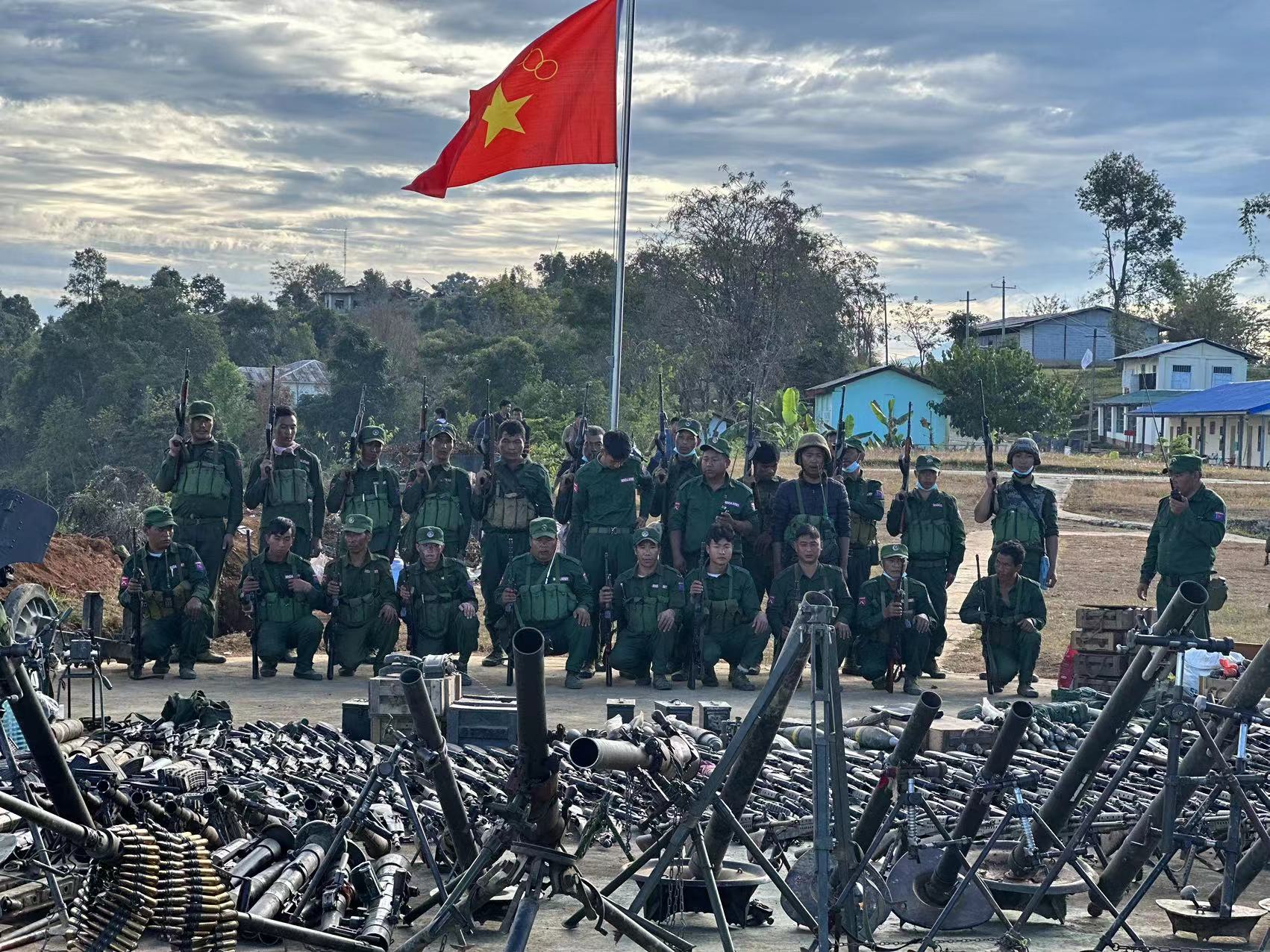
MNDAA troops pose along with a haul of weapons and ammunition after seizing a major junta base in Konkyan Township last week. / The Kokang

But there are also wild cards over which China’s influence is limited. The Kachin Independence Army (KIA) in the far north has little choice but to deal with the Chinese across the border, but in October it ignored their request not to seize control of the border town of Pangwa, the domain of former communist warlords who made peace with the Myanmar military in 1989 and  turned their area into a haven for logging, opium cultivation, and mining for rare earth metals. Today, the KIA controls not only Pangwa but also the official border-crossing at Kanpiketi and adjacent areas. China has even less influence in areas along the Thai border where Karen and Karenni resistance forces are active, or in Chin State in the west.

Recent developments raise three fundamental questions: what can the Bamar allies of the ethnic resistance armies realistically expect to achieve; what are China’s long-term objectives; and are there no outside forces at all that can stand up to China or, at least, counter China’s influence? Several resistance armies dominated by ethnic Bamar, including many youngsters who tried to oppose the junta by peaceful means after the coup and are collectively known as People’s Defense Forces (PDF), have since then been fighting alongside the ethnic armies. Many PDFs have raised the flag of resistance in Sagaing and even rural parts of Mandalay Region. But for the ethnic armies, the PDFs are mere buffers between them and the junta forces. By keeping Naypyitaw’s soldiers at bay, the ethnic armies can consolidate their hold on their own respective areas. The KIA, for instance, which has provided training and support for PDF forces now active in the north, would have no interest in marching into Mandalay, still less Naypyitaw or Yangon.

China’s strategic objectives are clear. The CMEC has to be protected, and China is doing it by playing both sides—being a major supplier of military hardware to the Myanmar military as well as several resistance forces. The MNDAA, the TNLA, and the AA are equipped with Chinese-made guns obtained through the officially neutral United Wa State Army (UWSA). In other words, China has leverage over the Myanmar military as well as ethnic armed organizations in a way nobody else can compete with.

At the same time, the emergence of a strong, peaceful, democratic, and federal Myanmar—the stated goal of most resistance armies—is not in China’s strategic interest. As long as Myanmar is weak, China can play official games of being a friendly neighbor and peacemaker and use a carrot-and-stick approach with whatever government is in power: trade coupled with investment on the one hand, and indirect support for the ethnic armies on the other. If Myanmar ever really became strong, peaceful, democratic, and federal, China would be the first to lose. Its leverage would be gone.

But then China does not want the situation to get totally out of hand either, because that would mean serious instability in the frontier areas and, most likely, a flood of refugees across the border. And it would seriously disrupt normally lucrative cross-border trade.

Western peaceniks, ASEAN, the U.S., and the EU are not in a position to influence the course of the civil wars, which are the heaviest and most widespread since the years immediately after independence from Britain in 1948, when the regime was so isolated that it was referred to as “the Rangoon Government.” Japan too, despite a strong interest in containing China’s influence, has been utterly unsuccessful in its efforts to bring peace to Myanmar.
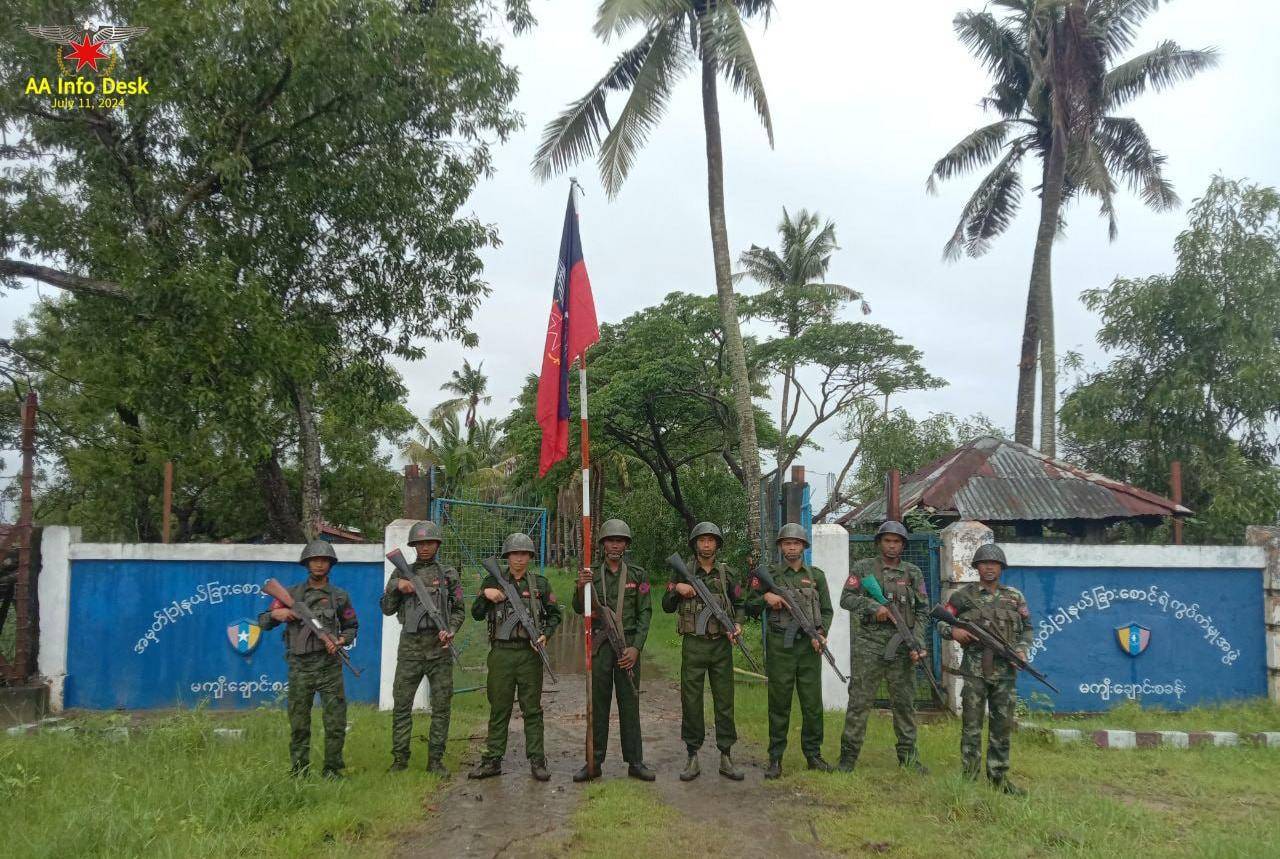
AA troops in Maungdaw after seizing a border guard post in July 2024 / AA

Myanmar’s western neighbors India and Bangladesh, which are not hamstrung by ASEAN’s Consensus and non-interference principles, could play roles—if only they had a clear strategy for dealing with the geopolitical consequences of wars in Myanmar. The Bangladeshis, naturally, are concerned about more than 1 million Rohingya Muslim refugees languishing in camps in their country, and about what would happen if the AA took over the whole of Rakhine State. Bangladesh shares a 271 km porous border with Rakhine and Chin states, and developments there would have a direct impact on its national security.

India’s interests in Myanmar appear to be motivated by four major concerns. The first is the future of New Delhi’s “Act East” policy. Myanmar is the obvious link between India and lucrative markets in Southeast Asia. India’s security planners also want to ensure that ethnic Assamese, Manipuri, and Naga rebels are deprived of cross-border sanctuaries in the remote hills of northwestern Myanmar, from where they can launch raids into India and smuggle guns into India’s volatile northeastern region. Unrest in Sagaing Region and Chin State has already spilled over into Manipur, which borders Myanmar. Thirdly, India’s rapidly expanding economy needs energy, and India has shown interest in importing oil, gas, and perhaps also hydroelectric power from Myanmar. That is not possible as long as wars are raging across the border. Lastly, India, more than any other neighboring country, wants to keep China’s influence in Myanmar at acceptable levels.

In February, it will be four years since the military seized power, arrested democratically elected representatives of the people, and re-introduced a strict dictatorship. In the coming year, it is highly unlikely that the junta will be able to defeat the plethora of ethnic and political resistance forces that are active in large areas throughout the country. But it also doubtful whether the resistance will be strong and united enough to unseat the junta. The present strategic stalemate is likely to continue, but everything depends on China’s next move.

Your Thoughts …
Tags: BangladeshChinaCMECEthic ArmiesIndiaMyanmartruce
Bertil Lintner

Bertil Lintner

Bertil Lintner is a Swedish journalist, author and strategic consultant who has been writing about Asia for nearly four decades.

Similar Picks:

Exodus: Tens of Thousands Flee as Myanmar Junta Troops Face Last Stand in Kokang
Burma

Exodus: Tens of Thousands Flee as Myanmar Junta Troops Face Last Stand in Kokang

by Hein Htoo Zan
November 28, 2023
99.8k

Myanmar National Democratic Alliance Army troops are opening roads and pathways through forests for people to flee Kokang’s capital as...

Read moreDetails
Drone Attack at Myanmar-China Border Gate Causes Over $14m in Losses
Business

Drone Attack at Myanmar-China Border Gate Causes Over $14m in Losses

by The Irrawaddy
November 27, 2023
39.3k

Jin San Jiao is latest northern Shan State trade hub in crosshairs of ethnic Brotherhood Alliance.

Read moreDetails
Brotherhood Alliance Marching Towards Capital of Myanmar’s Kokang Region
Burma

Brotherhood Alliance Marching Towards Capital of Myanmar’s Kokang Region

by The Irrawaddy
November 25, 2023
31.1k

Chinese embassy urges citizens to flee Laukkai Town as ethnic armies prepare to drive Myanmar junta troops from Kokang’s capital.

Read moreDetails
Junta Battalion Controlling Myanmar-China Trade Route Surrenders to KIA 
Burma

Junta Battalion Controlling Myanmar-China Trade Route Surrenders to KIA 

by Saw Reh
January 26, 2024
22.8k

Kachin Independence Army seizes another base in northern Shan State, cutting off regime troops in the border trade town of...

Read moreDetails
Has China Lost Control of Ethnic Armies in Myanmar’s War-Torn Borderland?
Guest Column

Has China Lost Control of Ethnic Armies in Myanmar’s War-Torn Borderland?

by Bertil Lintner
November 6, 2023
21.5k

The Brotherhood Alliance’s offensive against the junta in northern Shan has shut down trade and resource access, but Beijing still...

Read moreDetails
Myanmar Regime Raises the White Flag in Kokang Zone on China Border in Shan State
War Against the Junta

Myanmar Regime Raises the White Flag in Kokang Zone on China Border in Shan State

by The Irrawaddy
January 5, 2024
20.6k

Surrender of headquarters in Laukkai town brings the Brotherhood Alliance another step closer to its goal of ridding northern Shan...

Read moreDetails
Load More
Next Post
Myanmar Junta Blames Thailand, EAOs as China Urges Scam Crackdown

Myanmar Junta Blames Thailand, EAOs as China Urges Scam Crackdown

Myanmar Junta Says It Has Deported Over 50,000 Scam Center Workers to China

Myanmar Junta Says It Has Deported Over 50,000 Scam Center Workers to China

No Result
View All Result

Recommended

Myanmar in 2026: Military Dictatorship in Traditional Burmese Jackets

Myanmar in 2026: Military Dictatorship in Traditional Burmese Jackets

6 days ago
966
Looking Ahead to 2026: What Lies Ahead for Myanmar

Looking Ahead to 2026: What Lies Ahead for Myanmar

1 week ago
1.6k

Most Read

  • Resistance Keeps Punishing Myanmar Junta Forces in Eastern Bago

    Resistance Keeps Punishing Myanmar Junta Forces in Eastern Bago

    shares
    Share 0 Tweet 0
  • USDP Claims Sweeping Wins in Second Phase of Junta’s Election

    shares
    Share 0 Tweet 0
  • The Infiltration of Thailand’s State Power Structure by Wa Networks

    shares
    Share 0 Tweet 0
  • Myanmar Junta Slams Rohingya Genocide Case at ICJ

    shares
    Share 0 Tweet 0
  • Myanmar Junta Election Inspector Killed in Magwe Ambush

    shares
    Share 0 Tweet 0

Newsletter

Get The Irrawaddy’s latest news, analyses and opinion pieces on Myanmar in your inbox.

Subscribe here for daily updates.

Contents

  • News
  • Politics
  • War Against the Junta
  • Myanmar’s Crisis & the World
  • Conflicts In Numbers
  • Junta Crony
  • Ethnic Issues
  • Asia
  • World
  • Business
  • Economy
  • Election 2020
  • Elections in History
  • Cartoons
  • Features
  • Opinion
  • Editorial
  • Commentary
  • Guest Column
  • Analysis
  • Letters
  • In Person
  • Interview
  • Profile
  • Dateline
  • Specials
  • Myanmar Diary
  • Women & Gender
  • Places in History
  • On This Day
  • From the Archive
  • Myanmar & COVID-19
  • Intelligence
  • Myanmar-China Watch
  • Lifestyle
  • Travel
  • Food
  • Fashion & Design
  • Videos
  • Photos
  • Photo Essay
  • Donation

About The Irrawaddy

Founded in 1993 by a group of Myanmar journalists living in exile in Thailand, The Irrawaddy is a leading source of reliable news, information, and analysis on Burma/Myanmar and the Southeast Asian region. From its inception, The Irrawaddy has been an independent news media group, unaffiliated with any political party, organization or government. We believe that media must be free and independent and we strive to preserve press freedom.

  • Copyright
  • Code of Ethics
  • Privacy Policy
  • Team
  • About Us
  • Careers
  • Contact
  • Burmese

© 2023 Irrawaddy Publishing Group. All Rights Reserved

Welcome Back!

Login to your account below

Forgotten Password?

Retrieve your password

Please enter your username or email address to reset your password.

Log In
No Result
View All Result
  • Home
  • News
    • Burma
    • Politics
    • World
    • Asia
    • Myanmar’s Crisis & the World
    • Ethnic Issues
    • War Against the Junta
    • Junta Cronies
    • Conflicts In Numbers
    • Junta Watch
    • Fact Check
    • Investigation
    • Myanmar-China Watch
    • Obituaries
  • Politics
  • Opinion
    • Commentary
    • Guest Column
    • Analysis
    • Editorial
    • Stories That Shaped Us
    • Letters
  • Ethnic Issues
  • War Against the Junta
  • In Person
    • Interview
    • Profile
  • Business
    • Economy
    • Business Roundup
  • Books
  • Donation

© 2023 Irrawaddy Publishing Group. All Rights Reserved

This website uses cookies. By continuing to use this website you are giving consent to cookies being used. Visit our Privacy and Cookie Policy.