Around 16 hectares of farmland along the Lwe River in eastern Shan State, about 20 km downstream from rare-earth mines in Wa-controlled Mong Bawk, have been destroyed by unprecedented mud-laden floods since late July, according to a local human rights group, which blames expanded mining upstream.
The Shan Human Rights Foundation (SHRF) said in a report last week that heavy rain caused the Lwe River to burst its banks on July 27, leaving fields near Mong Khark—a town in Myanmar regime-controlled territory in eastern Shan State—under as much as 2 m of floodwater.
When the waters receded three days later, half of the fields in the area were buried in 60 cm of mud, destroying rice, corn, peanut and soybean crops.


Farmers replanted in areas that had not been covered with mud, but further floods on Aug. 5 and Aug. 10 brought more mud and wiped out the new crops.
Local farmers told the group that this year’s mud deposits are unprecedented. Even during severe flooding of the Lwe River from July to October 2024, when waters in Mong Khark reached 2 m, crops remained unharmed as no mud was left behind.
Ying Leng Harn, a spokesperson for the Shan rights group, told The Irrawaddy that around 16 hectares of farmland had been destroyed by the mud-laden floods.
“Local farmers dare not plant again, as it is still raining. As a result, locals are facing hardships in their daily lives,” she added.
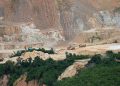
The SHRF believes the increased sediment load in the Lwe River is caused by the expansion of rare-earth mines in the Mong Bawk area, which mostly drain into streams joining the Lwe River upstream of Mong Khark.

Based on satellite images, the rights group recently reported that the number of rare-earth mines in UWSA-controlled Mong Bawk had risen from three in 2015 to 26 in 2025—a more than eightfold increase.
Those mines are run by Chinese nationals or through joint ventures between China and the United Wa State Army (UWSA), one of the biggest and best-equipped ethnic armed groups in Myanmar.
The rights group pointed out that the mines employ the hazardous “in-situ leaching” method to extract rare earths from the mountain soil, whereby minerals are dissolved within their natural underground deposit using chemical solutions injected through boreholes, after which the mineral-laden fluid is pumped to the surface.
Zung Ting, a Kachin environmentalist, recently told The Irrawaddy that the impact of rare-earth mining is severe, as forests on mountaintops are cleared first, and once digging begins, the whole mountain becomes riddled with holes that look like rats’ nests.
He said that when acid water is poured into the soil, microorganisms that keep the land fertile die off, leaving the soil layers damaged, while the untreated toxic wastewater that is dumped directly into downhill streams and rivers destroys aquatic ecosystems.
He added that the death of fish and other species collapses food chains, while poisoned water absorbed by crops threatens food supplies and the health of local communities.
Landslides, floods, and sediment-choked waterways, along with other increasingly frequent natural disasters, follow, the environmentalist warned.
After flowing through Mong Khark, the Lwe River flows between Kengtung and Mong La townships, then through areas of Mong Yawng Township under the control of the National Democratic Alliance Army (NDAA), before flowing into the Mekong River.
Apart from the ones in Mong Bawk, there are a further 19 rare-earth mines in the NDAA area draining into the Lwe River, the Shan rights group said.
Chinese-run mineral mining operations, including rare-earth projects in the UWSA-controlled area in eastern Shan, are blamed for polluting Thai rivers.
“This story was produced with support of the Internews Earth Journalism Network.”