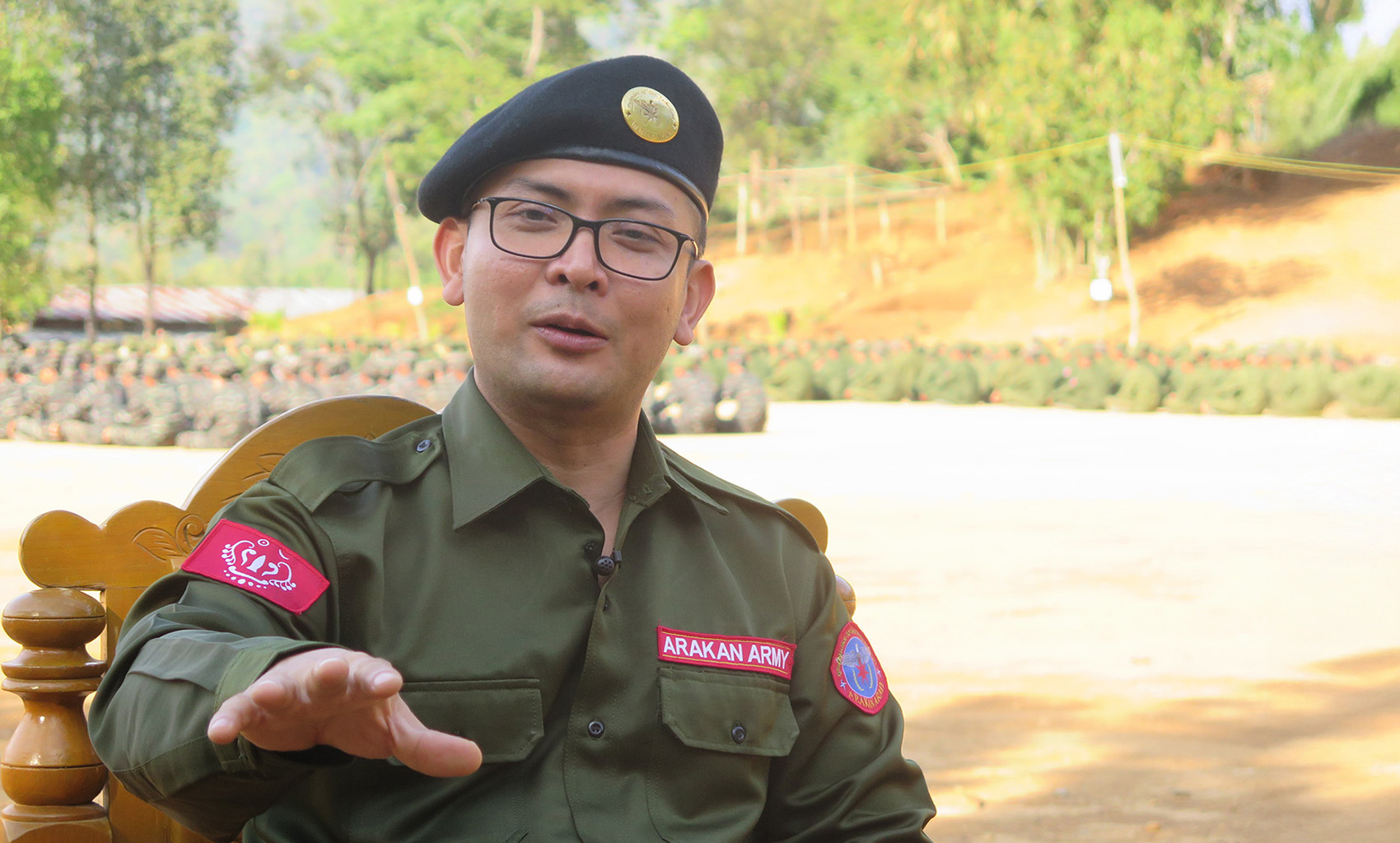
In the second part of his exclusive interview with The Irrawaddy’s editor-in-chief Aung Zaw, Arakan Army chief Major General Tun Myat Naing dives deeper into the Rohingya issue and answers other charges—including drug trafficking—against his armed group.
Aung Zaw: There have been attempts to file a lawsuit against you and others at the international court concerning the Rohingya issue in Rakhine State. How do you respond to that?
Tun Myat Naing: It seems I am part of a trend. I don’t feel much disturbed. It will be like a friendly greeting when I meet my friends. Just like I am talking to you right now, and you ask how I will respond.

We stand on the right side and while we are resolving this problem, we have a chance to explain.
We were cautious in our own actions when we came back to our homeland during this revolution because we were concerned about the impact it would have on people.
So we’re not going anywhere. We’re staying in Rakhine State.
For those who legally harass us or wage lawfare against us, they have been talking a lot about peaceful repatriation, but how would they return to Myanmar in the present circumstances?
If they want to highlight justice, they’d have a better chance of discovering the truth by filing a lawsuit against us in our own Arakan People’s Revolutionary Government court than in an international court of law.
AZ: Do you deny that the AA violated the human rights of Muslims over the past 40 or 50 years?
TMN: There were incidents when some of our soldiers broke the rules of conduct. For that, we punished them, and they know it. The media covered that. We also have some soldiers who committed crimes and then fled the army.
But we have never imposed collective punishment, as per the ULA’s policy. Nor are we going to.
If such cases continued, how could we implement our vision?
Unless we have peace and stability, we won’t have development.
So that’s something we are being careful of.
We neither violate human rights nor do we permit it as a matter of policy.
But when we fight against those who were trained and armed [by the junta], that’s the battlefield.
The junta urged them to protest and burned their houses. We had to arrest the people who did it.
We must act in accordance with the law. We have taken action to punish our officers who broke the law.
AZ: Apart from human rights violations, there are accusations of discrimination against the Rohingya people. That doesn’t happen only in Rakhine State but throughout Myanmar.
What I want to know is whether the AA has given the Rohingya people, including their religious leader, positions or roles in the administration and the legal sector. Could you elaborate?
TMN: The controversy concerning the name of this ethnic group is not just today’s issue. They have been using this name for a political purpose, not just in Rakhine State but throughout Myanmar.
When you read history books about Rakhine or Burma or Bagan, there are weaknesses because they were written by authors with different views. People take what they want and write a new narrative to stimulate others.
It will take time to resolve this issue. The problem won’t disappear the moment we take control. There is no magic cure. We need to handle it slowly.
As I mentioned earlier, it should not be viewed solely from the human rights angle.
If they don’t respect the law of the country they’re living in, how can we talk about international law? That is a question we asked.
They have been saying that all should have been done in accordance with international law. That is the language of big nations used to bully small countries. Are you saying that those who broke our country’s laws somehow have international law on their side? Are you supporting them? That is another question we would like to ask.
Every citizen has the responsibility to respect his own country’s flag, laws, and constitution. But they ignoring all of them and then talk about international law.
Instead of addressing human rights violations, we should gradually resolve inequalities. But as long as there are attacks, incitement, and accusation from the outside, It will be very difficult to resolve this problem.
AZ: Can you answer my question about their participation in the administration and legal system?
TMN: We won’t leave any community behind in building a peaceful and effective administration, and creating a developing community in Rakhine State. We don’t have a plan to exclude any community.
When discussing human rights, we must view the individual as a human being and as a citizen.
We need to do this slowly to make them equal.
We used to hear our elders say things like, “Oh, these Kala do this and that” when we were young, and we felt hatred just seeing a crowd of them.
But I visited a Muslim village on the other side of the town when I was in high school, grade 10, and I saw a kid from a Muslim family who was sick and unable to get medicine. The boy had a high fever, and when we asked where his father was, he was working in the market at the time.
So we bought medicine for that boy immediately to cure him, and helped him out of humanity. At that time, I was not a politician, and I only felt a sense of humanity. We all have natural empathy.
Now that I am a political leader, I am responsible for making the right decisions and implementing them for all our people. At the same time, we must build based on a humanitarian approach and be accountable to our country.
We always tell them to participate effectively in providing public security, the judicial system, government services such as healthcare and education, and disaster protection.
So far they haven’t participated in military operations much. We actually want to include them. But military affairs involve weapons, so we need to establish mutual trust first through practical action.
We haven’t included them in the military because in the past some people took the weapons and ran away. I told this to the Muslim leaders.
We don’t forcefully recruit people. If they want to be in the military, they have to get a recommendation from the Muslim leader in their community, and then we will allow them to join our army.
But these lobbyists masquerading as activists sensationalized this case into forced recruitment, sparking a media frenzy. They fabricated cases.
That is why we have been training these human resources gradually to integrate them into the civil service and administrative and judicial systems. We have started providing training related to law and administration.
AZ: The junta has been handing out arms and military training to various groups to attack the AA since two or three years ago, right?
TMN: Yes. They still do.
AZ: So have they increased their numbers? Are those people they have trained now a force the junta can rely on? How is the situation on the ground?
TMN: It’s a dangerous gamble. The junta did it for short-term gain, but it opens the door to chaos in the long term in this region.
They (the militants) have been teaching and inciting the students in the madrasas with militant indoctrination in the refugee camps. According to our investigations, the militants have already recruited around 4,500 people along the border, though not all of them have been given weapons yet.They are trying hard to get access to weapons. These camps are near the BGB (Border Guard Bangladesh) camps on the Bangladeshi border.
When there were deliveries of rice and fuel from there to Rakhine, they were intercepted by those militant groups, not the BGB itself. But it’s as if they were given the responsibility to block all shipments from there to Rakhine.
And sometimes, when there were opportunities, they come over to the Rakhine side to detonate mines and shoot, and then they flee back to the Bangladeshi side. Whether we like it or not, we can’t choose our neighbors; we have to be patient and establish a long-term relationship in everything. So we are trying to establish a good relationship with Bangladesh.
We assume that it’s not a decision made by politicians, but rather by certain officers [in the Bangladesh border security forces] who support the idea of militancy.
That is why, rather than responding to it severely, we find ourselves in a situation where we must respond patiently and wisely.
AZ: I want to ask about the activists from overseas that you often mention here. Do exiled Rohingya activists and Rohingya Muslims in the refugee camps have a lot of common ground between them?
And do the Rohingya people still living in Rakhine State’s Buthidaung and Maungdaw regions, and the Rohingya leaders advocating campaigns from the outside, have a unified approach or views? Are there significant gaps?
TMN: There are significant gaps based on the parts of the world where they live. Rohingya people in Rakhine State or much more in favor of peaceful coexistence. Many people living along the border welcome the current peaceful situation. But there are also influences from militants in villages in the mountains and forests.
So we can’t say what their thinking is. It’s like a layered cake, and it seems to be fluctuating all the time; they have their own audience.
As for the refugee camps, there too there are people who want to return peacefully to Rakhine State. But in the madrasas, they are brainwashing their students with jihadist ideology to attack the Rakhine State and annihilate their enemies. They are poisoning their students’ minds daily, so of course the AA is their enemy. We have witnessed it, which is very concerning.
AZ: This is happening in the refugee camps?
TMN: It is happening in the madrasas and in the refugee camps.
Some people from the refugee camps want to return, and a lot of them have returned. But for political reasons, the UN and some Bangladeshi officials only point out the people who fled Myanmar. But they never talk about the hundreds of families who are returning from Bangladesh.
When they talk about the statistics, they differ wildly, sometimes it’s 20,000, sometimes it’s 120,000 or 200,000. It varies. Their references vary.
Their reference are always “according to the UN.” But when the UN’s local staff are militants themselves, how can we trust the statistics they reference?
Sometimes, they tell us to allow NGOs and investigation teams to enter
And of course we can do that, but it has to be people we can trust.
That’s why we need to verify their investigators first.
That is how complex the situation is.
That’s why the assumptions and support of people in the refugee camps differ from those living in Myanmar.
And the diaspora in the West doesn’t want to see unity, development, and harmony in Rakhine State.
Their goal and strategy is to cause conflict, referring to human rights violations and genocide, to show that they can’t live with the Rakhine people and that they need international help, which is this “responsibility to protect” that Western nations supposedly have, to come here to free them.
They don’t want to move forward constructively.
We have a proverb in Rakhine that says even if you give a beautiful sarong to a person, but it has a little cigarette burn, people will only point that out.
It’s like that.
AZ: You mention that some UN staff are associated with militant groups.
What do you mean by that?
TMN: In the refugee camps, there are people like Dil Mohammed and his followers, who were trained by the Myanmar regime. When the regime’s soldiers surrendered, and some died in battles, some people from Dil Mohammed’s group fled. The Bangladesh army’s intelligence favored him because the previous ARSA leader didn’t listen to them; also they don’t like the other groups.
What they wanted was someone with leadership skills to represent the refugees and speak on their behalf, and Dil Mohammed is a good communicator. He is really good at persuading the militants with religious indoctrination. So they favor him.
Suppose he calls a meeting, then the camp leaders must attend it. If they don’t attend it, they won’t be allowed to ask for help. And he can use that as leverage over the UN and INGOs’ support if they don’t support the militants’ plans.
That means in effect that the UN and the NGO staff are part of his network.
Regarding the statistics, for instance, after we seized Buthidaung, we discussed with high-ranking officials of the Border Guard Bangladesh that we wee going to proceeded to Maungdaw.
Upon being told of our plan, they requested us to prevent further border crossings so that they wouldn’t have to accept even more refugees into their territory and that we ensure border security.
And we said ok, we will, but in return we asked them to allow life-saving medicines or items across the border. If we don’t have those, people will flee across the border. We told them to allow us to buy medicines and they agreed.
But once the battle began, people began to spin their own narrative and when accusations arose, they closed the border after all. Being familiar with one another, they find it easy to trust each other.
There are accusations against us. Yes, there were human rights violations, and people fled during the time of junta control. But they specifically highlighted why people keep fleeing even under the AA’s control.
It’s obvious, no? Myanmar is in a civil war. The citizens lack jobs, and they are unable to go anywhere. Their daily lives are not safe.
The region they were talking about repatriating the refugees to is being bombed every day. People will run away to save their lives even if Bangladesh closes all of its borders. That is one of the main factors that causes refugees to flee. It’s a vital factor.
But then, during the refugee conference, they said there was violence and kidnapping. They discussed it generally, but they didn’t mention who was responsible. But it made us look like the culprits.
In fact, the violence and kidnapping in the camps and along the border are committed by human trafficking gangs. Yet if we do something wrong, even one single thing, they exaggerate it a thousand times.
Who is the real culprit for the violence? We have to keep asking that.
AZ: Another accusation against the AA is drug trafficking.
On Sept. 13, the junta propaganda newspaper, the New Light of Myanmar, reported that an amphetamine shipment bound for Malaysia had been seized and the picture in the newspaper featured AA soldiers.
Around the same time, officials of the Border Guard Bangladesh accused the AA of dealing in drugs. These are repeated accusations that the AA is dealing drugs and trafficking them to support their forces.
How do you respond to these accusations against the AA of drug dealing?
TMN: More accusations are being made against us than ever before about illegal drugs It’s not the first or second time. It’s a concerted strategy: repeat false accusations against someone until people believe they are true.
It is human nature. Or call it “the new normal.”
We used to get very emotional about that. They have the effrontery to accuse us when they know best where these drugs come from; where they come from and where they go.
These drugs are worth a lot. I’ve never heard of such a large amount of drugs in my life. I even said that if we had that kind of money from selling drugs, we could swat the junta’s aircraft down like flies.
And they don’t just accuse us in the media but also send letters to Interpol to arrest our people. Following our territorial gains, they fabricate additional narratives to disrupt our diplomatic communication and undermine our legitimacy. They are framing us as mere drug dealers. They have always portrayed us in that way, and they have become used to it. It is their strategy to attack us.
The border region was under their control before, so they know how the drugs are made and where they are produced. Since we have taken control, things are no longer the same. Surely it isn’t possible that the junta’s navy didn’t know that the drug trade passed from Ayeyarwady Region and Yangon Port. How did the drugs from the Northern Shan State get to Yangon?
They can trace a single bullet to a pistol in Karen State. So who brought these vast amounts of drugs to Yangon? That’s what we have to explain to the world.
Sometimes, Chinese officials on the border ask us about the drug accusation. We give them a clear answer: you can find the origin of those illegal drugs simply by sitting in a tea shop in any town in northern Shan State. Now you’re confused because you read something in their newspaper.
To find the answer, have a cup of tea or a drink or a meal in any town in northern Shan State. We even heard that the drugs were carried by plane from Lashio airport to Yangon. Now, they use the junta’s surveillance aircraft to transport the drugs and the drugs can arrive in Yangon.
They know best who owns this huge amount of drugs. Oh yes, they know best. But that doesn’t mean we don’t know. We know quite a bit.
But they know a lot more than we do. They blamed us for all the drugs they found across Myanmar to undermine our legitimacy.
As for the accusations from Bangladesh, they never used to hate us that much before. But since we seized the territories that they desperately wanted, they have become embittered and envious.
Look: there are now four or five blockades to Rakhine State.The junta blocked the sea channel, starting from Yangon to Haingyikyun to Gwa, with many warships. And yet all the drugs they captured were mysteriously seized at the entrance of the sea channel.
According to newspapers from Bangladesh, they were seized at sea. But we don’t control the sea.
We intercept illegal fishing boats only about 5-7 km from the shore. The drug trade from Yangon or other routes is not under our control.
The general public have no understanding at all of the situation. It’s the junta and Bangladeshi officials who accuse us.
And that includes stoking the insurgency and trying to undermine our legitimacy. Oddly enough, they are not friends among themselves. But they share temporary common benefits, and we become their victims.
Whatever their attempts to infiltrate from the outside, by diplomatic means, legal strategies, or utilizing the international media, we will continue to do what we have to do.
We won’t respond harshly, not because we are terrified of our accusers but because we don’t want to escalate the situation.
AZ: I have one more question. Please briefly describe the relationship between Bangladesh and the AA.
TMN: The relationship seemed good before. That’s what we thought, because we share a common purpose concerning the refugee issue. We assumed that this would change our relationship constructively.
But when we approached them about policy implementation, they put us under pressure. What they should have done was to build trust between us and focus on empowerment.
If we wanted to work on refugee repatriation, surely we would need to have plans in place for their security and employment to ensure their survival.
Instead, they just put pressure and more pressure on us. So conflicts developed. But we are trying to balance things.
Rather than pressuring us, we have been discussing with them how they can approach the issue constructively, giving us recognition and working with us.