• Burmese
Wednesday, January 14, 2026
No Result
View All Result
NEWSLETTER
The Irrawaddy
30 °c
Yangon
  • Home
  • News
    • Burma
    • Politics
    • World
    • Asia
    • Myanmar’s Crisis & the World
    • Ethnic Issues
    • War Against the Junta
    • Junta Cronies
    • Conflicts In Numbers
    • Junta Watch
    • Fact Check
    • Investigation
    • Myanmar-China Watch
    • Obituaries
  • Politics
  • Business
  • Opinion
    • Commentary
    • Guest Column
    • Analysis
    • Editorial
    • Stories That Shaped Us
    • Letters
  • Junta Watch
  • Ethnic Issues
  • War Against the Junta
  • In Person
    • Interview
    • Profile
  • Books
  • Donation
  • Home
  • News
    • Burma
    • Politics
    • World
    • Asia
    • Myanmar’s Crisis & the World
    • Ethnic Issues
    • War Against the Junta
    • Junta Cronies
    • Conflicts In Numbers
    • Junta Watch
    • Fact Check
    • Investigation
    • Myanmar-China Watch
    • Obituaries
  • Politics
  • Business
  • Opinion
    • Commentary
    • Guest Column
    • Analysis
    • Editorial
    • Stories That Shaped Us
    • Letters
  • Junta Watch
  • Ethnic Issues
  • War Against the Junta
  • In Person
    • Interview
    • Profile
  • Books
  • Donation
No Result
View All Result
The Irrawaddy
No Result
View All Result
Home From the Archive

Remembering Saffron: Of Monks and Military Men

Aung Zaw by Aung Zaw
September 24, 2019
in From the Archive
Reading Time: 4 mins read
0 0
A A
A look back at the legacy of the 2007 Saffron Uprising

A look back at the legacy of the 2007 Saffron Uprising

7k
VIEWS
Share on FacebookShare on Twitter

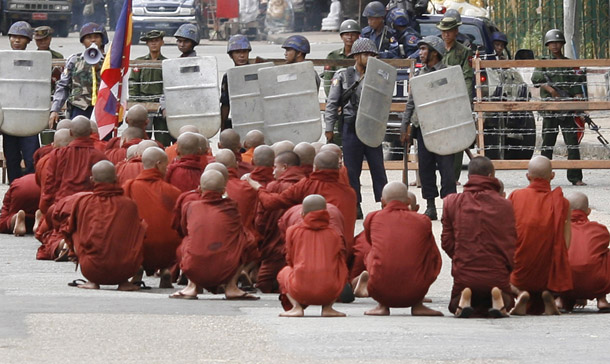
When thousands of monks took to the streets in September 2007 to protest the military government’s corrupt and repressive rule, the generals immediately perceived a significant threat and wasted no time sending troops onto the streets. As The Irrawaddy founding editor Aung Zaw recounted in this commentary first published in September 2014, those responsible for the resulting bloodshed remain largely unaccountable.

In 2007, thousands of monks marched in protest against one of the most repressive and corrupt regimes in the world. They were peaceful demonstrations, with the clergymen chanting the prayers of the Metta Sutta—the Buddha’s discourse on loving kindness. They took to the streets to show that monks shared a deep sympathy with the suffering Burmese people, who had lived under authoritarian rule for decades.

Military leaders saw a threat: the strongest movement of defiance against their iron grip on power since the 1988 pro-democracy uprising.

RelatedPosts

The Infiltration of Thailand’s State Power Structure by Wa Networks

The Infiltration of Thailand’s State Power Structure by Wa Networks

January 14, 2026
114
Myanmar Junta Election Inspector Killed in Magwe Ambush

Myanmar Junta Election Inspector Killed in Magwe Ambush

January 12, 2026
775
Myanmar Junta Election Official Killed as Blasts Rock Bago Region

Myanmar Junta Election Official Killed as Blasts Rock Bago Region

January 11, 2026
974

Troops joined the monks in the streets, not to take up their chants but to fire on them, and raid their monasteries. Seeing live footage and images of the brutality, the world condemned the regime. The UN said it deplored the crackdown, and regional neighbors that were usually passive in addressing Burma’s gross human rights violations openly condemned the killings. The United States tightened the noose of its sanctions regime.

The monk-led protests, known as the “Saffron Revolution,” were a turning point in Burma’s modern history. Unlike the 1988 uprising, during which hundreds if not thousands of peaceful demonstrators were gunned down, the uprising in 2007 was rather short-lived, but also had a lasting impact.

Social media played a key role, exiled media produced 24-hour coverage of the events, and campaign groups overseas reached out to key policymakers in the West and Asean to speak out against the regime’s brutality. Grassroots opposition was strong, both inside and outside the country. Burma headlines appeared everywhere, and the White House spoke out.

“Americans are outraged by the situation in Burma,” then US President George W. Bush said in an address to the UN General Assembly, as he announced even stricter sanctions on regime leaders and financial backers.

The images of thousands of monks pouring onto the streets in defiance of the regime no doubt shook the military leadership. Within three years, we saw the beginnings of a political opening in the country that continues—in fits and starts—to this day. However, many of the same people who have brutalized the nation and mismanaged its resources have continued to rule, albeit having swapped their military uniforms for civilian garb.

But today, while poverty and oppression persist in Burma and accountability for the Saffron Revolution crackdown remains elusive, the monks are not coming out as they did seven years ago. Over the last two years or so, some have instead shown a darker side of Buddhism, one in stark contrast to the teachings of the Metta Sutta.

Since mid-2012, we have seen the rise of an extremist fringe of Buddhism, featuring not peaceful street protests, but rather sword-wielding monks, hate-filled speeches and economic discrimination against Burma’s Muslim minority. The moderate voices, and many of the monks who once chanted for peace and loving kindness, have disappeared or been marginalized.

In the process, the country’s much-acclaimed “peaceful transition” to democracy has been stained by the blood of victims of the interreligious violence that has plagued many parts of Burma in recent years. It has also raised questions about the government’s ability and willingness to crackdown on extremists, and the most cynical allege that some powerful politicians had even conspired to stir up the hatred in the first place.

The Sangha community in Burma is under siege and divided. After the 2007 uprising, regime leaders have managed to carefully divide the monks’ community, estimated to be between 300,000 to 400,000 members. The politically active monks who are known to be anti-regime have been punished or marginalized. Monks who appear to take a neutral stance or promote nationalism and narrow-minded religious hatred are allowed to operate freely.

So far, it seems the strategy is working. Over the last two years, we saw the ascent of the anti-Muslim 969 movement, complete with proposals to limit interfaith marriage, boycotts on Muslim-owned businesses and an entire Muslim population denied its own existence in the country’s first census in more than 30 years.

All this at a time when officers who were involved in the Saffron uprising continue to live out their lives unpunished. Myint Swe, a former general who was then a powerful commander in Rangoon Division, was in charge of security affairs in 2007. Last year, when monks from the 2007 uprising sought a formal apology from the former regime leaders, Myint Swe (now chief minister for Rangoon Division) denied involvement in the violent crackdown.

“If you think I’m responsible, I am ready [to face justice],” he reportedly told businesspeople from the Myanmar Fisheries Federation at a meeting in Rangoon. He said that he was willing to be investigated and would even submit to the death penalty if found guilty of involvement. In a country where the concept of “rule of law” is laughable, and the justice system a farce, the words carried little weight.

Indeed, Myint Swe and many senior leaders and ministers who served in the previous regime are still serving in the current government or sitting in Parliament.

As the Saffron Revolution faltered in the face of seemingly insurmountable government brutality, the regime officially announced that 15 people were killed during the demonstrations. A press briefing held by then police chief Gen. Khin Yi had little credibility. He was on the ground and demonstrators watched as he commanded truncheon-wielding riot police to attack the monks and thousands of others who had joined the clergymen’s lead.

Then UN human rights special rapporteur Paulo Sergio Pinheiro countered by saying that at least 31 people were killed during the nationwide protests. Thousands of others were detained and monks were roughly tossed into temporary detention centers and full-fledged prisons.

As for Khin Yi, today he is one of the powerful Union ministers of this self-styled reformist government. If anyone can answer the question of how many people actually died or were tortured over those two months in 2007, it would be Khin Yi, Myint Swe or any of several other former generals who still hold positions of power. For a government that has in recent years trumpeted the virtues of transparency and accountability, however, the truth in Burma remains a surprisingly hard thing to come by.

 Aung Zaw is founder and editor of The Irrawaddy magazine. He can be reached at [email protected].

Your Thoughts …
Tags: CorruptionDemocracyjuntamilitary governmentMonksProtestrepressionSaffron RevolutionTatmadaw
Aung Zaw

Aung Zaw

Aung Zaw is the founder and editor-in-chief of The Irrawaddy.

Similar Picks:

Enter the Dragon, Exit the Junta: Myanmar’s Brotherhood Alliance makes Chinese New Year Vow
Burma

Enter the Dragon, Exit the Junta: Myanmar’s Brotherhood Alliance makes Chinese New Year Vow

by The Irrawaddy
February 12, 2024
45.7k

Ethnic armed grouping says it will continue Operation 1027 offensive until goal of ousting the junta is achieved. 

Read moreDetails
Drone Attack at Myanmar-China Border Gate Causes Over $14m in Losses
Business

Drone Attack at Myanmar-China Border Gate Causes Over $14m in Losses

by The Irrawaddy
November 27, 2023
39.3k

Jin San Jiao is latest northern Shan State trade hub in crosshairs of ethnic Brotherhood Alliance.

Read moreDetails
Arakan Army Captures Myanmar Junta Brigade General in Chin State Rout: Report
Burma

Arakan Army Captures Myanmar Junta Brigade General in Chin State Rout: Report

by The Irrawaddy
January 15, 2024
37.2k

Rakhine-based armed group has reportedly detained the chief of 19th Military Operations Command after seizing his base in Paletwa Township.

Read moreDetails
General Close to Myanmar Junta Boss Placed Under House Arrest, Interrogated for Corruption
Burma

General Close to Myanmar Junta Boss Placed Under House Arrest, Interrogated for Corruption

by The Irrawaddy
September 14, 2023
28.9k

The arrest of ‘kickback king’ Lt-Gen Moe Myint Tun, once seen as a possible successor to Min Aung Hlaing, comes...

Read moreDetails
AA Urges Myanmar Junta Troops to Surrender as Western Command Burns
War Against the Junta

AA Urges Myanmar Junta Troops to Surrender as Western Command Burns

by The Irrawaddy
December 18, 2024
25.7k

Ethnic army reportedly poised to capture regime’s last stronghold in Rakhine State.

Read moreDetails
Myanmar’s Brotherhood Alliance Calls on Northeast Command Chief to Surrender
War Against the Junta

Myanmar’s Brotherhood Alliance Calls on Northeast Command Chief to Surrender

by The Irrawaddy
August 9, 2024
25.1k

Brigadier-General Soe Hlaing handed ultimatum to relinquish northern Shan State after resistance seizes command base in Lashio.

Read moreDetails
Load More
Next Post
U Min Thu, minister for the Office of the Union Government, meets Yoon Jong-In, the deputy minister for the Ministry of the Interior and Safety of the Republic of Korea, on Monday in Naypyitaw. / Ministry of Information / Facebook

South Korea to Help Reform Myanmar’s Once Military-Controlled Administration

An ethnic Kayan woman, wearing a National League for Democracy sticker bearing an image of Daw Aung San Suu Kyi, waits for the then-candidate to appear at an election campaign rally in Demoso, Kayah State on Sept. 10, 2015.

Myanmar’s Ethnic Parties Dismiss NLD’s Ethnic Affairs Committee as Pre-Election Ploy

No Result
View All Result

Recommended

Myanmar in 2026: Military Dictatorship in Traditional Burmese Jackets

Myanmar in 2026: Military Dictatorship in Traditional Burmese Jackets

6 days ago
957
Looking Ahead to 2026: What Lies Ahead for Myanmar

Looking Ahead to 2026: What Lies Ahead for Myanmar

1 week ago
1.6k

Most Read

  • Resistance Keeps Punishing Myanmar Junta Forces in Eastern Bago

    Resistance Keeps Punishing Myanmar Junta Forces in Eastern Bago

    shares
    Share 0 Tweet 0
  • USDP Claims Sweeping Wins in Second Phase of Junta’s Election

    shares
    Share 0 Tweet 0
  • Myanmar Junta Election Inspector Killed in Magwe Ambush

    shares
    Share 0 Tweet 0
  • Myanmar Junta Keeps Pushing Revival of China-Backed Hydropower Project

    shares
    Share 0 Tweet 0
  • Rohingya ‘targeted for destruction’ by Myanmar, ICJ hears

    shares
    Share 0 Tweet 0

Newsletter

Get The Irrawaddy’s latest news, analyses and opinion pieces on Myanmar in your inbox.

Subscribe here for daily updates.

Contents

  • News
  • Politics
  • War Against the Junta
  • Myanmar’s Crisis & the World
  • Conflicts In Numbers
  • Junta Crony
  • Ethnic Issues
  • Asia
  • World
  • Business
  • Economy
  • Election 2020
  • Elections in History
  • Cartoons
  • Features
  • Opinion
  • Editorial
  • Commentary
  • Guest Column
  • Analysis
  • Letters
  • In Person
  • Interview
  • Profile
  • Dateline
  • Specials
  • Myanmar Diary
  • Women & Gender
  • Places in History
  • On This Day
  • From the Archive
  • Myanmar & COVID-19
  • Intelligence
  • Myanmar-China Watch
  • Lifestyle
  • Travel
  • Food
  • Fashion & Design
  • Videos
  • Photos
  • Photo Essay
  • Donation

About The Irrawaddy

Founded in 1993 by a group of Myanmar journalists living in exile in Thailand, The Irrawaddy is a leading source of reliable news, information, and analysis on Burma/Myanmar and the Southeast Asian region. From its inception, The Irrawaddy has been an independent news media group, unaffiliated with any political party, organization or government. We believe that media must be free and independent and we strive to preserve press freedom.

  • Copyright
  • Code of Ethics
  • Privacy Policy
  • Team
  • About Us
  • Careers
  • Contact
  • Burmese

© 2023 Irrawaddy Publishing Group. All Rights Reserved

Welcome Back!

Login to your account below

Forgotten Password?

Retrieve your password

Please enter your username or email address to reset your password.

Log In
No Result
View All Result
  • Home
  • News
    • Burma
    • Politics
    • World
    • Asia
    • Myanmar’s Crisis & the World
    • Ethnic Issues
    • War Against the Junta
    • Junta Cronies
    • Conflicts In Numbers
    • Junta Watch
    • Fact Check
    • Investigation
    • Myanmar-China Watch
    • Obituaries
  • Politics
  • Opinion
    • Commentary
    • Guest Column
    • Analysis
    • Editorial
    • Stories That Shaped Us
    • Letters
  • Ethnic Issues
  • War Against the Junta
  • In Person
    • Interview
    • Profile
  • Business
    • Economy
    • Business Roundup
  • Books
  • Donation

© 2023 Irrawaddy Publishing Group. All Rights Reserved

This website uses cookies. By continuing to use this website you are giving consent to cookies being used. Visit our Privacy and Cookie Policy.