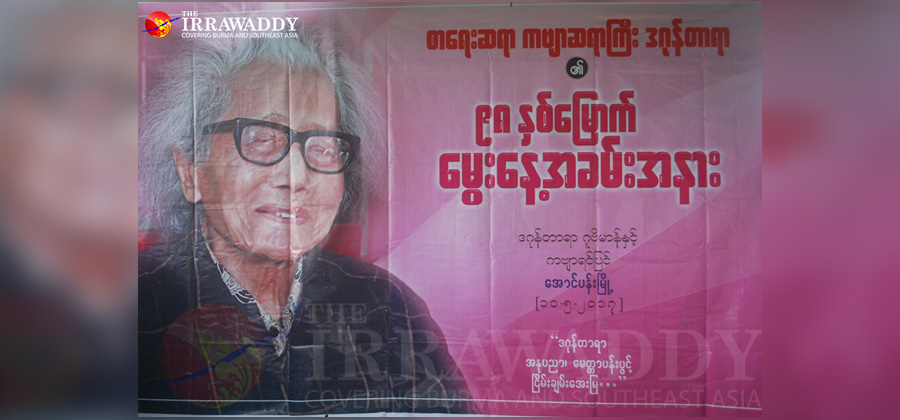
Today would have been the 100th birthday of Dagon Taya, one of Myanmar’s most celebrated literary figures, who died in August 2013. To mark the occasion of his birthday, The Irrawaddy revisits this 2013 profile of the late novelist and poet.
Dagon Taya, one of Burma’s greatest literary figures, continues to draw strength from his convictions despite attacks from critics and political opponents. At the turn of the 20th century, Burmese literature made a remarkable departure from its traditional classicism.
In 1904, James Hla Kyaw adapted part of the story The Count of Monte Cristo, by the French writer Alexandre Dumas, into Burmese under the title Maung Yin Maung Ma Me Ma, the first modern Burmese novel. It was an epoch-making work in the history of Burmese literature. This innovation led others to realize that exposure to world literatures, particularly those of the West, would greatly assist efforts to modernize Burmese literary writing.


In 1920, the University of Rangoon was founded and some persons connected with it— most notably J S Furnivall, founder of the Burma Education Extension Association— were determined to make foreign literature available to Burmese.
Many new adaptations of foreign works into Burmese followed. The writers of the new movement, who were called the “University Wits,” also did original works, including short stories and poems. There were three luminaries in this movement, which we now call Khitsan (“New Writing”). Theitpan Maung Wa was famous for his lucid prose style, while Zawgyi and Min Thu Wun were highly respected for their keen powers of observation, revealed in poems about the everyday life of people and the minute details of nature.
The styles and outlooks of William Wordsworth, P B Shelley, John Keats and Rabindranath Tagore of India—broadly speaking, the major exponents of Romanticism—were the major influences on the Khitsan writers. Later on many critics pointed out that while the Khitsan movement had made great strides in the development of artistic technique, they had failed to meet the contemporary political needs of the whole nation—particularly, the growing demand for independence from British colonial rule.
The most influential literary figure throughout the colonial period was Thakin Kodaw Hmaing, a highly respected journalist, playwright, poet and historian. His literary works succeeded in arousing patriotism, love and compassion, mainly dealing with the past history of Burma as well as the contemporary political movement for independence. Commentators agree that Kodaw Hmaing, alone amongst his contemporaries, was completely successful in meeting the esthetic and political requirements of his age, even though he continued to write in a traditional style of poetic composition.
Many of the young writers who emerged in the years following the Second World War were deeply affected by their experiences during the struggles against imperialism and fascism, as well as by their exposure to the prevailing left-wing political ideologies of the post-war period. Dagon Taya, a tremendously creative writer who continues to compose beautiful poems, short stories, novels and commentaries even now, became the recognized leader of the post-war progressive writers with his magazine Taya, which strove to promote literary realism and “art for people’s sake” under the banner of Sar Pe Thit (“New Literature”).
He was, in fact, the direct heir of Kodaw Hmaing’s politically oriented brand of literature, bringing to it a more sophisticated outlook and manner of presentation. Some observers have described the work of Dagon Taya as the product of a fusion of Kodaw Hmaing’s style with that of the earlier, pre-independence Khitsan writers. Min Thu Wun, the hero of Khitsan, dubbed Dagon Taya’s New Literature Movement “the Khitsan of the Khitsan.”
In fact, Dagon Taya and his fellow writers made a breakaway from Khitsan not only in terms of theme but also in sensibility and style, though many of them continued to use the rhyme schemes of their Khitsan predecessors when composing poems. The influence of Dagon Taya’s literary movement has, amazingly, continued to the present day. But he has not been without his critics, particularly amongst rival literary schools (including other advocates of “People’s literature”), which have accused him of writing in an overly stylized and unrealistic, even abstract, manner.
Not just a leading literary figure but also a famous peace activist who has made a significant contribution to both internal and international peace efforts, Dagon Taya has also been subjected to political persecution. After the military staged a coup in 1962, he was arrested and imprisoned for four years on suspicion of being a communist.
Personally, Dagon Taya is known to be calm, reserved and flexible, but also firm in his convictions. He was a close friend of Burma’s independence hero, Aung San, who in 1943 offered him a high-ranking position in the Japanese occupation government—an offer that Dagon Taya refused. Before Aung San’s assassination in 1947, Dagon Taya wrote a very beautiful but highly critical essay about Aung San’s personality, titled “Aung San the Untamed”.
Many Burmese were shocked by this apparent criticism of their revered father of independence, but Dagon Taya, and Aung San himself, merely smiled in response to the storm of controversy that this essay generated when it first appeared in Taya magazine. Even more daring was Dagon Taya’s rejection of an honor bestowed upon veterans of the independence movement by Gen Ne Win’s socialist regime.
The State Honorary Award, which carried a grant and a monthly stipend, was generally regarded as a bribe to win the loyalty of famous patriots. After his refusal to accept the award, Dagon Taya went into self-imposed exile from the capital and composed one of his best-known poems, “Sending myself to the Mae Za.”
“He then came to be seen as the Boris Pasternak of Burma in the eyes of the authorities,” recounts a young poet and close associate of Dagon Taya now living in exile. “Mae Za, in the Burmese political context, means the place where opponents of the king used to be sent as exiles, something like the gulags of Soviet Russia.”
Despite his strong leftist sympathies, Dagon Taya felt no need to conform to pre-conceived notions of socialist orthodoxy, either intellectually or in his lifestyle. He eschewed any sycophancy towards self-declared “liberators” of the masses, and throughout his life, kept his distance from political parties. A lifelong bachelor with long, wavy hair and a custom of wearing iridescent silk longyis and colorful Indonesian batik shirts, this “friend of the common man” also loved to express his free-spirited nature through painting and by playing the piano in a completely improvised, unrestrained manner.
In the 1970s, a new generation of poets, strongly influenced by their reading of contemporary Western literature and by their fervid, anti-imperialist response to the Vietnam War, broke with tradition and began composing poems in free verse. Although not explicitly anti-government in nature, the artistic liberties taken in these poems, as well as the themes of social injustice that frequently ran through them, provoked harsh criticism from conservatives close to Ne Win’s regime. Accused of trying to destroy classical literature or of being communist agents, these young poets found their greatest defender in Dagon Taya, who reiterated his position that, while it was good to have knowledge of the classics, it wasn’t strictly necessary as long as the poet’s work served the interests of the people.
In 1988, when demands for political reform in Burma came to a head, many writers both young and old became actively involved in the pro-democracy movement. Since then, to avoid censorship, many have used a variety of highly abstract styles and techniques, including surrealism, magic realism and stream-of-consciousness, to express their dissatisfaction with the status quo and their hopes for a more democratic society.
Meanwhile, Dagon Taya, who continues to write prolifically even as his eyesight fades in his old age, addressed the changes in the global political climate in a poem titled “The Thaw,” written after the fall of Berlin Wall, and in an article on the collapse of both individuals and entire nations as a result of political dogmatism and artistic rigidity. While the retreat from realism in Burmese literature has been understandable considering the circumstances, an unfortunate side effect of this development has been a growing tendency for young writers to divorce themselves from reality altogether.
Modernist and postmodernist literary theories have found many adherents in Burma since the early 1990s, resulting in a number of original works that are both aesthetically and politically significant. But, for the most part, they seem to have created an almost totally detached attitude towards the issues of society at large. “To an extent, [the introduction of new theories] needs to be welcomed. But when it becomes excessive, the young writers seem to be distracted from reflecting on the current situation,” commented one well-known writer based in Mandalay.
In reaction to the military regime’s propagandistic works of art, which promote an ideal of selfless service to the nation, and blindly following imported Western concepts, some young writers have even gone to the extreme of declaring themselves followers of the school of “art for no sake.” According to a well-known literary critic who writes for a famous magazine inside Burma, Dagon Taya briefly came under attack from one such group in the mid 1990s. This group—consisting of ex-communists, former members of Ne Win’s Burma Socialist Program Party and a few younger writers—accused Dagon Taya of being outdated and an obstacle to a new generation of writers.
“These attacks seemed to have had a hidden agenda,” observed one historian who closely followed the renewed controversy surrounding Burma’s most famous living author.
“They tried to denounce Dagon Taya by labeling him an old communist. The military regime was no doubt pleased to see him come under fresh attack.”
He also noted that Dagon Taya was not the only casualty of this latest assault on the living bastion of Burma’s modern literary history.
“The Burmese literary movement is scattering and dividing itself up,” remarked the historian, adding that literary figures and other left-leaning intellectuals have always been regarded as a threat by the country’s ruling military elite.
These attacks have since subsided; and, as if to demonstrate his own powers of endurance, Dagon Taya seems to have derived from them an even deeper awareness of the social and psychological state of Burma today.
Recognizing the deep sense of intellectual and spiritual drift that afflicts many young writers as they desperately seek a meaningful direction for the future, Dagon Taya reaffirms his belief that writers cannot afford to lose touch with their surroundings.
“One can not separate the arts from their socio-political setting,” he wrote recently. “Burma is now in a transitional period, and young people naturally feel that something is lacking in their minds and in their creative efforts. Indeed, Burmese literature is now looking for a new shore.”
You May Like This
NRPC, Karenni Rights Groups Still Struggle to Resolve Aung San Statue Debate
Political Prisoners Miss Out in President’s New Year Amnesty
China’s Xi Urges Teachers of Political Courses to Tackle ‘False Ideas’
Myanmar’s First Christian Missionary Dies at Sea