In an interview early in 2017 with the BBC, Fergal Keane asked State Counselor Daw Aung San Suu Kyi whether she thought that people in the West had misjudged or mischaracterized her, “expecting you to be this sort of amalgam of Mahatma Gandhi and Mother Teresa, for example, and actually maybe you’re closer in your determination and steeliness to someone like [former British Prime Minister] Margaret Thatcher?”
“Well, no,” she answered. “I am just a politician. I am not quite like Margaret Thatcher, no. But on the other hand, I am no Mother Teresa, either. I have never said that I was. Mahatma Gandhi was a very astute politician.”
Aung San Suu Kyi left Myanmar when she was 15. She studied philosophy, politics and economics at the University of Oxford. She only came back to Myanmar to look after her ill mother in 1988. Later she took part in the 1988 pro-democracy uprising as a daughter of General Aung San. She had never experienced political struggle in her life before then. That was the beginning of her life as a politician.

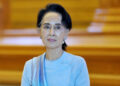
From 1990 to 2010 she was, in German sociologist Max Weber’s term, “a voluntary politician” — she spent 15 years under house arrest, “economically independent from the earnings that the work as a politician may produce.” She enjoyed the “naked” possession of power. She stood as an opposition leader until she became a member of parliament in the 2012 by-elections.
Weber, in his essay “Politics as Vocation,” published in 1919, said that “the ethics of moral conviction is an absolute ethics.” Weber was right. The luxury of the activist is that he or she can preach this absolute ethics. However, absolute ethics is not concerned with practical consequences. The activist does not share with the politician the ethics of responsibility.
Not long ago, in 2012, after her release from house arrest, Aung San Suu Kyi was finally able to deliver her Nobel lecture at Oslo City Hall, in Norway. She explained why she was fighting for human rights and democracy, first quoting from the Universal Declaration of Human Rights:
…it is essential, if man is not to be compelled to have recourse, as a last resort, to rebellion against tyranny and oppression, that human rights should be protected by the rule of law…
If I am asked why I am fighting for human rights in Burma, the above passages will provide the answer. If I am asked why I am fighting for democracy in Burma, it is because I believe that democratic institutions and practices are necessary for the guarantee of human rights.
Such beautiful sentiments are those of an activist before accepting the responsibilities of an “absolute politician.” As an activist, she practiced the “duty to truthfulness,” which is indispensable to “absolute ethics.” However, she did not have to take responsibility for what she said. Whatever she says today has consequences because she has to take full responsibility for the country as a minister of foreign affairs and as state counselor.
Western Icon-Activist
Since being awarded the Nobel Peace Prize “for her nonviolent struggle for democracy and human rights,” Aung San Suu Kyi has been portrayed as a human rights icon. However, in 2017 her portrayal in the media changed from that of a saint to “an ignoble laureate,” as The New Yorker put it in September, because of her perceived silence on the flight of more than 600,000 refugees from western Myanmar to Bangladesh. The international community questioned her moral authority.
Typical of this reversal, the Washington Post wrote in December: “We expect President Trump to be a boor. We expect the Putins, the Xis, the Erdogans to brutalize their own people. However, there is something uniquely awful about a Nobel Peace Prize laureate acting as an enabler of the murder and displacement of an entire community.”
Some have called for her Nobel Peace Prize to be revoked. While the international community recognized her “for her nonviolent struggle for democracy and human rights,” it balked at recognizing her as a stateswoman and a politician. Her “ethics of moral conviction” has become a great concern for those who think of Aung San Suu Kyi as a saint. Her silence on the Rohingya crisis seems to have broken their hearts.
Aung San Suu Kyi’s nonviolent principles were questioned because of what activists saw as her failure to stop military action against the Rohingya, a Muslim minority group in Myanmar.
Politics has become Aung San Suu Kyi’s “professional vocation” only since she became minister and state counselor. Although the majority of voters chose her party in the 2015 election, the country is burdened with a constitutional provision that gives the military absolute power over the ministries that control the use of coercive force in Myanmar — namely Border Affairs, Home Affairs and Defense. That is why former UN Secretary-General Kofi Annan referred to “the duality in the leadership” in Myanmar. Aung San Suu Kyi has a responsibility as a stateswoman for the violent actions of the military and police force, but she does not have any power to control these forces.
The problem is that Aung San Suu Kyi needs to carefully handle the military for the use of violence while avoiding anarchy or a coup. Every step she takes as a politician comes with the risk of pushing the country back to military rule.
In the recent Rohingya crisis, Aung San Suu Kyi is being “accused of betraying the ideals for which the world once lionized her. Her long struggle for freedom has given her unchallenged moral authority. This power, too, she has conspicuously failed to use,” Washington Post editor Christian Caryl wrote in a December opinion piece, “In 2017, no one has fallen further than Aung San Suu Kyi.”
Aung San Suu Kyi’s efforts to balance passion and political objectivity have always created conflict with her sense of proportion.
Aung San Suu Kyi’s silence on the Rohingya and other issues is confusing. Is it a sign of “nonviolent reconciliation” with the military? Or is it true that she is the demon she is portrayed as internationally? The dominance of the military creates a conundrum for a crusading non-violence activist like Aung San Suu Kyi. On the other hand, she is dealing with conflicts with several ethnic groups besides the Rohingya whose demands for autonomy may not be consistent with national interests. Meanwhile, internationalists focus on abstract principles of human rights.
Aung San Suu Kyi is undertaking the (nearly) impossible, as Alan Clements, a biographer of hers, wrote a few months ago on his social media page, by “making peace with everyone in her country, the oppressed and oppressors alike. This is unprecedented emotional and psychological territory, and not easy for the ‘us and them’ dynamic that dominates mainstream politics.” Nor, for the matter, for the absolute ethics of “The Sermon on the Mount” that many activists ascribe to and expect the politician Aung San Suu Kyi to follow.
Myanmar has never been a “liberal democracy,” so what options does this leave a politician?
For Aung San Suu Kyi, “politics was to do with ethics, it was to do with responsibility, it was to do with service.” However, as a stateswoman, “politics” means dealing with physical force — the unavoidable ethical paradox of being a politician.
Potential Threats
The International Crisis Group (ICG) recently listed the Rohingya crisis as one of the top 10 conflicts in the world to watch in 2018. Myanmar’s young democracy is now facing threats that could tip the country into becoming a failed state. Aung San Suu Kyi plays a significant role in resisting those threats.
There are two main threats that the country might face. The first is targeted sanctions from the UN Security Council and the international community.
The Security Council and Western governments are moving toward targeted sanctions. Unfortunately, these sanctions are unlikely to have a significant positive impact on Myanmar’s policies. As the ICG said, “Myanmar’s Rohingya crisis has entered a dangerous new phase, threatening Myanmar’s hard-won democratic transition, its stability, and that of Bangladesh and the region as a whole.”
The second threat to Myanmar is another military coup or “state of emergency,” which would lead to the dismissal of Parliament and a clampdown on newly won freedoms. Such a state of emergency is defined in the military-drafted 2008 Constitution, which assigns the military to safeguard the country in any crisis situation.
Balancing Pressure, Balancing Power
Today, Myanmar is infamously known as a country that has committed crimes against humanity by violently uprooting hundreds of thousands of Rohingya and creating a major refugee crisis. As a consequence, Aung San Suu Kyi has been made responsible for the crime.
Ironically, the violent acts of the Myanmar military against civilians and various ethnic minority groups were never brought up at the UN Security Council until UN human rights chief Zeid Ra’ad Al Hussein labelled the military’s behaviour “a textbook example of ethnic cleansing.”
If Myanmar returns to military rule, what might happen? This is what the responsible politician must contemplate. Under military rule, would there be a million refugees? What would the Bangladesh government do? Would Aung San Suu Kyi herself be placed under house arrest again? Will the violent actions against ethnic minority groups and the Rohingya resume?
Both the UN and Aung San Suu Kyi are trying to avoid pushing Myanmar toward military rule and failed-state status. Sooner or later Myanmar’s ongoing civil war will produce even more refugees and potentially spread problems ever further across the region. Burdens will increase.
A real politician, in Weber’s sense, will want to avoid dangerous situations and manage the military generals who are responsible for violent actions against civilians rather than focus on the civilian government. The burden of balancing international pressure should be placed on a civilian government elected by the people and on the military institutions with the absolute power over armed force. UN resolutions should encourage military reform in Myanmar too.
If the UN Security Council wants to help balance power in Myanmar’s dual leadership system, it should be supportive to Aung San Suu Kyi’s civilian government as it strives for a peaceful democratic transition in a violent country that has never tasted the fruits of a liberal democracy.
In concluding his 1919 essay, Max Weber said, “Only the person who is sure that he will not despair when the world, from his standpoint of view, is too simpleminded and wicked to accept what he has to offer, and only the person [who] is able to say ‘In spite of it all!’ has a calling for the profession of politics!”
Being in no despair of all the harsh criticisms of her, Aung San Suu Kyi, in an interview with the Nikkei Asian Review in September, said: “Actually, nothing is surprising, because opinions change and world opinions change like any other opinion.”
So apparently she does have a calling for the profession of politics, even if she came to it late in her career.
This article uses Tony and Dagmar Waters’ book “Weber’s Rationalism and Modern Society” as a reference.
Mon Mon Myat is a freelance journalist and a graduate student in the PhD program in Peacebuilding at Payap University in Chiang Mai, Thailand.