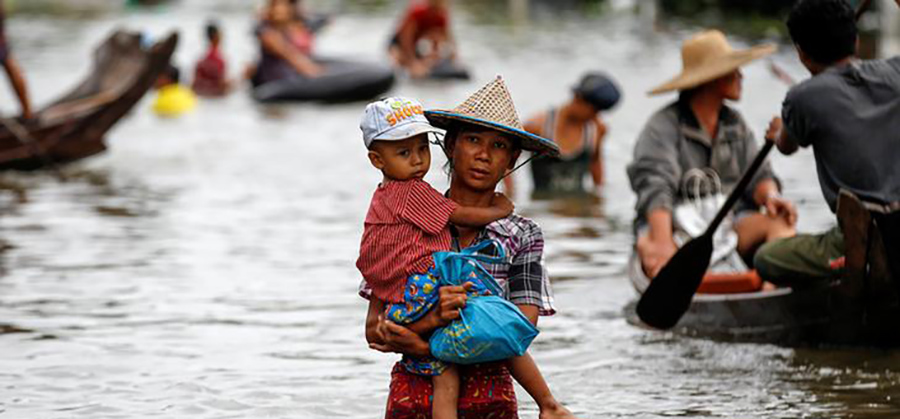
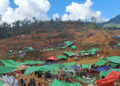
In May 2008, Cyclone Nargis struck Myanmar, causing loss of lives and widespread destruction of property. The category 4 cyclone strongly reiterated two facts: climate change and its repercussions have to be recognized and tackled; and, secondly, a natural disaster has the ability to bring people and civil society organizations together for re-building the spirit of the country. It was a critical moment of reflection for the nation, to take stock of its vulnerability and preparedness against an enemy which had generated havoc and panic for all.
According to the 2016 Climate Risk Index, Myanmar is the second most vulnerable country in the world to the effects of climate change. The intensity and regularity with which cyclones make landfall have increased with every year, with the delta region affected by tropical storms and the dry zone impacted by debilitating droughts. Researchers at the Center for Climate System Research at Columbia University, in collaboration with the Department of Hydrology and Meteorology, have stated that the country could see a rise in temperature by 1.3 and 2.7 degrees by the middle of the century along with increase in precipitation by 2 percent to 12 percent in 2011-40, 6 percent to 27 percent by 2041-70. This is evident from the 2010 severe drought, a year which saw temperatures rise up to 47.2 degrees Celsius, a sure sign of global warming hitting the country hard. Dry seasons have become longer with shorter rainy seasons, thus inviting hardships for people in the form of water shortages and flooding respectively.
Both plant and animal life are bound to struggle due to the occurrence of anomalies in the natural environment. Shrinking of glaciers in the Himalayas can affect water supplies in rivers like the Irrawaddy and inundation of coastal areas with salt water can destroy agricultural production and trigger forced migration. According to data collected by the International Earth Science Information Network of Columbia University, over 5 percent of the country’s land area lies below 5 meters in elevation, home to 11 percent of the population, estimated to climb to nearly 14 percent by the end of the century. This could have grave consequences for an agrarian country like Myanmar, where agriculture is the main source of livelihood. A post-Nargis disaster case study revealed that decades of poor environmental policy had resulted in reduction of mangroves by approximately 75 percent along the country’s coastline. This further exposed Myanmar to the ravages of climate change. Also low-lying regions like Rakhine are predicted to be more affected in the future. This in turn could lead to more ethnic clashes as this region could see a surge in environmental refugees pushing their way into other regions or crossing borders to seek shelter in Bangladesh.
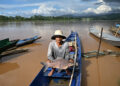
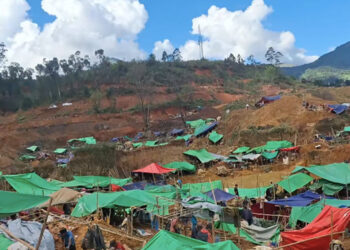
Climate change is forcing people to break man-made boundaries but future conflict is most likely to occur on issues of sovereignty, territory, resources and belonging. This could add volatility to the religious/inter-community clashes already existing in Myanmar. Climate change will also exacerbate heat and water related diseases like malaria, dengue, and diarrhea. The report titled “A Situational Analysis of Disaster Risk Reduction in Myanmar-DRR Working Group, June 2013” states that the Global Adaptation Institute ranked Myanmar 167 out of 176 countries surveyed, which not only shows its vulnerability but also its low capacity of adaptability to negotiate climate risks. The report further pointed out that over 2.6 million people could be affected by natural disasters in Myanmar. Fast paced economic growth, unsustainable agrarian practices, indiscriminate logging and mining can further put pressure on natural resources and ecology, endangering local communities. Poor governance, weak laws and lack of climate smart planning can add to the challenges.
In recent years, Myanmar has seen massive city development plans and a construction boom. But often these decisions are made without considering long-term environmental impacts. Disappearance of green spaces, the ignoring of subsidence risks and inadequate water management systems in a city like Yangon are well-known problems. The latter is very much evident every year during the torrential monsoon rains which hit the city. Aung Khant observes that the Yangon City Development Committee (YCDC) seems to lack proper equipment and is involved in constant repair work rather than initiating improvements. Although nature is blamed for flooding, it is known that reservoirs and waterways have been subjected to landfills during the military regime, thus leaving no room for excess water to escape. Also, the designs and the building materials used for stylish high rises are imported with no connection to the local landscape or the tropical weather.
Damon Zumbroegel, of the architectural firm Vihara Studio, believes in the strength of Myanmar’s traditional green architecture which uses locally available materials and is more sustainable for cooling. These indigenous methods need to be promoted to tackle climate change impacts as they could be much more effective, cheaper and more viable than imported technology. Environmental NGOs like ALARM and Green Lotus are trying to create awareness around green technologies.
A similar kind of promotion of local building techniques to combat natural disasters like floods and earthquakes is also happening across the border in North East India- a region which regularly faces displacement on account of rivers changing courses and tectonic shifts. A three-day-training workshop on the promotion of bamboo housing was held in Assam in February 2017. This was jointly organized by the Assam forest and environment department, the South Asia Bamboo Foundation, and the Building Material Technology Promotion Council, along with the Ministry of Housing and Urban Poverty Alleviation. Everyone participated to promote traditional bamboo housing, to be used in building schools, hospitals, rural community centers, and eco-tourism cottages. Ikra, the traditional bamboo frame structure, is being re-popularized over cement structures. Although the former is better at withstanding earthquakes and natural disasters (as evident in the Sikkim 2006 earthquake), people tend to use concrete as it is considered modern and a status symbol. Ikra not only preserves the housing structures better, but it is cheaper and more sustainable in the soft mountain soil.
Bhutan and Indonesia, like Myanmar, have also witnessed unpredictable phenomena linked to climate change. In Bhutan, the severity and frequency of windstorms have increased as well as loss of crops due to unusual outbreaks of pests and diseases. The country also runs the risk of seeing more forest fires in the future (Thinley 2015). Indonesia has seen the disappearance of the phenomenon of ‘bulan janda” (widow month), a period of 44 days of strong winds blowing from the south when fishermen would avoid venturing into the sea. Nobody understands the reason for this disappearance. Is global warming responsible, considering that higher temperatures can alter the scale of circulation (Banerjee 2015)?
Myanmar has initiated various interventions to combat climate change. The Myanmar Climate Change Strategy and Action Plan 2016-2030 is relevant for the future. The Myanmar Climate Change Alliance (MCCA) has worked with various stakeholders- ministries, civil society groups, private sector and communities. The 2013-2015 UNDP Environment, Climate Change, Energy and Disaster Risk Reduction Project promoted participation of local communities in adaptability, preparedness and mitigation. It also worked on including gender in the climate change narrative by supporting the inclusion of the gender dimension in all areas: environment impact analysis, environmental standards/procedures and multi-hazard risk information.
Myanmar needs to generate and disseminate more climate risk information at the local level so that community leaders can better coordinate with villagers. It also needs to record the responses of species and ecosystems to climatic changes. Application of local knowledge to weather impacts needs to be systematically compiled and documented. Public services like health, sanitation, flood warning systems and evacuation plans need to be further developed. Building the capacity and resilience of agriculture, tipping point identification and monitoring, mangrove protection, designing climate proof plans for infrastructural development, and recognizing at-risk neighbourhoods in urban areas are some of the immediate steps that Myanmar could take. The Chinese NGO, Global Environment Institute in 2015, in combination with an alliance of Myanmar NGOs and Blue Moon Foundation, provided solar panels and clean cooking stoves to Myanmar’s villages, an effort through the South-South Cooperation Fund for Climate Change set up in 2014 to reduce emissions. This seems like a welcome step towards promoting renewable energy and charting out new territories of green partnership.
The biggest challenge, however, in any country lies in getting people to converse about climate change. There is insufficient visibility for the topic (in the media, in academic discourse, in fiction writing, in art galleries) although its impact is felt daily. Amitav Ghosh, the much acclaimed writer whose recent book The Great Derangement is on climate change, laments the absence of fiction writings/imagination on it. He states that it seems the issue is reduced to ‘extraterrestrials or interplanetary travel’. Myanmar’s civil society needs to bring this issue more into the public domain for debate and solution-finding exercises. The government has already invited World Wildlife Fund (WWF) to conduct a natural capital assessment and WWF has chosen creative ways of sharing the results by launching a website and an instagram campaign, hosting a photography exhibition showcasing the country’s relationship with nature and encouraging people to engage deeply through panel discussions. Visual medium and art is used to convey information and get feedback which will ultimately help the country in making land use and conservation policies.
School curricula, college clubs, community associations, and local conservation-cum-heritage boards should seize every opportunity to broaden the canvas of participation; climate change has brought the global and the local closer: a global phenomenon which requires sustained local resourcefulness. Local governance, engagement of farmers and local leaders in decision making, better management of food and water systems, gender-sensitive climate change strategies will all go a long way in achieving growth – green, sustainable, equitable.
Works Cited
Banerjee, Reshmi (2015), “Climate Change in the Eastern Himalayas: Lessons to be Learnt” in Hazarika, Sanjoy and Banerjee, Reshmi (eds), Climate Change in the Eastern Himalaya- Impact on Livelihoods, Growth and Poverty, Delhi, Academic Publications, p.181.
Thinley, Pema (2015), “Climate Change Impacts and Policies in Bhutan” in Hazarika, Sanjoy and Banerjee, Reshmi (eds), Climate Change in the Eastern Himalaya- Impact on Livelihoods, Growth and Poverty, Delhi, Academic Publications, pp. 156-157.
This article originally appeared in Tea Circle, a forum hosted at Oxford University for emerging research and perspectives on Burma/Myanmar.