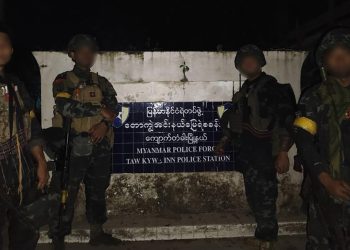
The military regime has likely set its sights on reclaiming territory lost to the resistance in Mandalay Region now that it has re-established a solid corridor in northern Shan state all the way to the Chinese border.
The junta’s reconquests in northern Shan are unlikely to continue, even though much of the state remains in the hands of the Brotherhood Alliance of ethnic armed groups.
Recently, the Ta’ang National Liberation Army (TNLA), an ethnic Palaung armed group, was forced to sign a ceasefire agreement with the regime at China-brokered peace talks in Kunming on Oct 27 and 28.


As part of the deal, the TNLA agreed to hand back to junta control the liberated towns of Mongmit in northern Shan State as well as Mogoke, a ruby hub in northern Mandalay.
The truce has given the regime time to rest and regroup in northern Shan State, allowing it to redeploy troops and military resources to other frontlines—such as Mandalay, Kachin, Chin, Karen, and Rakhine—where it has lost significant territory.
The next target for the regime offensive

More than half of northern Shan—including key China–Myanmar border trade gates and routes that generate billions in revenue for the controlling authorities—remains under the control of the Brotherhood Alliance, which seized it in the course of Operation 1027.
Tax revenues from the China–Myanmar trade flows are equal to 80 percent of the junta’s daily expenses, and the region is also home to investment projects under China’s Belt and Road Initiative.
That is why China forced the Myanmar National Democratic Alliance Army (MNDAA) to return the liberated state capital Lashio to the regime in April this year. And with Beijing’s backing, the junta also recently regained control of the TNLA-held towns of Nawnghkio, Kyaukme, and Hsipaw.

Instead of launching further offensives, the regime is now expected to try and consolidate its hold on these areas.
“The regime would not dare launch further offensives in northern Shan State near the Chinse border without Beijing’s approval,” said a military analyst who monitors the conflict in northern Shan. “The junta is afraid of China, and Beijing will not tolerate clashes near its borders.”
But Swe Taw, a prominent military defector, believes the regime will continue leveraging Chinese pressure to reclaim more lost territories, and Beijing too wants to see its projects completed under the current regime’s administration.
Turning to the heartland

The gains in northern Shan, then, allow the regime to turn its attention to territory lost or threatened in the heartland.
During Phase 2 of Operation 1027 starting in June 2024, People’s Defense Force (PDF) and other resistance groups in central Myanmar helped the TNLA to seize at least four towns in northern Shan and Mogoke in northern Mandalay.
In return, the TNLA helped the PDF groups in seizing Thabeikkyin, Singu, and Madaya townships as well as several junta bases in Patheingyi Township in Mandalay. The “Shan–Mann Operation” launched by the PDF
and TNLA even threatened Mandalay city.
To secure it, the regime has launched major offensives in northern Mandalay.
As a means of pressuring PDFs to abandon liberated territories, the regime is relentlessly bombarding civilian targets there, causing dozens of civilian casualties.

The regime used similar tactics to force the TNLA into signing the China-brokered ceasefire. Unable to deploy ground troops to retake the towns, the regime relied on daily airstrikes on TNLA-held areas, killing civilians and making it difficult for the ethnic army to administer the liberated towns.
But the PDFs have vowed to defend the liberated territories and declared that they will not hand over Mogoke despite the TNLA’s pledge.
Can the resistance defend northern Mandalay?

In a statement Wednesday, the Mandalay PDF said that, together with its allies, it will do its utmost to defend the territories under its control in Mandalay Region.
PDFs in Mogoke called for greater cooperation to defend the ruby-mining town.
Already the resistance has lost control of Thabeikkyin and several rural areas, as well as many previously liberated zones in nearby Madaya and Patheingyi.
Former army captain Zin Yaw, another prominent military defector, said the PDFs could hold their remaining territories in northern Mandalay for a long time provided they have sufficient weapons and ammunition.
But fellow defector Swe Taw is skeptical given the military’s superior firepower and airpower.
“If the junta conducts more attacks on civilian targets as a form of pressure, the PDFs will not continue resisting at the cost of civilian’s lives,” he said.