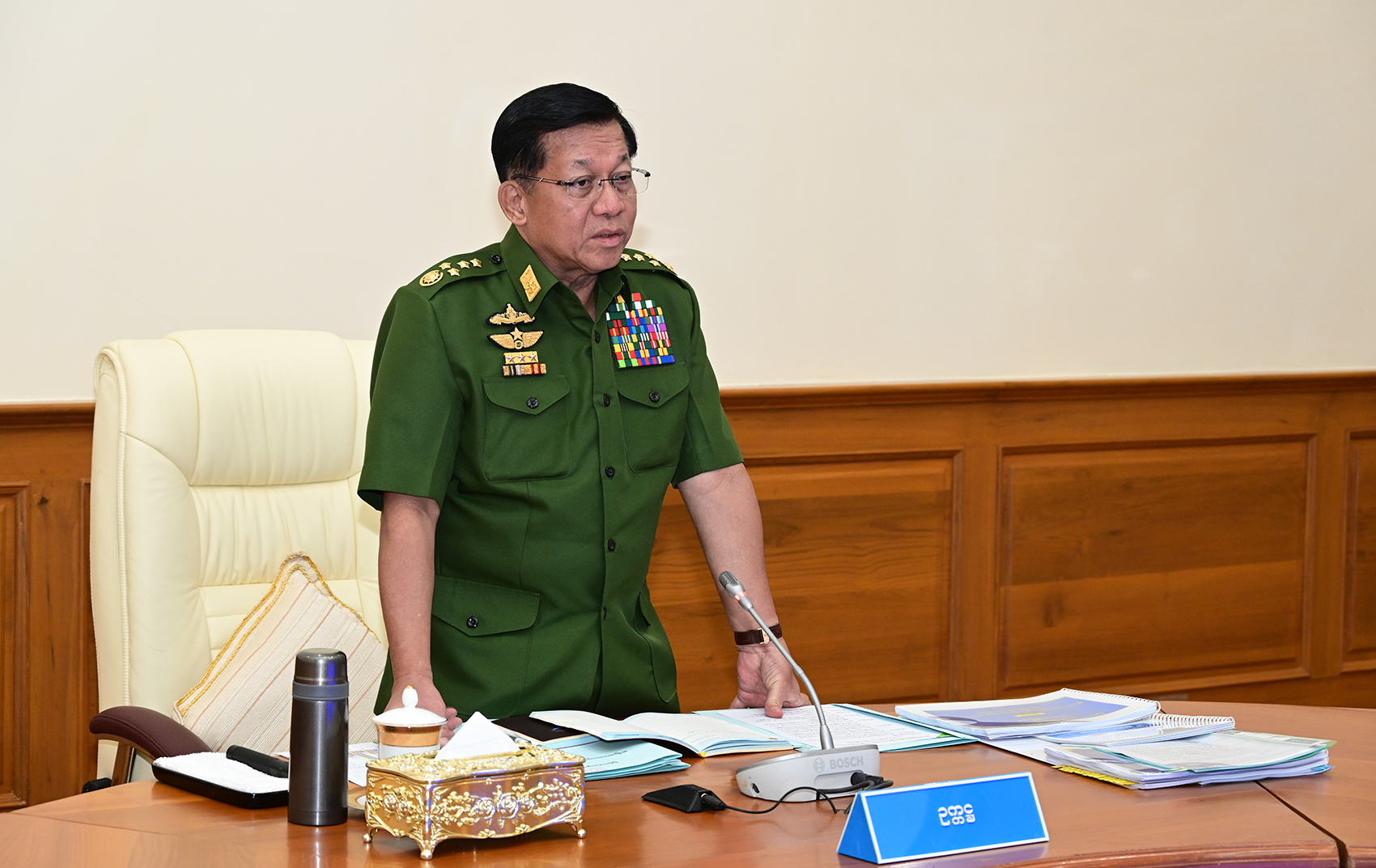
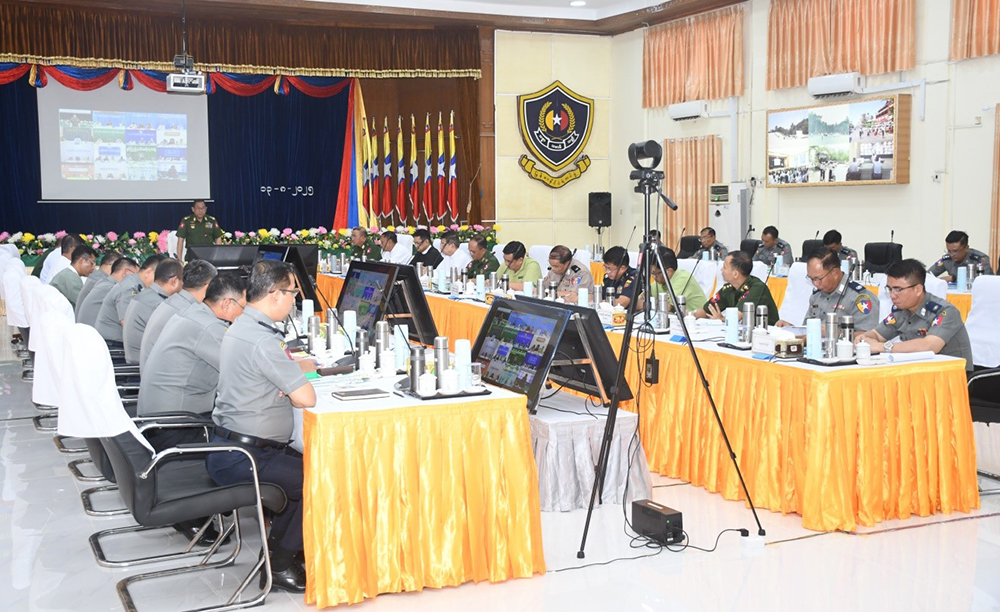
At the first meeting of the State Security and Peace Commission—the junta’s newly rebranded governing body, now focused on securing the December election—Senior General Min Aung Hlaing vowed the vote would be held “no matter what,” called for swift trials for any killings during the election period, and announced military operations to enable voting in more townships amid the civil war.
Tuesday’s meeting was attended by deputy commander-in-chief Soe Win, Prime Minister Nyo Saw, Defense Minister Maung Maung Aye, Home Affairs Minister Tun Tun Naung, Foreign Minister Than Swe, military No. 3 General Kyaw Swar Lin and other senior officials including Aung Lin Dwe, Ye Win Oo and Yar Pyae.
Vote to be held ‘without fail’
With just over four months to go, Min Aung Hlaing reiterated his commitment to proceed with the polls, saying they were necessary to convene parliament, elect a president and form a government. The regime is framing the election as a constitutional step toward “democracy,” but the junta’s real aim is widely recognized to be the consolidation of military control.
Political analysts note that with backing from the military’s proxy Union Solidarity and Development Party (USDP), Min Aung Hlaing is widely tipped to become president. The party is positioned to dominate under new electoral laws that exclude major opposition forces like the National League for Democracy. With 25 percent of seats reserved for the military and a shift to proportional representation, the USDP could govern with just over one-third of the popular vote.
Since seizing power in the February 2021 coup, the junta chief has repeatedly promised elections without setting a date. During a visit to Belarus in March, he for the first time specified a timeframe — late December 2025 to January 2026. He has said the exact date will be announced soon.
‘Swift justice for election-period crimes’
Min Aung Hlaing has called for measures to prevent election-related killings, predicting “an increase in assassinations of civil servants and civilians accused by anti-regime groups of collaborating with the junta.”
He also stressed suspects would be tried swiftly, saying such “assassinations” must not be treated as ordinary crimes.
Warning that individuals and organizations opposed to the polls may carry out acts of sabotage, he ordered tight security for candidates and voters.
The regime’s Election Protection Law, enacted on July 29, prescribes punishments ranging from three years’ imprisonment to death for actions that disrupt the planned polls.
Resistance forces have long rejected the election, and targeted killings of former military officers and pro-junta figures have heightened security fears among political parties and election commission staff.
The Arakan Army (AA), which controls 14 of 17 townships in Rakhine State, has said it will not allow voting in its territory. Karen National Union chairman Saw Kwe Htoo Win recently urged all Karen people to consider it their duty to the nation to prevent the election by any means necessary.
The Ta’ang National Liberation Army, which has been fighting the regime in northern Shan State, has accused the junta of using the election to extend military rule under civilian guise.
Expanding the vote by force
While analysts predict escalating hostilities between the regime and resistance forces in the run-up to the poll, Min Aung Hlaing told the Tuesday meeting that he expects to hold polls in more towns.
The junta’s Union Election Commission said earlier that elections would be held in 267 out of 330 townships across the country. While the list of townships has not been officially released, more than 60 are currently under martial law, mostly in areas controlled by ethnic armed groups and resistance forces, including in Kachin, Karenni, Karen, Chin, Rakhine, northern Shan, Sagaing, Magwe and Mandalay.
With martial law in place through October, analysts expect the military to try to seize these areas before the polls.
At the meeting, Soe Win briefed Min Aung Hlaing on the activities of anti-regime groups and ethnic armed organizations in various regions and states, and the military’s “progress” in security operations.
Home Affairs Minister Tun Tun Naung reported on ongoing efforts to expand territorial control to enable voting in more townships.
The following day, the junta’s committee on security supervision for the election held its first meeting in Naypyitaw, vowing to prioritize stability and prevent security breaches during the electoral period, junta media reported. Tun Tun Naung, the chair of the committee, urged committees charged with security supervision at various levels to understand their duties and powers under the law and to make special efforts in their security responsibilities, coordinating with relevant departments and partner organizations.
International reaction
The US and other Western governments, as well as the parallel National Unity Government and ethnic armed groups fighting the regime, have long rejected the election, calling it a sham designed to entrench military rule. Malaysia, as current chair of the Association of Southeast Asian Nations (ASEAN), has urged the junta to prioritize ending the violence in the country ahead of staging an election.
Stockholm-based democracy organization International IDEA this week urged the global community to reject any support—technical, material or political—for the election process.
In an August 12 statement, the organization warned that the planned vote was a calculated attempt to legitimize military rule, rather than restore democracy. The organization also criticized the junta’s Election Protection Law.
In contrast, regional neighbors China, India, Thailand and Cambodia—along with Russia and Belarus—have expressed support for the election.