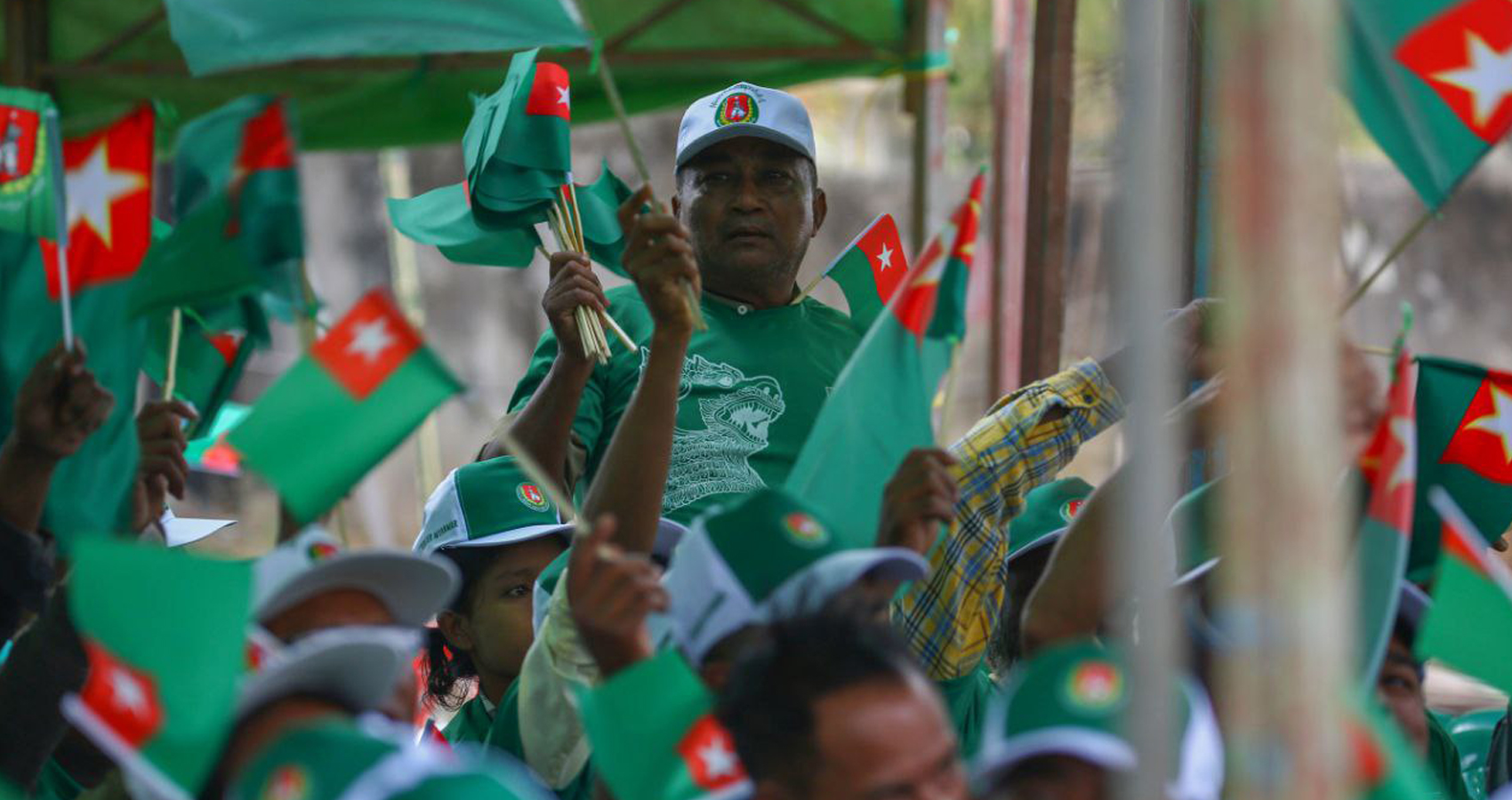
Some political parties and candidates who contested seats in the first phase of the junta-organized election have raised the alarm over alleged advance-ballot manipulation by the military-proxy Union Solidarity and Development Party (USDP)—a scenario similar to what the country saw in the widely discredited 2010 poll.
In the unpopular 2010 vote, the USDP secured victory through widespread advance-vote manipulation. Parties running in the junta’s ongoing election claim they are facing a repeat of those irregularities.
The first phase of the Myanmar regime’s election was held in 102 townships on Dec. 28 last year, with most seats won by the USDP. As of Thursday, the USDP had taken 89 of 102 Lower House seats—nearly 90 percent—contested in the first phase.



At least three parties have reportedly submitted formal complaints to junta chief Min Aung Hlaing over advance-vote irregularities by the USDP. Some parties and candidates who are afraid to come forward publicly for fear of repercussions told The Irrawaddy anonymously that the advance votes and late votes received by the USDP changed the election outcomes in some constituencies.
The Shan and Nationalities Democratic Party (SNDP), Myanmar Farmers Development Party (MFDP) and People’s Party (PP)—all contesting nationwide—accused the USDP of committing advance vote irregularities. Their complaints were submitted on Jan. 2 and 3, respectively.
“We complained to the commander-in-chief over advance-vote irregularities,” SNDP Chairman Sai Aik Pao told The Irrawaddy.
He said he hoped that submitting a complaint to the junta chief would result in greater transparency.
He also said the party’s complaint concerned constituencies across the country, not just a single township.
Junta chief Min Aung Hlaing has said the election must be free and fair, but the results did not reflect that, MFDP secretary Daw Khin Khin told The Irrawaddy.
“As a result, the USDP won, while our party received zero advance votes,” she said.
She said there was a lack of information on the number of advance voters, and on when and where advance ballots would be cast.
The Irrawaddy contacted leaders of the People’s Party, including party head U Ko Ko Gyi, for comment, but received no response.
“We received more votes in the rural areas and the city than the USDP. When the polling station closed at 5 p.m., we had 3,000 more votes than their party. At 11 p.m., we won in the Lower House and Upper House, but the USDP won the Regional Hluttaw [parliament] with votes that came in late,” a member of the Mon Unity Party said.
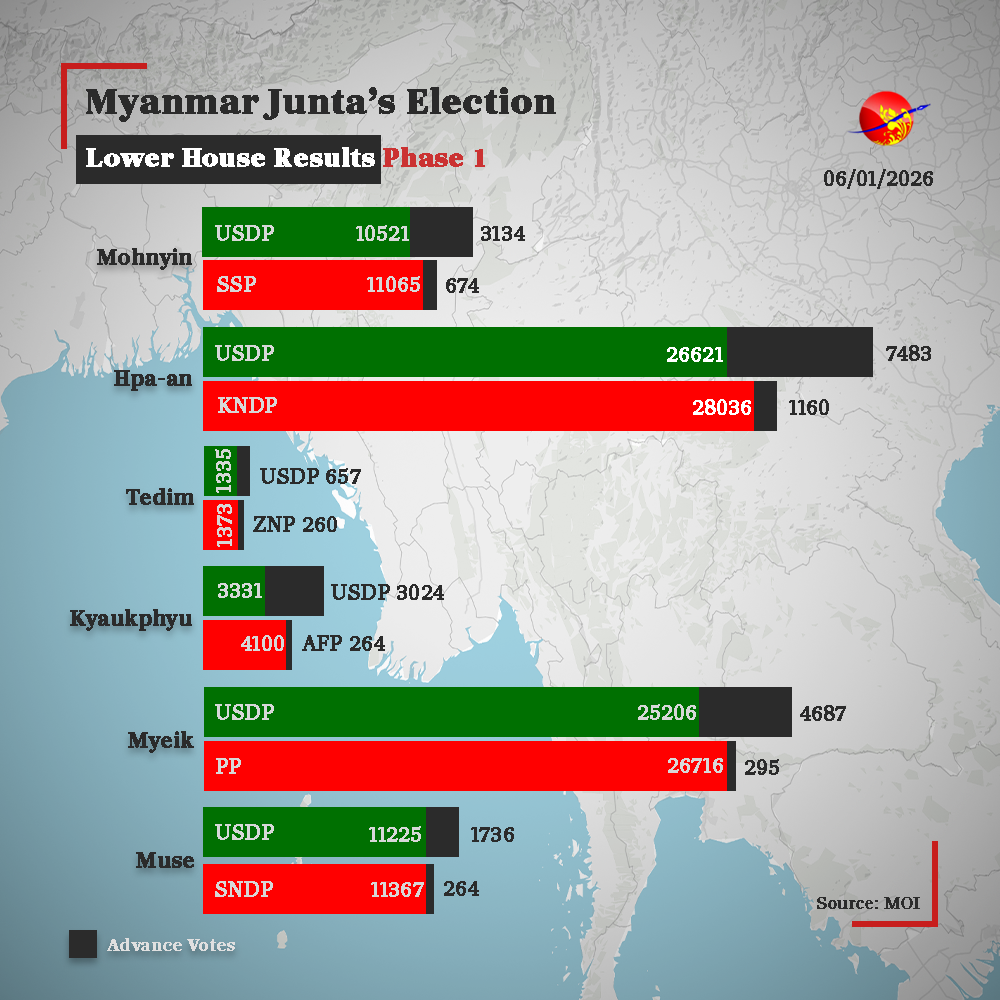
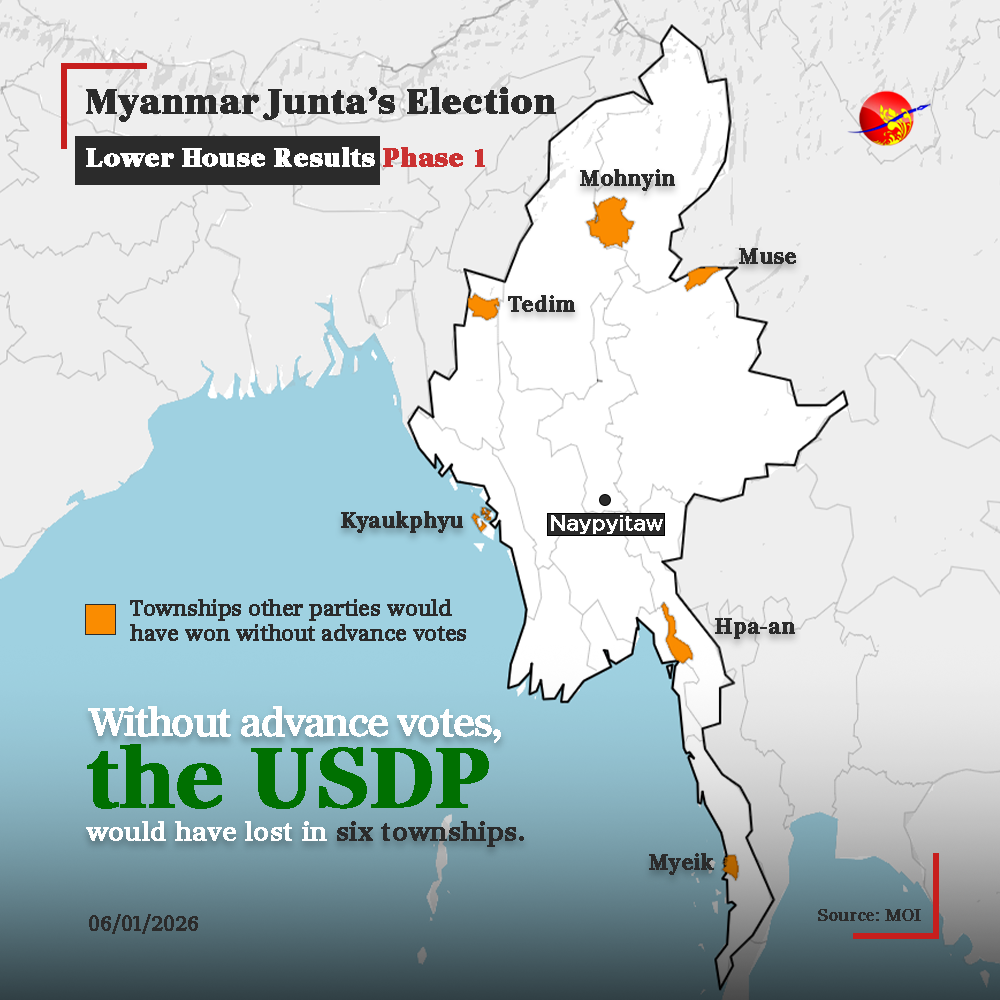
The Irrawaddy found that without advance votes, the USDP would have lost to the SNDP in Muse, Shan State; to the PP in Myeik, Tanintharyi Region; and to the Arakan Front Party (AFP) in Kyaukphyu, Rakhine State.
It would also have lost to the Shan-ni Solidarity Party (SSP) in Monghnyin, Kachin State; to the Karen National Democratic Party (KNDP) in Hpa-an, Karen State; and to the Zomi National Party (ZNP) in Tedim, Chin State, according to junta-released Lower House results.
USDP spokesman U Hla Thein insisted that the advance votes his party received were all proper according to the law.
“There are laws governing advance voting. Our party has no comment,” U Hla Thein told The Irrawaddy.
Village- and ward-level election sub-commission collected the advance votes, he added.
He said that under the procedures, parties wishing to file complaints should do so with the Union Election Commission (UEC), not by submitting them to the junta chief.
In the 2010 election, the USDP was widely accused of manipulating the advance-vote count to secure its win.
A member of the group that launched the Sham Election Tracker (SET) tool said this showed that parties contesting the election did not trust the election commission.
“We also found accusations that USDP members were involved in counting advance votes,” the SET group member added.
An analyst said these factors raised questions about the legality of the entire advance voting process.
According to research by Data for Myanmar, the USDP received the most advance votes among all parties across the 81 townships participating in the first phase of the election.
Data for Myanmar also pointed out that the USDP got 83.01 percent advanced votes in Karen’s Thandaunggyi, 78.78 percent in Karenni (Kayah)’s Bawlakhe, and 51.82 percent in Chin’s Hakha.
On Jan. 2, the UEC released a statement asserting that all advance votes in the first phase complied with the law. Three days later, the UEC met with the political parties and explained that it had conducted the advanced voting process transparently and accurately.
Even as the junta presses ahead with plans to hold the second and third phases of the election on Jan. 11 and Jan. 25, political parties are raising concerns about whether the first phase of the election was free and fair.
Many Western countries, the civilian National Unity Government (NUG) and resistance forces have denounced the junta’s election as a sham intended to legitimize the military regime.