• Burmese
Monday, January 12, 2026
No Result
View All Result
NEWSLETTER
The Irrawaddy
20 °c
Yangon
  • Home
  • News
    • Burma
    • Politics
    • World
    • Asia
    • Myanmar’s Crisis & the World
    • Ethnic Issues
    • War Against the Junta
    • Junta Cronies
    • Conflicts In Numbers
    • Junta Watch
    • Fact Check
    • Investigation
    • Myanmar-China Watch
    • Obituaries
  • Politics
  • Business
  • Opinion
    • Commentary
    • Guest Column
    • Analysis
    • Editorial
    • Stories That Shaped Us
    • Letters
  • Junta Watch
  • Ethnic Issues
  • War Against the Junta
  • In Person
    • Interview
    • Profile
  • Books
  • Donation
  • Home
  • News
    • Burma
    • Politics
    • World
    • Asia
    • Myanmar’s Crisis & the World
    • Ethnic Issues
    • War Against the Junta
    • Junta Cronies
    • Conflicts In Numbers
    • Junta Watch
    • Fact Check
    • Investigation
    • Myanmar-China Watch
    • Obituaries
  • Politics
  • Business
  • Opinion
    • Commentary
    • Guest Column
    • Analysis
    • Editorial
    • Stories That Shaped Us
    • Letters
  • Junta Watch
  • Ethnic Issues
  • War Against the Junta
  • In Person
    • Interview
    • Profile
  • Books
  • Donation
No Result
View All Result
The Irrawaddy
No Result
View All Result
Home Culture Books

Book Review—‘Understanding Reform in Myanmar’

Ashley South by Ashley South
March 23, 2016
in Books
Reading Time: 3 mins read
0 0
A A
Book Review—‘Understanding Reform in Myanmar’

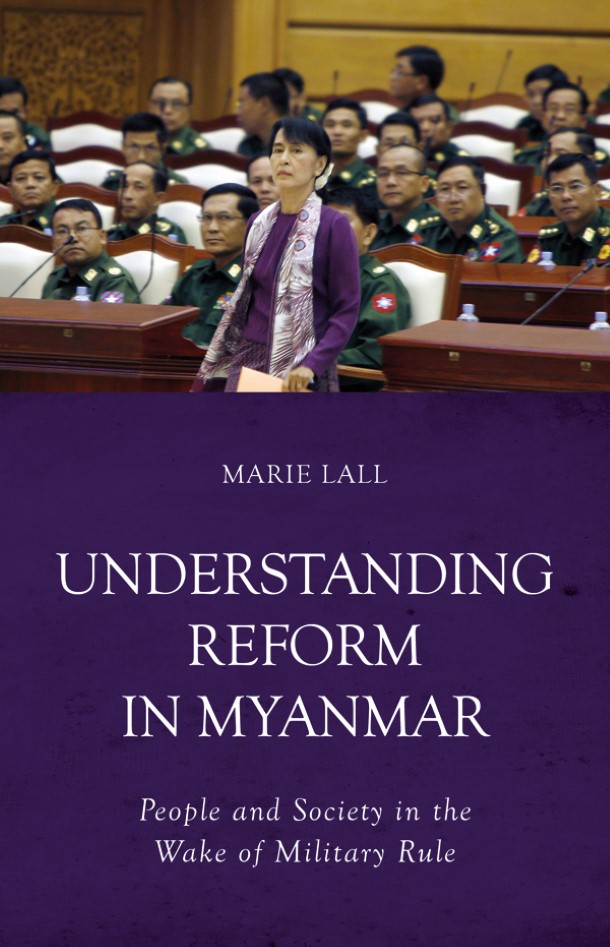
The cover of “Understanding Reform in Myanmar: People and Society in the Wake of Military Rule” by Marie Lall

11.6k
VIEWS
Share on FacebookShare on Twitter

Since mid-2011, Burma has been going through a profound—albeit contested—transition. Under President Thein Sein’s leadership, the country has experienced widespread—though at times uneven—reforms, including the release of most (but not all) political prisoners, a greatly improved climate for freedom of speech and association, economic and social changes such as the suspension of the Myitsone dam project in October 2011, the resurgence of civil society and the start of an as-yet incomplete peace process between the state government and Burma Army on the one hand, and some two dozen ethnic armed groups on the other.

The roaring victory by the National League for Democracy (NLD) in November’s general election seems set to entrench this change with a new government, led by NLD chairwoman Aung San Suu Kyi, to take up the mantle of political leadership on April 1. For the first time in more than a half-century, Burma will have a chiefly civilian government. While many challenges lie ahead, the country has made moves down a more democratic path.

“Understanding Reform in Myanmar: People and Society in the Wake of Military Rule,” a new book by Marie Lall, a professor of education and South Asian studies at the University College London’s Institute of Education, seeks to explain this rebirth (full disclosure: Lall is my colleague). Wherever Burma may be heading, it is unlikely to become a Western-style liberal democracy in the near future. As Lall points out, “what is happening in Myanmar cannot be measured by Western standards, but rather judged by local and Southeast Asian views.”


RelatedPosts

Low Turnout, Intimidation and Attacks Mark Phase 2 of Myanmar Junta’s Election

Low Turnout, Intimidation and Attacks Mark Phase 2 of Myanmar Junta’s Election

January 11, 2026
473
Myanmar Junta Election Official Killed as Blasts Rock Bago Region

Myanmar Junta Election Official Killed as Blasts Rock Bago Region

January 11, 2026
433
Live Updates: Junta’s Election Phase Two

Live Updates: Junta’s Election Phase Two

January 11, 2026
342

Lall provides such an assessment. Her book gives a detailed account of the past five years, tracing how Burma has gotten as far as it has. She sees the roots of the country’s transition as having grown out of the spaces that emerged following the 2004 purge of ex-intelligence chief Gen Khin Nyunt. Her underlying thesis is that a group of Burmese civil society actors (so-called “third force” actors), led by the late Nay Win Maung, played a key role in steering a course between the NLD-led opposition and the military government, which, in turn, nudged Burma in the direction of opening and ultimately reform.

Following the 2007 Saffron Revolution and the trauma of Cyclone Nargis the following year, this group of well-connected political and social activists worked within the constraints of the 2008 Constitution to ramp up a capacity for change in the country. For Lall, Nay Win Maung and his colleagues at the Myanmar Egress deserve much of the credit for spurring this change before and after the 2010 elections. According to this reading, the transition in Burma is primarily indigenous, driven by a need for an escape (“egress”) from decades of military (mis)rule and by the passion and vision of a small group of Burmese society activists.

One might question whether the Myanmar Egress guys (and they are mostly men) can really be described as a part of civil society, given their cozy business and government connections. For me, Lall somewhat overplays the role of Myanmar Egress, which later gave birth to the Myanmar Peace Center that opened in late 2012. Both institutions have been hugely influential in the country’s transition. Yet other factors should also be taken into account.

For instance, Lall correctly observes that one of the reformers’ main motivations was to reorient Burma’s international position away from dependence on Chinese patronage and protection (e.g., in the UN Security Council) and toward better relations with the West (particularly with the United States). While she seems to downplay the importance of international sanctions, it would actually appear that external pressure on the military junta was in fact crucial in promoting and encouraging policy shifts among the generals.

Still, Lall’s thesis is compelling, and it is important to recognize the significant hand had by different actors in encouraging change. This book therefore provides a critical window for anyone seeking to look into understanding recent events in Burma It is packed with information from many published and unpublished sources. Particularly valuable is the insight gained from first-hand observation of the dynamics of change in Burma.

Bold and incisive, this book is built around key topics, such as national reconciliation between the government and the NLD, the 2010 and 2015 elections, the peace process, economic and education reform and the rise of Buddhist nationalism. It also dives into some of the challenges awaiting the NLD, including constitutional reform, a fragmented peace process and stemming a rampant drug trade. Such well-researched and even-handed analysis of Burmese politics is quite rare, making this book a welcome contribution to the already sprawling literature on transition in Burma.

Lall ends by saying that “the military will remain an important stakeholder in the political and social process” in the years ahead, regardless of what domestic and international stakeholders desire. Her point is clear: While this is a time of celebration, with the NLD soon to take charge, reform will not come as rapidly as some predict and others hope.

 Ashley South is an analyst and consultant focused on political issues in Southeast Asia and Burma. He was also an advisor to the Myanmar Peace Support Initiative (MPSI).

Your Thoughts …
Ashley South

Ashley South

Ashley South is an independent analyst, and a Research Fellow at Chiang Mai University, specializing in politics and humanitarian issues in Myanmar and Southeast Asia. His views are his own.

Similar Picks:

Exodus: Tens of Thousands Flee as Myanmar Junta Troops Face Last Stand in Kokang
Burma

Exodus: Tens of Thousands Flee as Myanmar Junta Troops Face Last Stand in Kokang

by Hein Htoo Zan
November 28, 2023
99.8k

Myanmar National Democratic Alliance Army troops are opening roads and pathways through forests for people to flee Kokang’s capital as...

Read moreDetails
Burning Alive in Myanmar: Two Resistance Fighters Executed in Public
Burma

Burning Alive in Myanmar: Two Resistance Fighters Executed in Public

by The Irrawaddy
February 7, 2024
93.5k

People’s Defense Force says junta troops told every household in the village to send one member to witness the double...

Read moreDetails
Another Entire Junta Battalion Raises the White Flag in Myanmar’s Northern Shan State
War Against the Junta

Another Entire Junta Battalion Raises the White Flag in Myanmar’s Northern Shan State

by The Irrawaddy
November 29, 2023
87.7k

Brotherhood Alliance member says it now has complete control of Kokang’s northernmost section after the junta’s Light Infantry Battalion 125...

Read moreDetails
Depleted Myanmar Military Urges Deserters to Return to Barracks
Burma

Depleted Myanmar Military Urges Deserters to Return to Barracks

by The Irrawaddy
December 4, 2023
59.4k

The junta said deserters would not be punished for minor crimes, highlighting the military’s shortage of troops as resistance offensives...

Read moreDetails
As Myanmar’s Military Stumbles, a Top General’s Dissapearance Fuels Intrigue
Burma

As Myanmar’s Military Stumbles, a Top General’s Dissapearance Fuels Intrigue

by The Irrawaddy
April 19, 2024
47.7k

The junta’s No. 2 has not been seen in public since April 3, sparking rumors that he was either gravely...

Read moreDetails
Enter the Dragon, Exit the Junta: Myanmar’s Brotherhood Alliance makes Chinese New Year Vow
Burma

Enter the Dragon, Exit the Junta: Myanmar’s Brotherhood Alliance makes Chinese New Year Vow

by The Irrawaddy
February 12, 2024
45.7k

Ethnic armed grouping says it will continue Operation 1027 offensive until goal of ousting the junta is achieved. 

Read moreDetails
Load More
Next Post
Blaze Tears Through Mandalay’s Mingalar Market

Blaze Tears Through Mandalay’s Mingalar Market

Dangerous Path Toward Religious Extremism

Dangerous Path Toward Religious Extremism

No Result
View All Result

Recommended

Myanmar in 2026: Military Dictatorship in Traditional Burmese Jackets

Myanmar in 2026: Military Dictatorship in Traditional Burmese Jackets

4 days ago
832
Envoy’s Visit to Naypyitaw Undermines ASEAN Itself

Envoy’s Visit to Naypyitaw Undermines ASEAN Itself

3 days ago
781

Most Read

  • Low Turnout, Intimidation and Attacks Mark Phase 2 of Myanmar Junta’s Election

    Low Turnout, Intimidation and Attacks Mark Phase 2 of Myanmar Junta’s Election

    shares
    Share 0 Tweet 0
  • Myanmar Junta Election Official Killed as Blasts Rock Bago Region

    shares
    Share 0 Tweet 0
  • Live Updates: Junta’s Election Phase Two

    shares
    Share 0 Tweet 0
  • Polls Open in Second Phase of Myanmar Junta-run Election

    shares
    Share 0 Tweet 0
  • Myanmar Junta Suffers Heavy Losses in Bago Days Before Election

    shares
    Share 0 Tweet 0

Newsletter

Get The Irrawaddy’s latest news, analyses and opinion pieces on Myanmar in your inbox.

Subscribe here for daily updates.

Contents

  • News
  • Politics
  • War Against the Junta
  • Myanmar’s Crisis & the World
  • Conflicts In Numbers
  • Junta Crony
  • Ethnic Issues
  • Asia
  • World
  • Business
  • Economy
  • Election 2020
  • Elections in History
  • Cartoons
  • Features
  • Opinion
  • Editorial
  • Commentary
  • Guest Column
  • Analysis
  • Letters
  • In Person
  • Interview
  • Profile
  • Dateline
  • Specials
  • Myanmar Diary
  • Women & Gender
  • Places in History
  • On This Day
  • From the Archive
  • Myanmar & COVID-19
  • Intelligence
  • Myanmar-China Watch
  • Lifestyle
  • Travel
  • Food
  • Fashion & Design
  • Videos
  • Photos
  • Photo Essay
  • Donation

About The Irrawaddy

Founded in 1993 by a group of Myanmar journalists living in exile in Thailand, The Irrawaddy is a leading source of reliable news, information, and analysis on Burma/Myanmar and the Southeast Asian region. From its inception, The Irrawaddy has been an independent news media group, unaffiliated with any political party, organization or government. We believe that media must be free and independent and we strive to preserve press freedom.

  • Copyright
  • Code of Ethics
  • Privacy Policy
  • Team
  • About Us
  • Careers
  • Contact
  • Burmese

© 2023 Irrawaddy Publishing Group. All Rights Reserved

Welcome Back!

Login to your account below

Forgotten Password?

Retrieve your password

Please enter your username or email address to reset your password.

Log In
No Result
View All Result
  • Home
  • News
    • Burma
    • Politics
    • World
    • Asia
    • Myanmar’s Crisis & the World
    • Ethnic Issues
    • War Against the Junta
    • Junta Cronies
    • Conflicts In Numbers
    • Junta Watch
    • Fact Check
    • Investigation
    • Myanmar-China Watch
    • Obituaries
  • Politics
  • Opinion
    • Commentary
    • Guest Column
    • Analysis
    • Editorial
    • Stories That Shaped Us
    • Letters
  • Ethnic Issues
  • War Against the Junta
  • In Person
    • Interview
    • Profile
  • Business
    • Economy
    • Business Roundup
  • Books
  • Donation

© 2023 Irrawaddy Publishing Group. All Rights Reserved

This website uses cookies. By continuing to use this website you are giving consent to cookies being used. Visit our Privacy and Cookie Policy.